
The popular advice is to add more CAPTCHA challenges, require heavier KYC, and score every payment after the customer has already committed. That approach feels rigorous, but it often protects the wrong moment. Modern fraud rings can assemble convincing identities, automate signup flows, and use synthetic media to pass individual checks while coordinating activity across many accounts.
Effective prevention and detection of fraud starts earlier. Screen the event before account creation, trial activation, login completion, or payment capture. Then connect what you learn across events, preserve the evidence, and give a human reviewer a clear path when the signals conflict. The objective isn't to make every customer prove who they are. It's to stop coordinated abuse without turning legitimate users into suspects.
Table of Contents
- Why Traditional Verification Fails Modern SaaS
- The True Cost of Reactive Fraud Management
- Deploying Inline Screening Across Product Touchpoints
- Building a Persistent Identity Graph to Stop Repeat Abuse
- Moving Beyond Binary Decisions with a Three-Way Policy
- Evaluating Models Without Rejecting Legitimate Customers
- Operationalizing Fraud Controls for Product and Engineering Teams
Why Traditional Verification Fails Modern SaaS
Heavy verification assumes that identity is a single event. A user submits a document, passes a biometric check, completes a CAPTCHA, and receives access. That model can work for some high-risk actions, but it breaks down when fraudsters treat each account as disposable and operate many apparently independent identities at once.
Entrust's analysis of identity-verification events across 195 countries found that digital forgeries represented 57.46% of document fraud in 2024, while deepfake attacks rose 3,000% in one year and deepfaked videos represented 40% of video-biometric fraud attempts. These findings don't mean every biometric or document check is ineffective. They show why a one-time pass shouldn't become the entire trust decision. Entrust's 2025 fraud and identity analysis describes the pressure on verification systems as synthetic media becomes more accessible.

Verification needs context
A genuine customer can use a VPN, share a household payment method, access a product from a corporate device, or rely on accessibility software that looks unusual to a simplistic rule. A fraud ring can present a polished document and a clean email address, then repeat the same trial pattern through linked devices and payment artifacts.
That distinction makes cross-event context more valuable than another isolated challenge. Useful signals include:
- Velocity: Count repeated signups, trial starts, login attempts, and checkout events over a relevant time window.
- Linkage: Connect hashed emails, device tokens, card fingerprints, payer wallets, and account histories.
- Sequence: Look for suspicious orderings, such as many new accounts followed by rapid trial use or repeated cancellations.
- Outcome feedback: Feed confirmed abuse and overturned decisions back into future verdicts.
The U.S. Federal Trade Commission recorded more than $12.5 billion in consumer-reported fraud losses in 2024, a 25% increase from 2023, and the proportion of people reporting fraud who also reported losing money rose from 27% to 38%. Those figures cover broad consumer fraud rather than SaaS alone, but they reinforce the product lesson: prevention can't wait for a final payment or a customer complaint. The FTC's 2024 consumer fraud data supports evaluating risk before the irreversible action.
Practical rule: Treat verification as one input into a continuing trust decision, not as a permanent certificate of legitimacy.
Inline screening also reduces friction. Low-risk users can proceed without an unnecessary KYC flow, while suspicious activity can be blocked or routed to review before the business creates an account, spends free-tier resources, or exposes valuable product features. That is a better fit for SaaS than forcing every visitor through the same brittle gate.
The True Cost of Reactive Fraud Management
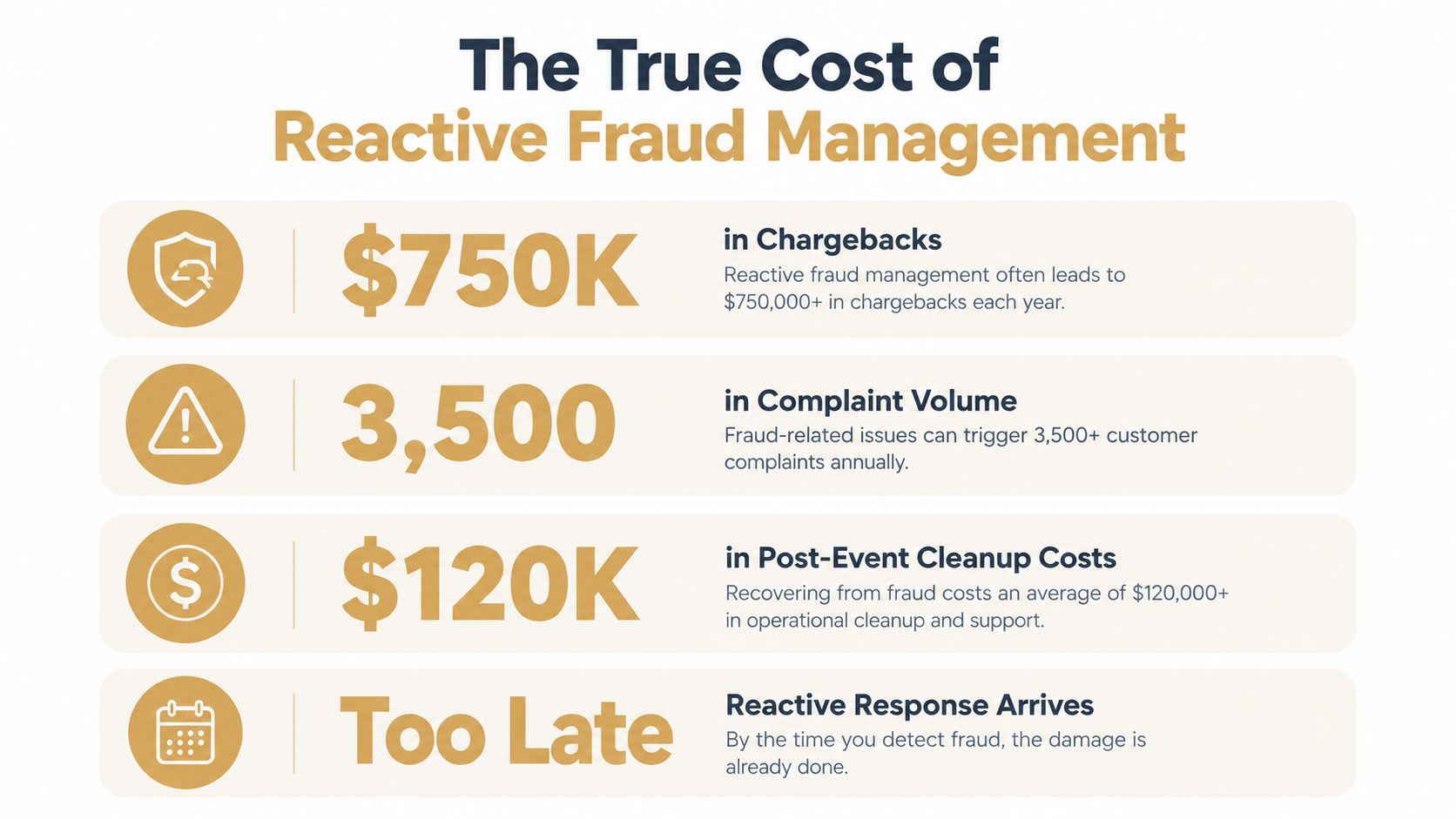
Reactive fraud management begins after the business has already accepted risk. A trial has been issued, credits have been consumed, a payment has been captured, or a compromised account has reached other users. The team then investigates logs, handles complaints, reverses access, responds to chargebacks, and tries to identify related activity that should have been connected earlier.
The scale is substantial. The Association of Certified Fraud Examiners' 2024 Global Fraud Study analyzed 1,921 occupational-fraud cases from 138 countries and territories, representing more than $3.1 billion in identified losses. A typical case lasted 12 months before detection, the median loss was $145,000, and 22% of cases caused losses of at least $1 million.
Delay expands the blast radius
The ACFE study found that tips exposed 43% of cases, more than three times the frequency of the next most common detection method. Organizations with anonymous reporting hotlines experienced median fraud losses 50% lower than organizations without hotlines. Automation matters, but those findings show why a complete control system needs both machine detection and trusted human reporting.
The FBI's 2024 Internet Crime Report compiled 859,532 complaints and reported losses exceeding $16 billion, a 33% increase from the prior year. Cryptocurrency-related investment fraud alone exceeded $6.5 billion. These datasets aren't directly additive because the agencies use different populations and classifications, and both likely understate harm because many victims don't report. The FBI's report on internet crime nevertheless illustrates why fraud shouldn't be treated as a narrow payment problem.
For a subscription business, the operational cost appears in places that a chargeback report won't show:
- Provisioned resources: Fraudulent accounts consume credits, storage, support time, and moderation capacity.
- Investigation overhead: Analysts reconstruct timelines across authentication, billing, and product systems.
- Customer friction: Legitimate users encounter delayed access while teams clean up abuse.
- Evidence loss: Post-event reviews may lack the exact device, payment, or decision context available at the moment of signup.
A proactive model places a decision before each consequential action. Signup screening can stop automated enrollment, trial screening can protect free resources, login screening can contain account takeover, and checkout screening can prevent payment capture when the evidence is strong. Teams can also use a unified fraud detection case study to compare the cost of early intervention with downstream remediation.
Reactive workflows still have a role. Human reports, chargebacks, and customer complaints are valuable feedback signals. They shouldn't be the first line of defense.
Deploying Inline Screening Across Product Touchpoints
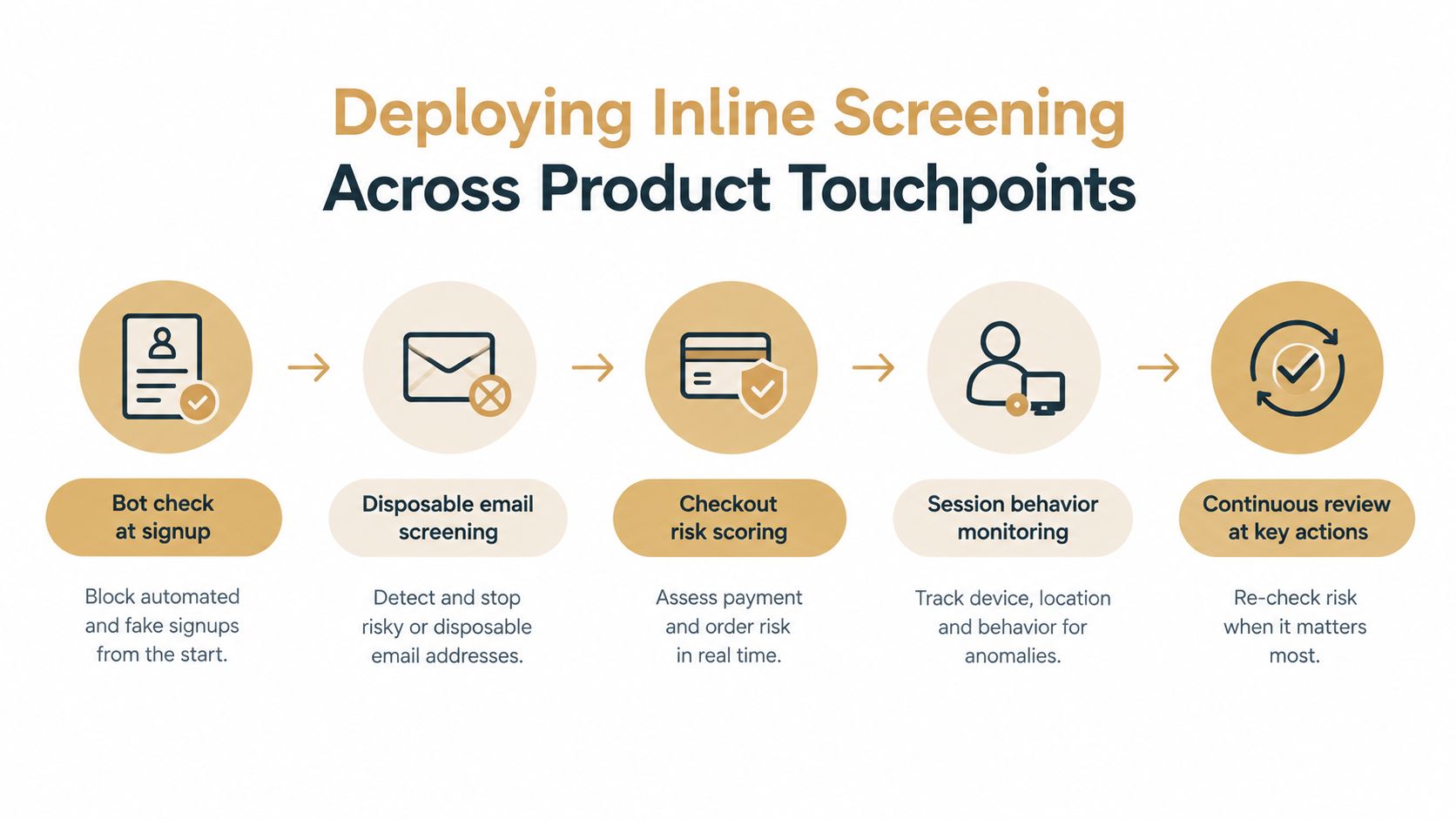
Fraud prevention should follow the user journey, not sit exclusively inside the payment page. A bot can create damage before checkout by farming trials, consuming AI credits, probing account recovery, or creating identities that later become part of a larger abuse network.
Start with a single verdict contract that every product surface can call. The request should include the event type and relevant tenant-scoped signals. The response should be deterministic, with an allow, review, or block result, reason codes, and an identifier that lets engineering and review teams retrieve the supporting evidence.
Put the gate before commitment
Use the same screening layer at distinct checkpoints:
- Signup: Evaluate device token, email, signup velocity, linked history, and automation indicators before creating the account.
- Trial start: Check whether the device, payment artifact, wallet, or related identity has already received or abused an offer.
- Trial conversion: Reassess the event because risk can change after product usage, billing details, or account behavior develops.
- Checkout attempt: Combine payment and identity signals before payment capture, not only after a processor returns a dispute.
- Login and sensitive actions: Review session context, device continuity, account history, and unusual sequences before allowing access or changing recovery details.
IP address can provide context, but it shouldn't serve as the core identity key. It may represent a household, office, mobile network, VPN, or shared hosting environment. A device token or payment fingerprint can still be imperfect, but its relationship to repeated product events is generally more useful than treating an IP as a person.
Latency determines whether the control is genuinely inline. A verdict that arrives after account creation has already happened is an investigative signal, not a preventive gate. Keep the request small, cache only where the risk model permits it, define timeout behavior, and make the degraded state visible to operators.
For implementation patterns, teams can compare their design with this guide to fraud prevention and detection. The important design choice is consistent placement: every high-impact action should have a known pre-commit decision point.
A good screening layer doesn't make the interface feel like a security product. Low-risk users continue normally. Ambiguous activity takes a controlled path to review. High-confidence abuse stops before the business gives away value.
Building a Persistent Identity Graph to Stop Repeat Abuse
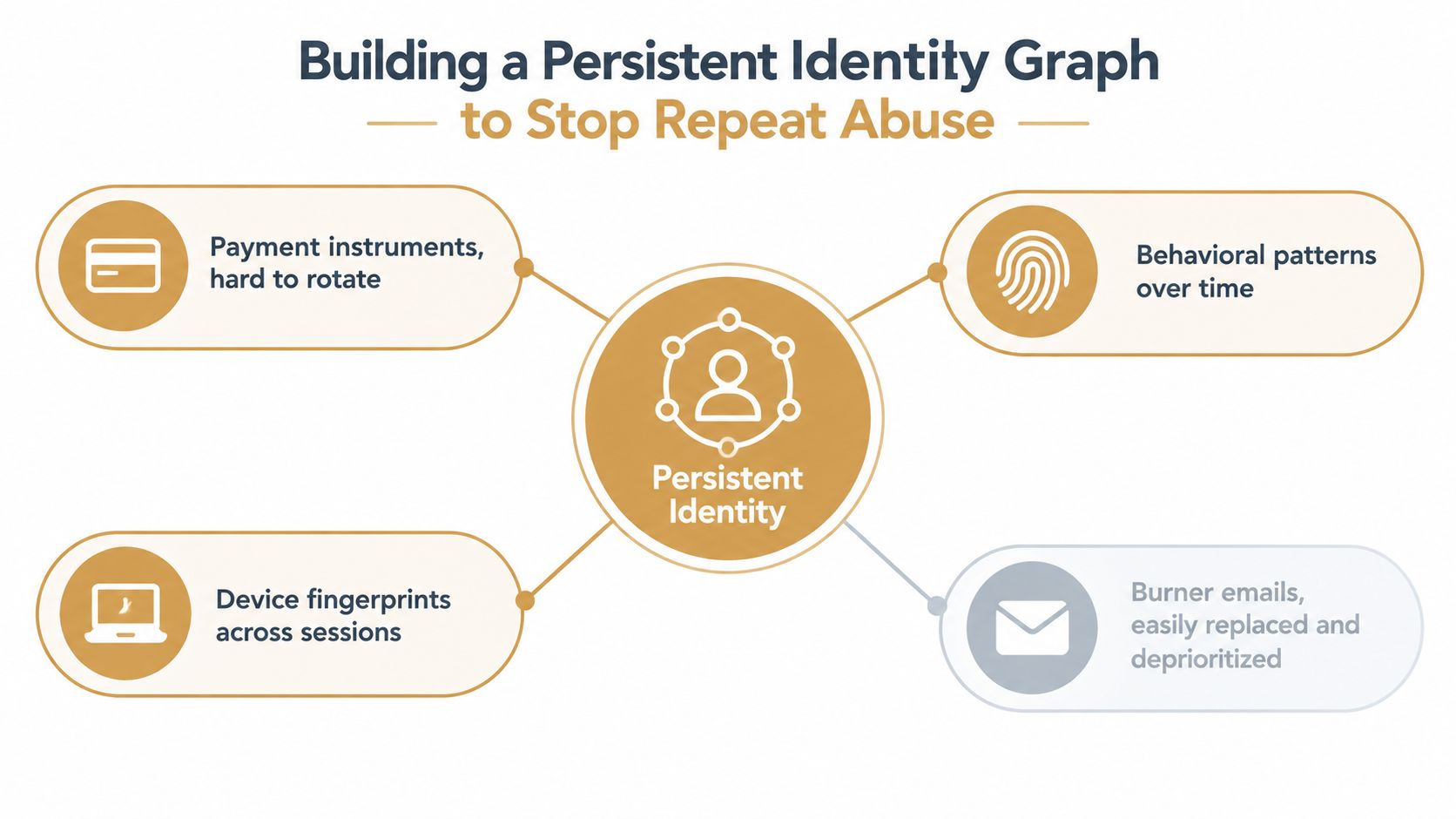
Burner emails are cheap. Fraudsters can also rotate account names, browser properties, and other superficial attributes. The harder problem for them is maintaining separation across artifacts that recur over time, such as payment instruments, payer wallets, device tokens, account histories, and behavioral sequences.
A persistent identity graph represents those relationships without pretending that any single signal proves fraud. Each event becomes a node or relationship within a tenant-scoped graph. A device can connect to several emails, an email can connect to multiple trial starts, and a payment fingerprint can connect otherwise unrelated accounts. The graph then gives reviewers and decision rules a way to see the pattern.
Design relationships for investigation
A useful graph distinguishes between strong evidence and weak context. A confirmed-abuse marker linked to a payment fingerprint may deserve more weight than a shared IP. A device used by several legitimate employees shouldn't automatically condemn every associated account. The system needs relationship types, confidence, timestamps, and reason codes.
Look for patterns such as:
- Many-to-one: Multiple new accounts connect to one device, card fingerprint, or payer wallet.
- One-to-many: One identity repeatedly creates accounts, starts trials, cancels, and returns with changed emails.
- Temporal clusters: Events that appear across a short interval and follow the same sequence.
- Propagated risk: A confirmed abuse node informs future events connected through strong artifacts.
Memory should match the abuse pattern. A short window can identify rapid card testing, while recurring trial farming and subscription manipulation may require much longer history. Unlimited memory can help with persistent abuse, but it also increases the need for retention controls, review procedures, and careful handling of legitimate shared environments.
Privacy is an engineering requirement, not a documentation afterthought. Hash identity keys, scope them per tenant, restrict access, and define retention rules. Don't create a universal identity database that allows one customer's activity to influence another customer's decisions.
The graph should make repeat abuse harder without making shared infrastructure suspicious by default.
Measure whether linkage is doing useful work. Track prevented repeat attempts, confirmed-fraud lift, review precision, and false-link rate. A graph that blocks more events but incorrectly joins households, corporate devices, or family payment methods may create a different form of product damage.
Moving Beyond Binary Decisions with a Three-Way Policy
A binary system asks one question: allow or reject. That sounds simple until the model encounters a legitimate customer using a shared device, a returning subscriber with a changed payment method, or a new account that resembles known abuse but lacks decisive evidence. A hard threshold forces uncertainty into the wrong bucket.
The more resilient policy has three outcomes:
| Decision | Use it when | Product response |
|---|---|---|
| Allow | Evidence indicates low risk | Complete the action normally |
| Review | Signals conflict or confidence is limited | Hold or limit the action while a reviewer investigates |
| Block | Evidence strongly indicates abuse | Deny the action and preserve reason codes |
The review state isn't a failure of automation. It's how the system avoids making every uncertain event a customer-facing rejection. It also creates a controlled place to learn from edge cases instead of steadily accumulating false positives.
Make every verdict explainable
An opaque risk score forces a second system to interpret what the score means. Reason codes remove that ambiguity. Examples include repeated trial history, linked confirmed-abuse device, unusual event velocity, payment artifact conflict, or a failed policy requirement. The code should be stable enough for support, product, engineering, and fraud operations to use consistently.
The review workspace should show the evidence in one view:
- The triggering event and its complete sequence.
- Linked emails, devices, payment fingerprints, and wallets.
- Previous decisions and whether they were overturned.
- Relevant account, payment, and product history.
- The exact policy rule or reason code that caused routing.
A reviewer shouldn't need to search five dashboards to answer a basic question. Fragmented evidence slows decisions and encourages inconsistent judgments. A unified case record also makes appeals possible because the team can explain what happened rather than repeating an untraceable score.
Human reporting belongs in this workflow. The ACFE's findings on tips and anonymous hotlines show that employees and other stakeholders can identify context automated controls miss. A report should create a case or enrich an existing identity cluster, not disappear into an inbox disconnected from the automated decision.
Evaluating Models Without Rejecting Legitimate Customers
Accuracy is a seductive metric because it produces a single number. In fraud detection, it can hide the outcome that matters most. If legitimate transactions dominate the dataset, a model can reach approximately 99.9% accuracy while still missing meaningful fraud or producing an operationally unacceptable number of false positives. The study of imbalanced card-transaction models demonstrates why teams need a broader evaluation framework.
Use precision to understand how often flagged events are fraudulent. Use recall to understand how much known fraud the system catches. Use F1 to balance those two measures, and use PR-AUC to evaluate ranking quality when the positive class is rare. Accuracy can remain a supplementary diagnostic, but it shouldn't decide whether a fraud policy is ready for production.
Tune thresholds against business costs
The right threshold depends on the event. A missed fraudulent checkout has a different cost from a delayed trial start, and a false block on a long-standing customer has a different cost from sending a new signup to review. Set policy by considering:
- Chargebacks and payment-network fees.
- Lost free-tier resources or AI credits.
- Manual-review capacity and response time.
- Customer abandonment after friction.
- Support contacts and appeals.
- Revenue retained from good users.
One model study reported that logistic regression reached 100% recall with 24.24% precision, while XGBoost reached 91.67% precision and 95.00% recall. The comparison illustrates the trade-off, not a universal winner. A business may accept lower precision for a high-risk action, but that same threshold could overwhelm a review queue or reject too many legitimate customers elsewhere.
Evaluate with time-based validation and production-like prevalence. Random oversampling can help train a model, but it shouldn't be the only evidence that the system generalizes. Fraud patterns change, and synthetic minority examples may make performance look stronger than it will be in live traffic.
Monitor recall at a fixed false-positive rate and precision at the review queue's capacity. Break results down by event type, geography, payment instrument, and identity segment. Test known legitimate edge cases, including shared corporate devices, family payment methods, VPN use, and accessibility tools.
A fraud-block rate measures activity. Retained good users and prevented abuse measure business value.
Operationalizing Fraud Controls for Product and Engineering Teams
Fraud controls become reliable when the team treats them as a product surface with owners, service levels, and failure behavior. Start by assigning responsibility for each event. Product owns the customer experience, engineering owns the integration and resilience, and trust and safety owns policy, review quality, and feedback loops.
Build the operating layer
Use an SDK where client context improves collection, but keep the final decision on a server-controlled path. An HTTP endpoint can handle backend events such as signup, trial start, checkout attempt, and login. Webhooks should carry later updates, including payment outcomes, reviewer decisions, appeals, and confirmed abuse, back into the graph and reporting layer.
A practical implementation checklist includes:
- Define event contracts: Standardize event names, required signals, idempotency behavior, and verdict handling.
- Persist evidence: Store the reason code, decision, relevant links, timestamp, and policy version with each event.
- Configure memory deliberately: Use short retention for rapid testing patterns and longer memory for recurring trial or subscription abuse.
- Protect tenant isolation: Hash identity keys, scope them per tenant, limit access, and document retention.
- Test degraded service: Decide what happens when the screening dependency times out, and expose that state to operators and support.
- Close the feedback loop: Record confirmed fraud, overturned blocks, reviewer decisions, and customer appeals as structured outcomes.
Fail-open behavior can protect availability when a screening service degrades, but it creates a temporary exposure window. Fail-closed behavior can protect a sensitive action, but it may lock out legitimate customers during an outage. Choose by event risk, make the choice explicit, and disclose degraded service internally so teams don't mistake missing verdicts for clean approvals.
The review queue should have clear ownership and escalation paths. Analysts need reason codes, linked identity history, and an auditable decision record. Product managers need aggregate outcomes by funnel stage. Engineers need latency, timeout, error, and webhook delivery monitoring.
Teams can use fraud data analysis to structure reporting around prevented repeat attempts, confirmed-fraud lift, review precision, false-link rate, chargebacks, appeals, and retained good users. Don't optimize the raw block count. A system that blocks more users can look successful while damaging conversion and support capacity.
Portreeve is one inline screening option for this architecture. Its Verdict API evaluates signups, trials, checkouts, and logins, returns allow, review, or block decisions with reason codes, and keeps tenant-scoped history in an abuse graph. Its integration surface includes a Node SDK, an HTTP endpoint, webhooks, a review workspace, configurable memory depth, and cluster marking for confirmed abuse.
Portreeve helps online products screen signups, trials, checkouts, and logins before risky actions commit, with explainable decisions and linked identity history. If you're reducing repeat abuse without adding unnecessary friction for legitimate customers, visit Portreeve to explore the screening layer and integration options.