
If your team's free-trial dashboard suddenly fills with the same email patterns, the same devices, and the same checkout attempts, you're already paying for fraud. Growth people see conversion noise, payments see chargebacks, support sees angry users, and engineering gets asked to “add another check.” That's the wrong response. Fraud prevention and detection should be one inline decision policy that decides, in the moment, whether an event is allowed, reviewed, or blocked.
The practical goal is simple. Stop abuse before it commits, keep good users moving, and leave a clean audit trail for the cases that need human judgment. For subscription products, that means treating signups, trials, logins, and payments as connected events, not separate teams' problems.
Table of Contents
- Why Fraud Hits Subscription Products So Hard
- Prevention and Detection as a Single Decision
- Three Architectural Patterns Worth Knowing
- Signals That Compose Into a Verdict
- The Four Abuse Patterns Online Products Face
- Metrics That Prove Prevention Is Working
- A 90-Day Rollout for a Small Team
- Measuring Success Without Killing Conversion
Why Fraud Hits Subscription Products So Hard
The moment most SaaS founders recognize the problem is familiar. A free-trial launch looks healthy, then the same patterns start repeating, trial credits disappear faster than expected, and a few days later payments and support are full of messy edge cases. That's not random churn. It's abuse finding the path of least resistance.
Growth features are also attack surfaces
Subscription products give attackers three things they love. First, generous free trials and credits let them extract value before paying. Second, stored payment methods make card abuse easier to repeat once a weak identity slips through. Third, self-serve onboarding removes the friction that used to slow a human fraudster down.
That's why fraud in SaaS isn't just a finance issue. It's a product-quality issue that shows up as polluted signups, wasted compute, support burden, and avoidable churn in legitimate users who get caught in the mess. The board-level framing is blunt. The ACFE 2024 Report to the Nations estimates organizations lose approximately 5% of annual revenue to fraud and reports an average loss of more than $1.5 million per fraud case (ACFE report). That's enough to justify putting fraud controls on the engineering roadmap, not in the back office.
SaaS abuse tends to cascade
Once abuse gets inside the product, it rarely stays in one lane. A burner email becomes a trial. A trial becomes a reused device. A reused device becomes a card attempt. A card attempt becomes a refund, a dispute, or a support escalation. That cascading pattern is exactly why isolated controls fail.
Practical rule: if a control only looks at one event in isolation, it will miss the abuse pattern that spans several events.
The right response is to wire screening into the product flow where value is created, then let the decision policy share memory across events. For subscription businesses, that's the difference between trimming risk and running a permanent cleanup operation.
Prevention and Detection as a Single Decision
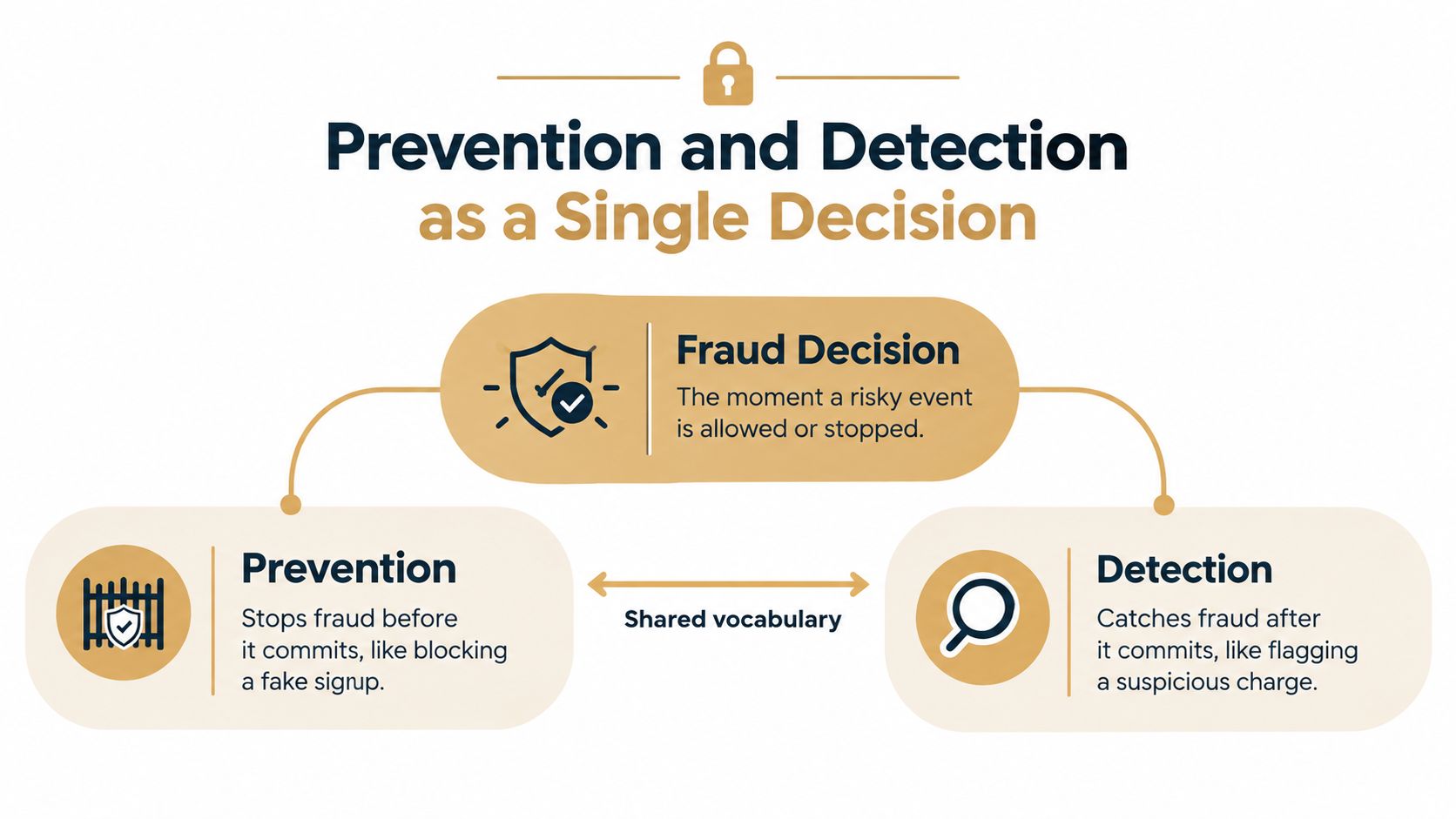
A signup, trial activation, login, or checkout should not wait for separate fraud teams to weigh in after the fact. If the action is risky enough to stop, stop it before it commits. If it is ambiguous, route it to review with the evidence attached. If it is clean, allow it and move on.
Build one verdict, not two disconnected systems
The clean model is a single verdict: allow, review, or block. Make that decision inside the product flow, inside the latency budget of the user experience. NIST Digital Identity Guidelines Rev. 4 supports this multi-signal approach, calling for fraud indicators across identity, device, payment, and behavioral history, plus automated attack-detection tools and privacy assessments of fraud controls (NIST Digital Identity Guidelines Rev. 4).
Risk scores do not run operations. They hide too much. A verdict with a reason code tells a reviewer what happened, gives engineering something to debug, and lets product teams see where friction is being added. If you cannot explain the decision, you cannot manage it.
Reason codes are operational infrastructure
Attach a reason code to every denied or reviewed event. Support gets a script. Analysts get a filter. Product gets a clean signal on where customers are getting stuck.
NIST's recovery guidance treats notification as an auditable event trail. Apply the same standard to fraud verdicts by attaching a reason code to every denied or reviewed event, so signup, login, recovery, and checkout all produce a record that can be traced and questioned (NIST Digital Identity Guidelines Rev. 4).
Decisions should be auditable, privacy-scoped, and made before the user finishes the action.
That is the shift. Prevention is the gate. Detection is the evidence trail. Run them as one policy, and the rest of the fraud stack becomes easier to defend.
Three Architectural Patterns Worth Knowing
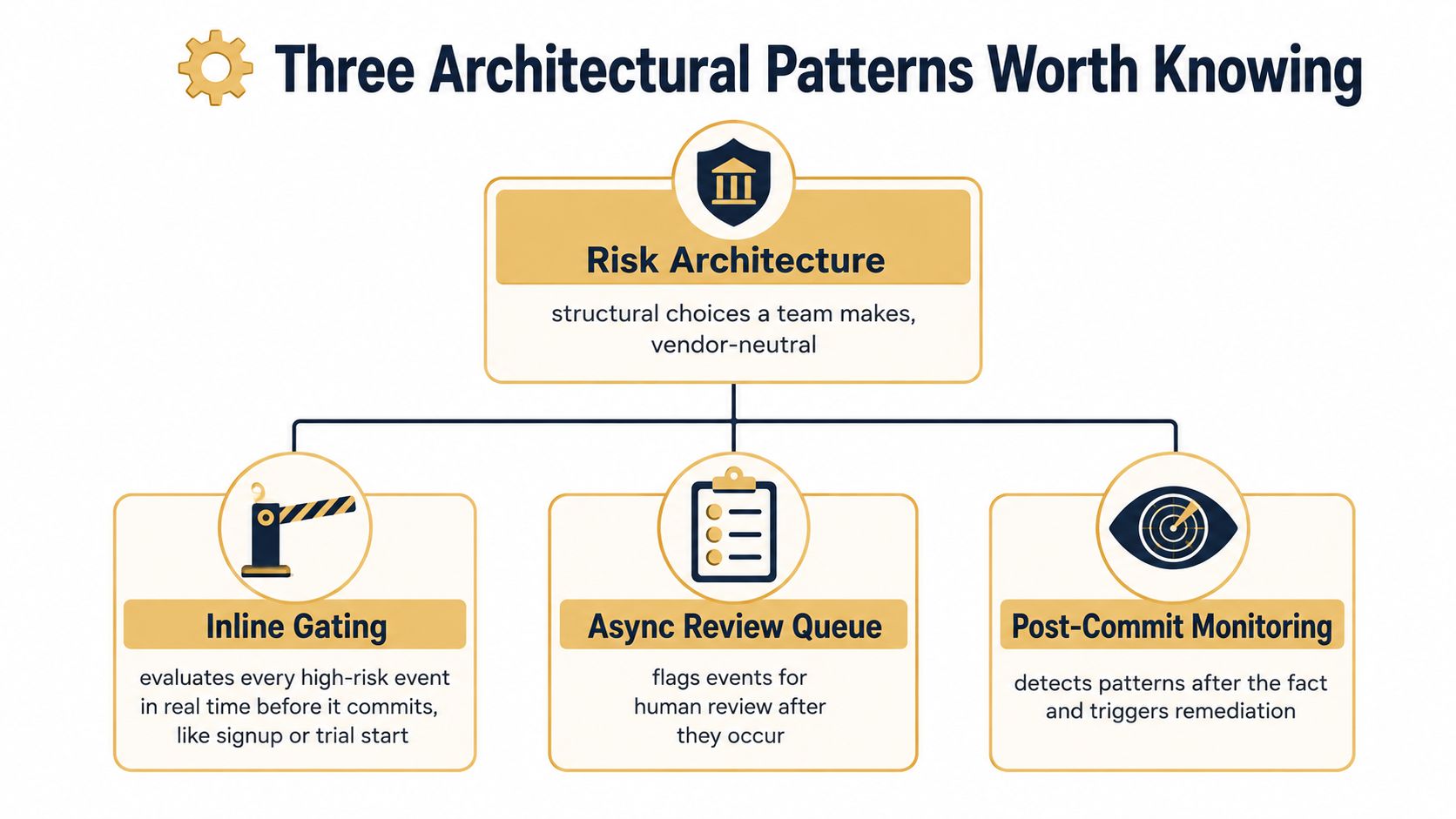
Inline gating is the first pattern worth shipping. It evaluates signup, trial start, login, or checkout before the action commits, then returns a verdict within the user-experience latency budget. This is the only pattern that prevents direct loss upstream. It fails when teams try to make it a one-score-fits-all system instead of a layered decision, because one weak signal can't reliably distinguish fraud from normal customer variation.
A review queue solves a different problem. It takes events the engine can't confidently allow or block and routes them to a human with the evidence already attached. That works when the queue is small, the reasons are clear, and the reviewer can adjudicate quickly. It fails when teams dump too much into review, because human operators become the bottleneck and the queue turns into a backlog factory.
An abuse graph is the memory layer. It links devices, cards, wallets, and accounts over time so that a burner email doesn't look clean just because it's new. Persistent linkage is what exposes serial abuse that identity-by-identity checks miss. It fails if you treat linkage as a replacement for decisioning, because history without a verdict still lets the bad event through.
Portreeve's fraud detection software overview is a useful example of this architecture in practice. It combines a verdict API, a review workspace, and per-tenant history so the team can make one decision at the gate instead of stitching together three different tools.
The right answer isn't choosing one pattern. Mature programs use all three together, because each one covers a different failure mode.
Signals That Compose Into a Verdict
A working fraud system should start with identity keys, not generic suspicion. The most useful keys are email, device token, card fingerprint, and payer wallet. IP address is context, not identity. It changes too easily, gets shared too often, and tells you less than the artifact that persists across events.
Build the decision from linked signals
Here's the practical logic. An email address by itself is weak. The same email plus a newly seen device is more concerning. Add a shared card fingerprint or wallet, and the pattern starts to matter. Add prior abuse on that same device, and you have a strong block candidate.
That's how linkage beats isolated screening. A burner email is just another address until it shares a device with previous chargebacks or repeated trial abuse. Then it stops being harmless variation and starts looking like a cluster. The abuse graph is what turns those separate facts into a verdict.
Use reason codes to make the decision legible
Reason codes matter because they collapse the time from decision to action. A reviewer can see why an event was sent to manual review. An engineer can see which signal fired. A support agent can explain the outcome without guessing. Without that, every false positive turns into a small forensic project.
Operational rule: if you can't explain the block in one sentence, the rule is too fuzzy to run in production.
The metal-detector analogy still holds. You want a checkpoint at the door, not a forensic lab after the fact. That means the decision has to be made fast enough to sit inside signup, trial start, login, or checkout. If the product already let the event through, you're no longer preventing fraud. You're just documenting it.
The Four Abuse Patterns Online Products Face
Free-trial and AI-credit farming is usually the first bleed point. Attackers cycle through repeated signups, often with small changes in email, device behavior, or both, to consume scarce resources without paying. Wire the verdict around the cluster, not the address. A single email is weak. A repeated pattern across devices, wallets, and prior behavior is the signal that matters. Start with review while the pattern is forming. Move to block once the cluster is clearly repetitive.
Card testing and payment abuse come next. Fraudsters probe checkout flows with small, suspicious attempts to see which instruments get through. Device continuity and card fingerprints are the signals to trust here, because attackers can rotate names and emails while keeping the same payment artifacts. This deserves a fast block when the signals line up, because the loss lands twice, once at capture and again in chargebacks. UK Finance reported banks prevented £1.68 billion in unauthorized payment fraud in 2025 against £703.4 million in actual losses, including £423.5 million from remote card purchases (UK Finance fraud report).
The patterns are different, so the verdict should be too
Account cycling with burner emails is subtler. The attacker is not always trying to break payments right away. They want repeated new-account value, and the linked device or payer wallet gives them away. This pattern often starts at review, because real users also re-enroll after losing access or forgetting credentials.
Bot signups and low-quality traffic should be stopped before account creation. That keeps fake accounts out of the product, reduces moderation load, and protects analytics from being polluted by junk events. The FBI's IC3 annual report recorded 859,532 complaints and more than $16 billion in reported losses across a broad mix of internet crime, including phishing or spoofing, extortion, and personal-data breaches (FBI IC3 annual report). The scale is the point. Event-level signals beat vague suspicion.
Do not overblock on the first weak signal. Wait until the device, payment artifact, and behavior line up, then act decisively.
The goal is not to catch every odd event. It is to identify the patterns that drain the business and route them to the right verdict.
Metrics That Prove Prevention Is Working
Most fraud dashboards are misleading because they measure the wrong thing. Accuracy looks tidy, but it says almost nothing about whether the business is safer. A model can score well by approving almost everything and still let abuse through.
Measure prevention value, not model vanity
Track prevented attempts, confirmed fraud, false-positive rate by segment, review yield, chargebacks, and prevented-loss estimates by signal combination. Those numbers tell you whether the policy is protecting revenue without crushing conversion. The point is net value, meaning losses avoided minus friction, review cost, and good customers incorrectly denied.
If you want a compact scorecard, use this:
| Vanity Metric | Why It Misleads | Operational Metric | What It Tells You |
|---|---|---|---|
| Accuracy | Can look high even when fraud slips through | Prevented attempts | How much abuse never committed |
| AUC | Says little about operational friction | False-positive rate by segment | Which customer groups are being overblocked |
| Model score distribution | Hides the decision outcome | Review yield | Whether manual review is worth the effort |
| Overall precision only | Misses downstream cost | Chargeback rate | Whether payment abuse is still leaking |
| Raw block count | Rewards overblocking | Prevented-loss estimate | Whether the policy created net value |
If you need a tighter operating model for the numbers behind this, use the same lens in Portreeve's payment fraud analytics overview. Focus on decision quality, linked signals, and downstream business impact, not model output.
Metric discipline keeps the team honest
Measure prevention directly. Separate prevented loss from false positives and review cost, or you will not know whether the policy is helping or just creating busywork. The point is simple, leadership needs a dashboard that shows where abuse stops, where legitimate users get blocked, and which signal combinations deserve more weight. That is the level of clarity an abuse graph and reason codes should give you across trials, signups, and payments.
The right dashboard is built around verdicts, not scores. It tells analysts whether the policy is saving money and where it hurts conversion.
A 90-Day Rollout for a Small Team
Start with one gated event, not the whole funnel. Signup is usually the cleanest first choice, though checkout works too if payment abuse is the main pain. Log every verdict with a reason code from day one, even if the first version is simple.

Months one and two should be about signal quality
In the first month, wire the call into the product flow and start recording outcomes. In the second month, stand up a review queue, compare outcomes against historical abuse, and set an appeal path for legitimate users who get caught. Then expand to a second event, such as trial start, so you can link behavior across the lifecycle.
The next move is graph linkage on device and card fingerprints. That gives you memory across churned emails, which is where most early abuse hides. If your team is evaluating tools, the right question is whether they can connect evidence across events and return a clear verdict, not whether they have the most complicated scoring layer.
Don't overbuild in the wrong order
Do not build a custom rules engine on day one. Do not chase generative-AI detection before basic identity linkage is stable. Do not promote any verdict to a block unless it has a reviewable reason code.
Sequencing rule: first make the decision legible, then make it smarter.
By the end of 90 days, you should have cluster marking, a monthly metrics review, and a documented fail-open policy for service degradation. Portreeve's fraud detection case study is the kind of implementation story that helps teams pressure-test this sequence against a real workflow. The goal is not perfection. It's getting a stable policy into production without hiring a data-science team first.
Measuring Success Without Killing Conversion
Fraud prevention and detection is a calibration exercise, not a blocking exercise. Set the threshold by how much loss and friction the business can tolerate, then keep the policy there. The same logic works like a thermostat. You're tuning the temperature, not slamming the system on or off.
Keep the policy honest over time
Three habits make the program durable. First, review a sample of denied events every month. Second, publish prevention net value to leadership, not just block counts. Third, treat the policy as versioned code with named owners, because unowned fraud rules drift fast.
The hard truth is that good fraud programs make fraud boring for everyone else. Events are decided, evidence is logged, and only genuinely ambiguous cases land in front of a human. That's the standard you should hold.
If you want to turn this framework into something your team can ship, Portreeve gives you an inline screening layer for signups, trials, checkouts, and logins with allow, review, or block outcomes and reason codes. Visit Portreeve to see how an abuse graph and a single decision policy can fit into your product flow without turning fraud handling into a second system.