
Integration is the main obstacle in AI fraud prevention, with 35% of respondents naming it as their biggest hurdle. Payment fraud analytics only creates value when signals from checkout, identity, device, and payment systems become a clear allow, review, or block decision before the transaction completes.
That operational gap is where many fraud programs fail. Teams may have a payment processor, an identity provider, a device intelligence product, a rules engine, and a case-management queue, yet still lack one reliable decision path. The Mastercard report on AI and payment fraud prevention identifies integration, trust in AI decisions, data quality, and proving return on investment as persistent barriers.
A practical fraud system shouldn't stop at producing a risk score. It should collect event-level evidence, connect that evidence to persistent identities, apply deterministic policy, and return a decision quickly enough to protect conversion. The difference between detecting abuse after payment capture and gating it before account creation is the difference between investigation and prevention.
Table of Contents
- The Baseline Problem in Payment Fraud
- How Real-Time Gating Works Under the Hood
- Building a Unified Identity Graph
- Real-World Patterns - Free Trial Farming and Card Testing
- Designing Efficient Review Workflows
- Implementation Checklist for Engineering Teams
The Baseline Problem in Payment Fraud
Payment fraud looks small when measured only as a rate. The absolute loss tells a different story. Global card fraud losses were estimated at $33.41 billion in 2024, down 1.2% from $33.83 billion in 2023, according to the Annual Payment Fraud Intelligence Report. A separate estimate cited in the same research placed 2024 card fraud at about 6.5 cents per $100 spent, with cumulative losses projected at roughly $404 billion over the following decade.
The important engineering implication is that fraud isn't an occasional exception to an otherwise clean payment flow. It is a persistent operating condition. A subscription company absorbs the cost through payment disputes, wasted trial resources, support tickets, recovery work, false declines, and abuse that never reaches the chargeback system because it happens during signup or account access.

Small rates still create large queues
The EU and EEA provide a useful example of scale. In 2024, roughly 17.06 million fraudulent card transactions occurred among approximately 111.05 billion card transactions, producing an annual fraud rate of 0.015%. The European payment fraud statistics summary reports that the rate was practically unchanged from the previous year.
That percentage can tempt a team into treating fraud as a manageable exception queue. The volume shows why that view is misleading. A low rate across a massive payment population still produces millions of events requiring prevention, review, dispute handling, or customer communication.
Practical rule: Measure fraud as both a rate and an event population. The rate protects perspective, while the event count determines the workload your systems must handle.
Why chargeback cleanup is too late
A chargeback arrives after authorization, fulfillment, and often customer access. For a physical product, that may mean lost inventory and payment fees. For SaaS, the customer may already have consumed credits, exported data, used premium features, or created additional accounts. A post-transaction workflow can recover evidence, but it can't reliably undo the underlying abuse.
Pre-authorization gating moves the control point earlier. A signup can be screened before an account is created. A trial can be evaluated before free resources are issued. A checkout attempt can be assessed before payment capture. This doesn't mean every suspicious event should be blocked. It means the business can choose a response while it still has options.
The useful target is not a single perfect model. It's a real-time operating loop that combines signals, makes a transparent decision, and records the outcome for later tuning. Rules remain useful for hard constraints, while behavioral and identity context handle patterns that static thresholds miss.
How Real-Time Gating Works Under the Hood
An inline gate runs directly in the request path. The application sends an event such as signup, trial_start, checkout_attempt, or login to a screening service, receives a verdict, then commits or interrupts the action. In a production checkout, the decision must return in under 100 milliseconds. Otherwise, fraud control starts creating abandonment and timeout risk of its own.
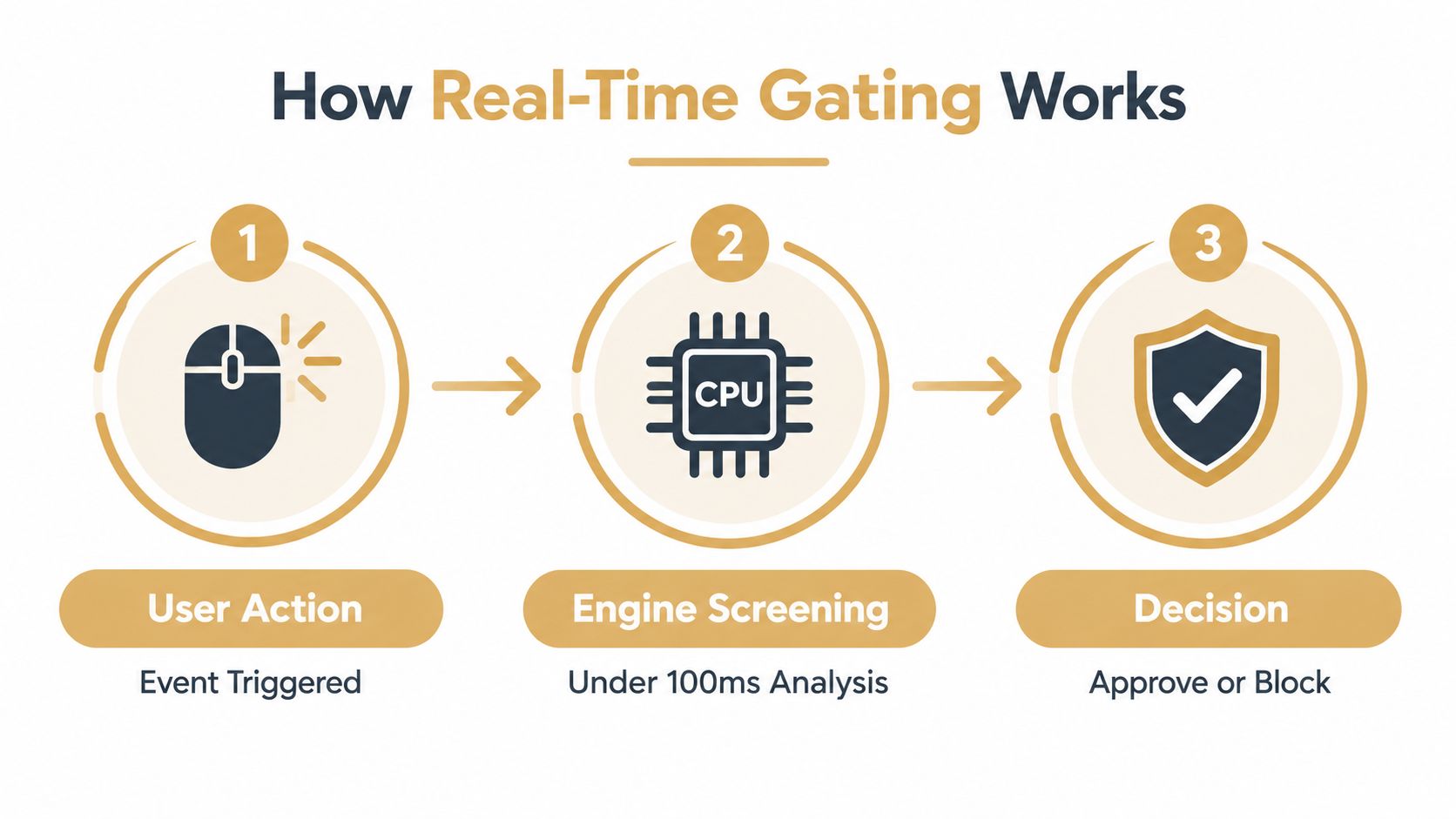
The event path
A practical gate turns raw signals into a deterministic operating decision through three steps:
-
Normalize the event. Identify the tenant, event type, account context, payment artifact, device token, and relevant session metadata. Reject malformed or ambiguous requests before policy evaluation.
-
Resolve relationships. Check whether the email, device, payer wallet, or card fingerprint connects to earlier events. Evaluate velocity, repeated failures, unusual transitions, and previously marked clusters.
-
Apply policy and return a verdict. Return an explicit allow, review, or block, with reason codes that explain the outcome.
The final step distinguishes an operational decision engine from an opaque score endpoint. A score can serve as a model feature, but every event type still needs a policy that defines the action. A deterministic verdict keeps enforcement visible to engineers, reviewers, and product teams. The fraud detection software overview explains how deterministic verdicts can replace opaque scores in the enforcement path.
Why reason codes matter
A blocked trial request needs more explanation than “high risk.” The cause might be repeated enrollment, a device linked to confirmed abuse, a payment artifact cycling across accounts, or a burst of automated activity. Those conditions require different responses. One may support a block, another may belong in manual review, and a third may reveal a broken customer flow.
Reason codes also make policy tuning measurable. Investigators can compare decisions with outcomes, product managers can adjust friction by event type, and engineers can test policy changes without reverse-engineering a vendor's score. Preserve the evidence used at decision time, not only the final verdict.
Velocity is context, not proof
Velocity signals become more useful when paired with identity and behavior. A burst of attempts from one device means something different when that device belongs to an established customer than when it cycles through new accounts and payment artifacts. The guidance on card-testing attacks describes bots using tiny authorizations, rotating devices, and repeated low-value attempts to validate stolen cards.
Static thresholds create a direct trade-off. A low threshold blocks legitimate retries, while a high threshold can let an automated burst through. Payment fraud analytics works better when velocity contributes to a linked decision, rather than acting as an isolated trigger. The gate then turns timing, identity, and behavior into an action the checkout can execute immediately.
Building a Unified Identity Graph
Fraudsters benefit when each event looks unrelated to the last one. A new email address, a cleared cookie, and a different payment attempt can reset a system that only examines the current transaction. The remedy is to represent relationships across events, while keeping those relationships scoped to the right tenant and use case.
A unified identity graph can connect hashed emails, device tokens, card fingerprints, payer wallets, and event history. IP data may add context, but it shouldn't carry the entire identity decision. Networks change, shared environments exist, and an address alone rarely proves that two users are the same actor.
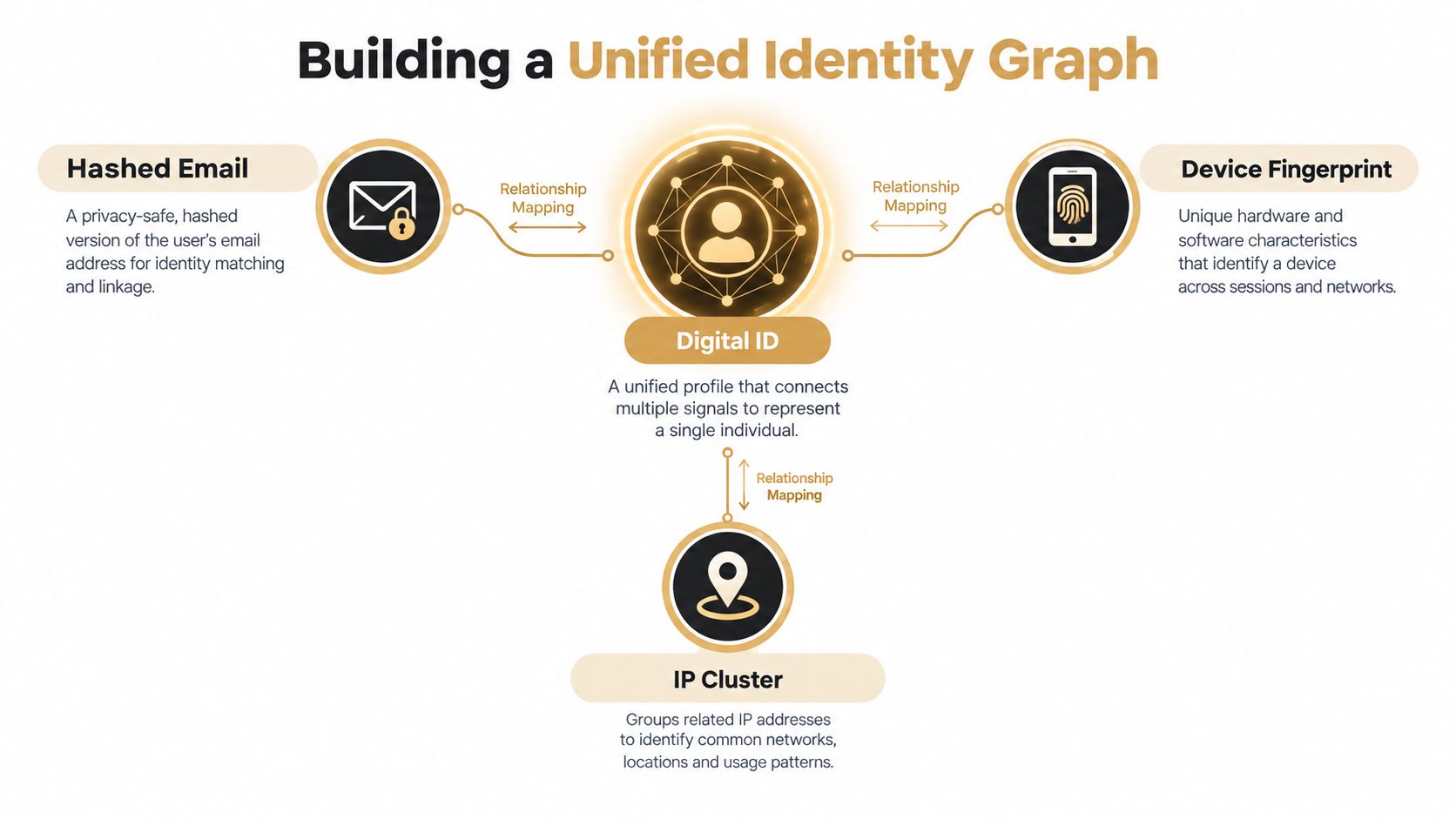
Start with stable keys
Choose the identifiers that persist across the abuse pattern you're trying to stop. For a subscription product, email and device relationships may expose trial cycling. For checkout, a card fingerprint or payer wallet can connect payment attempts that use different accounts. For account takeover, a device token and login history can show a sudden change in access behavior.
The device fingerprinting reference guide is useful background for understanding why device context adds more value than a standalone IP address. The implementation detail matters: identity keys should be hashed, tenant-scoped, and access-controlled so the graph supports abuse prevention without becoming an unrestricted cross-customer identity database.
Build edges from events
An event should create or strengthen relationships, not merely append another row to a transaction table. A signup links an account to an email and device. A checkout adds a payment artifact and payer context. A login records the device and behavioral transition. A confirmed abuse decision can mark connected identities or devices so later events inherit the relevant context.
This creates a memory layer. A burner email used today may have no history, but its device could be linked to several prior trial attempts. A card with no obvious issue may become suspicious when it appears across a cluster of accounts that share a device pattern and repeated enrollment behavior.
Keep memory useful
Unlimited memory isn't automatically better. Old relationships can become stale, and shared devices can create false connections. Configure retention around the abuse problem, preserve the evidence needed for investigations, and allow confirmed signals to carry more weight than weak associations.
A useful graph distinguishes between observed linkage and confirmed abuse. The first can route an event to review. The second can support a block or cluster mark. That distinction prevents one uncertain relationship from poisoning every connected customer.
A graph should remember enough to recognize repetition, but not so much that it forgets context.
Real-World Patterns - Free Trial Farming and Card Testing
The most revealing fraud patterns usually appear across several events rather than inside one transaction. A single new email can look normal. A sequence of new emails tied to the same device, similar signup timing, and repeated use of a free resource tells a different story.
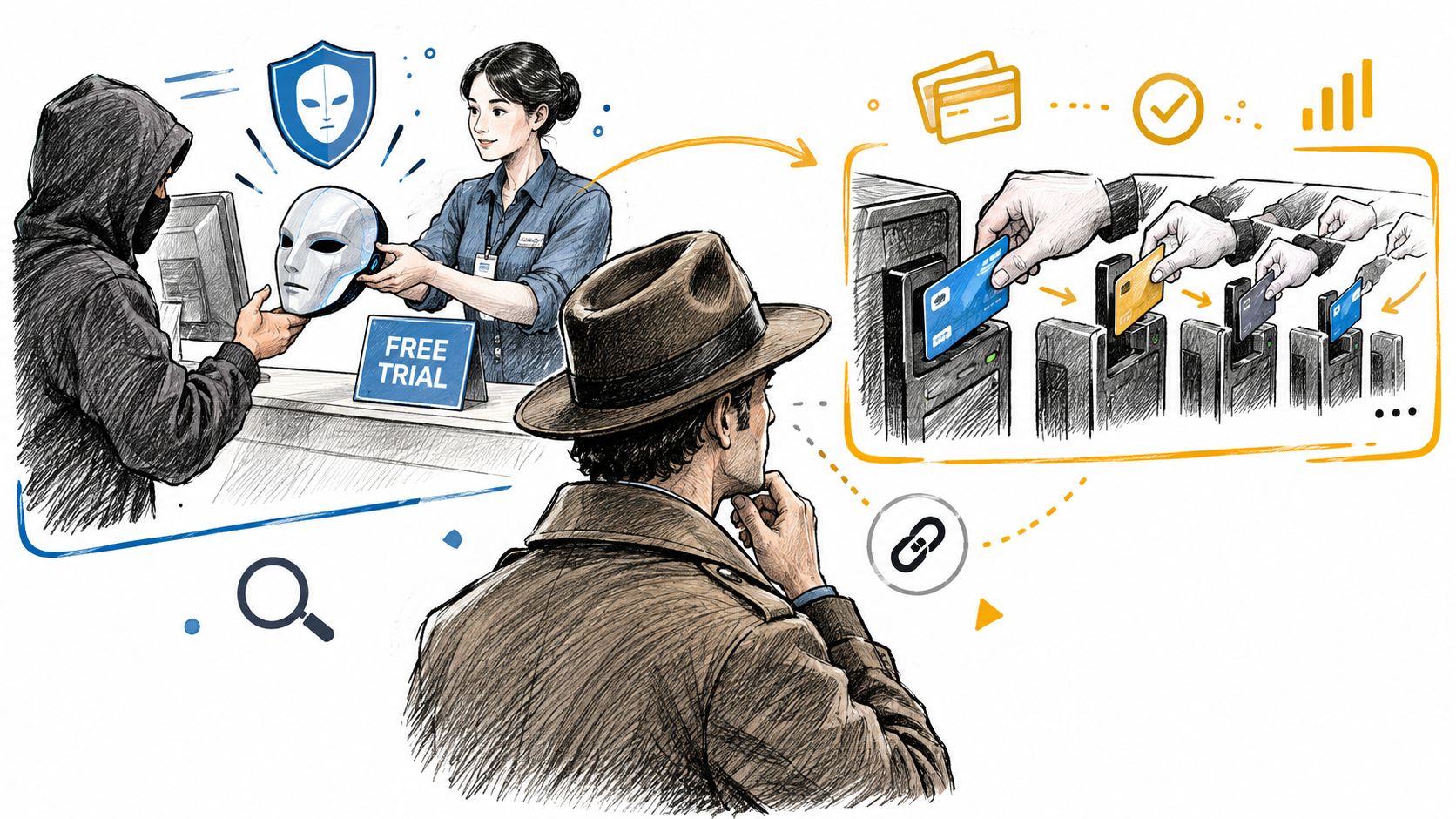
Trial and AI credit farming
Consider a product that offers a free trial or AI credits. An attacker submits several signup requests using different email addresses. The addresses don't match, but the device token remains consistent, the events arrive with similar behavioral characteristics, and the linked payment context recurs.
A transaction-only system may approve each signup because every individual email is new. An identity graph can identify the repeated enrollment pattern before the product issues another allocation. The policy might block the request when a confirmed abuse cluster is present, or route it to review when the relationship is suspicious but not conclusive.
The right response isn't always a hard decline. A legitimate household, office, or customer support environment can produce shared-device signals. That's why the verdict should include the specific reason, the linked events, and the confidence of the relationship rather than hiding everything behind a generic score.
The free-trial-abuse guide covers this problem from the product-flow perspective. The key operational choice is to place the gate before the scarce resource is released, not after the user has consumed it.
Card testing
Card testing has a different rhythm. A bot submits rapid, low-value authorization attempts to learn whether stolen card details work. Individual amounts may appear harmless, but the combination of timing, decline clusters, card cycling, and device rotation is a strong behavioral signal.
The engine should correlate the authorization attempts with the session and device context, then decide whether to allow a normal customer retry, review an unusual pattern, or block an automated burst. A rule based only on amount misses the attack because the attacker intentionally keeps the amount small.
Login and payment linkage
A third pattern begins at login rather than checkout. A compromised account may show a new device, unusual navigation, a changed payment method, and a checkout attempt soon afterward. Each event belongs to a different system, but the sequence is meaningful when the systems share a common identity and event timeline.
That linkage enables proportionate intervention. The login can receive a review verdict, the payment method change can require additional verification, and the checkout can be held until an investigator resolves the case. Payment fraud analytics becomes more useful when it models the journey around a payment event, not just the payment event itself.
Designing Efficient Review Workflows
Automation should remove obvious abuse from the queue, not turn every uncertain event into a manual case. A review workflow works when an investigator can answer three questions quickly: what happened, what is connected, and what action is justified.
Fragmented tools make those questions expensive. The reviewer switches between payment logs, authentication records, device dashboards, customer notes, and a separate case system. By the time the evidence is assembled, the queue has grown and the reviewer may make a different judgment from the person handling the next case.
Put evidence beside the verdict
A review workspace should show the triggering event, prior related activity, linked identities, payment context, and reason codes in one view. It should also show what the system decided previously and whether an investigator confirmed or overturned that decision.
This structure reduces interpretation work. A reviewer doesn't need to infer why an event was flagged from a score or search through unrelated logs. They can see that a new account shares a device with previously confirmed trial abuse, or that a checkout burst contains repeated low-value authorization failures.
A clear workspace also improves feedback quality. The reviewer can classify the outcome as confirmed abuse, legitimate activity, or unresolved. That label can feed policy tuning and cluster marking without forcing investigators to write an essay for every case.
Separate certainty levels
Use different queues or priorities for different types of evidence. A direct match to a confirmed abuse cluster may be eligible for automatic blocking. A weak relationship combined with unusual behavior may require review. A normal returning customer with a transient payment failure should remain in the allow path unless additional evidence appears.
This is more reliable than tuning one global threshold. Signup, login, trial conversion, and checkout have different consequences and different customer expectations. Each event type deserves its own policy, reason-code vocabulary, and escalation path.
Measure operational quality
A fraud team should monitor more than prevented loss. Track approval outcomes, review volume, false positives, overturned decisions, unresolved cases, and the reasons behind blocks. The 2026 Global Payments and Fraud Report from the Merchant Risk Council describes benchmarks across attack patterns, detection methods, and post-purchase abuse, which supports comparing performance by market and workflow rather than relying on one static threshold.
Review principle: If an investigator can't explain a verdict from the evidence on screen, the workflow isn't finished.
The goal is not to eliminate human judgment. It is to reserve that judgment for cases where context matters, while giving every reviewer the same evidence and decision vocabulary.
Implementation Checklist for Engineering Teams
A fraud gate should be treated like a production dependency in the payment and identity path. Build the integration around explicit event contracts, predictable failure behavior, and controlled identity scope.
Define the event contract
Start with the actions that create exposure. Typical events include signup, trial start, trial conversion, checkout attempt, payment method change, and login. For each event, define the request fields, the response schema, the timeout behavior, and the application action for each verdict.
Use a stable event identifier so retries don't create duplicate decisions. Record the tenant, account, session, and relevant identity keys. Send only the data needed for the decision, and keep sensitive values protected through hashing or tokenization.
Make latency observable
Set a latency budget before integration, then instrument the full path from application request to verdict handling. Measure normal response time, timeout frequency, retry behavior, and the time taken to commit the business action. An inline screening service should return the decision in under 100 milliseconds, according to the operating requirement described for this workflow.
Don't hide timeouts from the application. If the screening service degrades, the integration should expose the state and apply the documented fail-open policy rather than changing behavior without notice. A fail-open design may be appropriate for preserving availability, but the business must know which events passed without a completed screening decision.
Validate identity isolation
Check that identity keys are hashed and scoped per tenant. Confirm that an email, device token, card fingerprint, or payer wallet from one customer environment can't create a relationship in another. Test deletion, retention, access controls, and investigator permissions before production traffic reaches the graph.
Test decisions, not just connectivity
Create test cases for:
- Known abuse: A linked identity should produce the intended block or review response.
- Legitimate repetition: A returning customer should not be blocked merely because a device or payment artifact is familiar.
- Burst activity: Rapid attempts should produce useful velocity reason codes.
- Service degradation: The application should follow the documented fallback and disclose the screening state.
- Manual adjudication: Reviewers should be able to inspect evidence, record an outcome, and apply a confirmed abuse mark where appropriate.
Finally, version policies and reason codes. When approval or review behavior changes, engineers and risk teams need to know which rule set produced each verdict. That audit trail turns payment fraud analytics from a black box into an operable part of the checkout stack.
Portreeve provides an inline screening layer for signups, trials, checkouts, and logins, returning allow, review, or block decisions with reason codes and linked event history. If your team needs to move from fragmented signals to deterministic gating before abuse reaches payment or product resources, visit Portreeve to review the integration options.