
You can see the pattern already. A product team launches a free trial, the dashboard looks healthy, and then a wave of signups never converts. A few days later, the payments team notices card testing attempts, support starts seeing weird account churn, and the fraud queue fills with cases that all look slightly different but feel the same.
That's where fraud detection software stops being a back-office checkbox and becomes product infrastructure. The reason is simple. Reported fraud losses are too large for manual cleanup to keep up with, with the FBI's Internet Crime Complaint Center reporting 859,532 complaints in 2024 and $16.6 billion in losses, up 33% from 2023, and an average reported loss of $19,372 per complaint (UK Finance Fraud Report 2026). In the UK, 2024 brought 3.13 million confirmed cases of unauthorised fraud and £722 million in losses in the same report. Those numbers explain why teams are moving away from after-the-fact cleanup and toward decisions made before an account, trial, or payment commits.
The question isn't whether to detect fraud. It's where in the product flow the decision happens, and what happens after that decision. A score that lands after a signup is complete helps investigations, but it doesn't prevent the abuse from consuming resources. An inline gate that can allow, review, or block in real time changes the economics of the whole funnel.
Table of Contents
- Introduction Why Fraud Detection Matters Right Now
- What Fraud Detection Software Actually Does
- Core Components That Make Detection Work
- How Fraud Detection Software Fits Into Your Product
- Real World Applications From Trials to Payments
- How to Evaluate and Choose Fraud Detection Software
- Conclusion Putting Fraud Detection Into Practice
Introduction Why Fraud Detection Matters Right Now
A SaaS founder usually notices abuse in stages, not all at once. First it shows up as a spike in trials that never convert. Then the payment team sees low-value card testing. Then the support inbox fills with users who insist they were blocked for no reason. By the time all three teams are comparing notes, the fraudster has already learned where the weak spots are.
That's why the market shifted from post-event scoring to pre-commit gating. Fraud detection software used to mean a system that flagged suspicious activity for later review. Now the more useful version sits in the path of signup, trial start, checkout, and login, and it decides whether the action should continue. The product impact is bigger than the security label suggests. A system that catches abuse after the event may help with analysis, but a system that stops it before the commit preserves margin, support time, and user trust.
The timing pressure is real. Independent benchmarks and operator guidance place competitive real-time decision latency at under 100 milliseconds at the 99th percentile, because the fraud stack has to leave room for network transit, payment processing, and retries (Fluxforce benchmark discussion). If the check is slow, the product feels broken. If the check is too permissive, abuse slips through. Founders and PMs end up managing both risks at once.
Practical rule: treat fraud review like product gating, not only like investigation. If the decision comes after the action commits, you're already doing cleanup.
The rest of the mental model is easier once you hold onto that distinction. Inline gating answers, “Should this action happen now?” Post-event investigation answers, “What just happened, and what should we do about it?” Those are related problems, but they're not the same one.
What Fraud Detection Software Actually Does
Think of fraud detection software as a gatekeeper, not a detective. A detective shows up after theft and reconstructs the timeline. A gatekeeper checks ID before entry, decides whether someone can pass, and logs what happened for later audit. That's the difference between merely observing abuse and preventing it.
The software usually evaluates an event, pulls in signals, and returns a verdict. In a product flow, that might be allow, review, or block. The value of those outcomes is that they're deterministic. Product teams don't just get a vague risk score and a shrug. They get a decision that can route a user down the right path immediately.
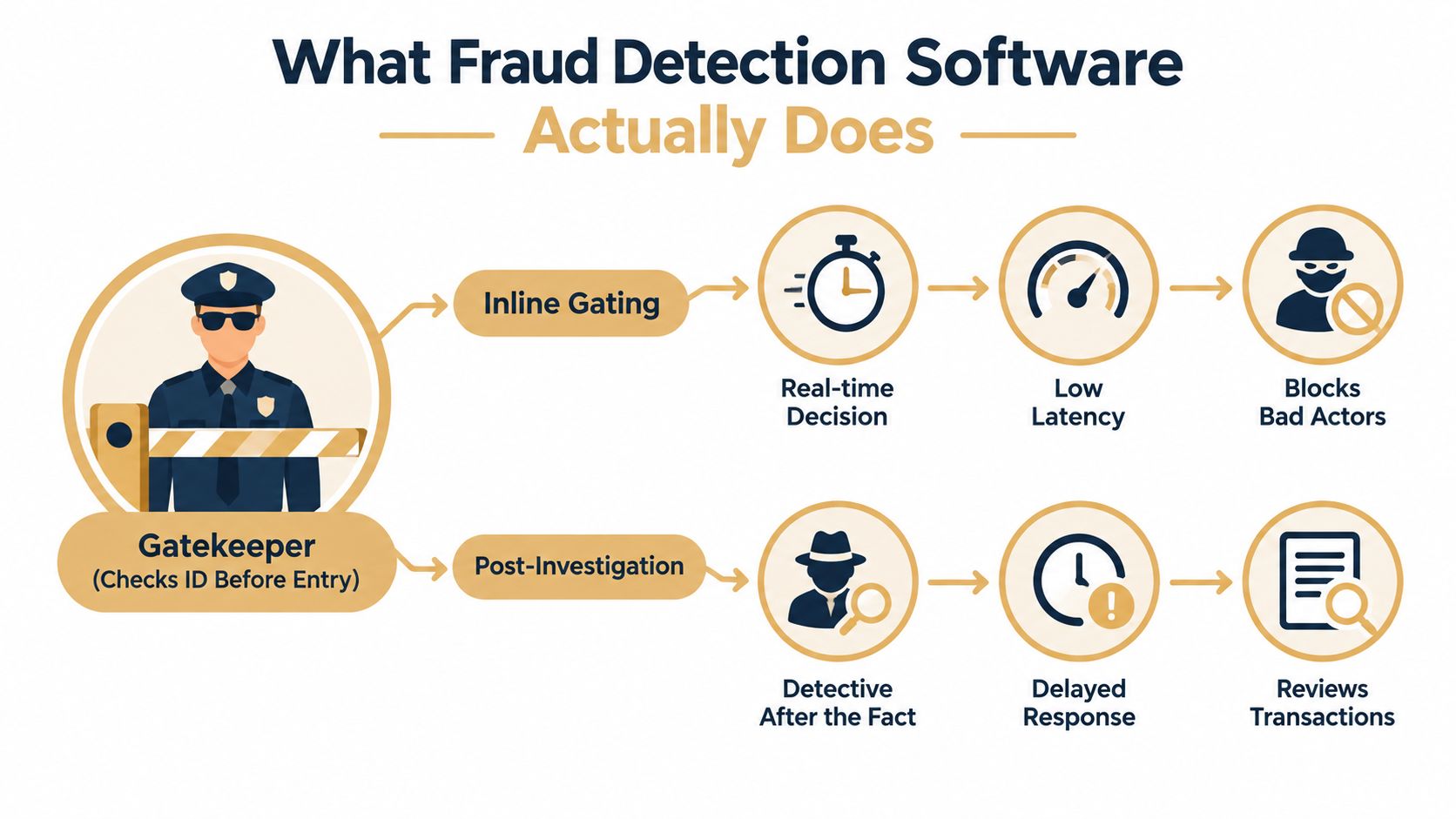
Inline gating versus post-investigation
Inline gating happens while the user is still trying to act. The system checks context, identity, and behavior before the signup, payment, or login completes. That makes the decision useful to the product itself, because the action can still be allowed, challenged, or stopped.
Post-investigation happens after the event. That mode is still valuable, especially for pattern discovery and case building, but it doesn't protect the original action. If the goal is to stop a free-trial abuser from creating 20 accounts, you need a gate. If the goal is to reconstruct their network after the fact, you need an investigator.
The cleanest systems connect both jobs. They make the decision in real time, then preserve the evidence trail for analysts, operations, and compliance. That evidence trail matters because reviewers need to know why something was blocked or sent to manual review, not just that the system made a call.
Scores, alerts, and decisions are not the same thing
A lot of confusion starts when vendors blur three layers together. A score is a signal. An alert is a prompt for attention. A decision is an operational outcome. Product teams often buy a score and think they bought prevention, but prevention only happens when the score is tied to a rule or decision path.
Key distinction: a useful fraud system does not merely rank risk, it converts risk into a decision the product can act on.
Reason codes sit between the verdict and the reviewer. They explain why a request was allowed, reviewed, or blocked. That's what makes the system auditable, tunable, and easier to trust. Without reason codes, every false positive turns into a mystery. With them, the team can see whether the problem was a device signal, a linked identity, a card pattern, or something else entirely.
That's also why the best systems keep evidence attached to the verdict. A reviewer shouldn't have to hunt across five tools to understand a single event. The point isn't just to catch more abuse, it's to make the decision legible enough that the business can safely use it.
Core Components That Make Detection Work
A modern fraud stack is usually a set of small parts working together, not one magic model. The engine has to do three things at once. It has to screen fast, reason over patterns, and learn from confirmed abuse without turning every odd event into a manual chore.
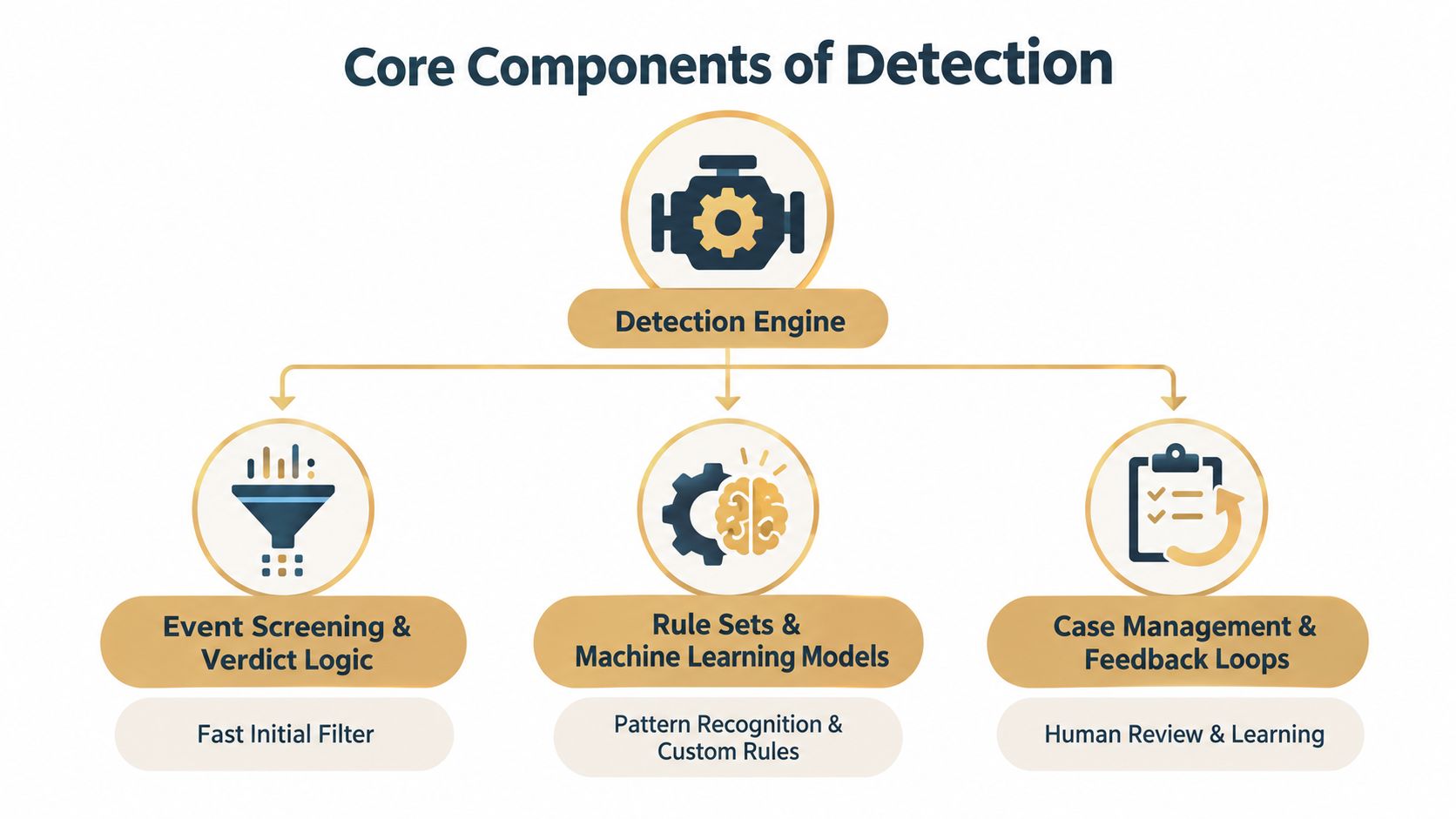
Screening logic and verdict generation
Event screening is the first pass. The system looks at the request, checks the attached signals, and decides whether it should proceed, be reviewed, or be blocked. That verdict logic needs to stay simple enough to explain and fast enough to sit in the live path.
A lot of teams overcomplicate things. They assume sophistication means more score layers. In practice, the strongest setups usually make the first decision legible. If the request is obviously safe, let it through. If it's obviously abusive, stop it. If it's ambiguous, route it to review.
Rules, models, and why both matter
Rules are good at known patterns. They're also easy to update when a new abuse burst appears. Machine learning helps when patterns shift faster than a human team can encode them one by one. In 2026 market research, machine-learning systems were reported to detect 96.2% of fraud attempts compared with 72% for legacy rule-based systems, which helps explain why so many teams have moved toward advanced analytics (AARP fraud and scam loss analysis).
That said, the model doesn't replace the rule layer. It usually complements it. Rules capture the business's hard boundaries. Models catch drift, nuance, and combinations of signals that are hard to express by hand. The best systems let both layers work together instead of forcing a false choice.
Memory and graph linkage
Fraud rarely happens as a single event. It tends to repeat across identities, devices, cards, and wallets. That's why persistent memory matters. A burner email by itself may look harmless. The same email linked to a reused device token and a repeated card fingerprint tells a different story.
Graph-based systems are strongest when they connect those soft links into clusters. Academic fraud-graph work distinguishes weaker associations, such as device fingerprints and cookies, from stronger entity ties, then uses clustering to reveal coordinated abuse rings (graph fraud framework). That linkage reduces reliance on any one noisy signal. It also gives the system memory across time, which is what repeat abusers try to exploit.
Review queues and feedback loops
Ambiguous cases still need humans. Review queues absorb those edge cases and make sure analysts can see the evidence behind the machine's call. Once a reviewer confirms abuse, that result should feed back into the system so the same pattern gets recognized earlier next time.
A useful mental model is deterministic decisioning plus reason codes, then human review for the gray area.
If the analyst can't tell why a request was routed to review, the system hasn't really helped. It only moved the ambiguity into a different inbox.
That's why cluster marking and linked-history views matter. They turn isolated incidents into a visible pattern, and that pattern is what reviewers need in order to act consistently.
How Fraud Detection Software Fits Into Your Product
The cleanest integration point is usually before commit. That means the product asks for a decision before the action becomes permanent, whether the action is a signup, trial start, payment attempt, or login. If you wait until after the action is done, you're mostly measuring damage.
Where the decision belongs
The most common insertion points are signup, trial_start, trial_convert, checkout_attempt, and login. Each one has a different business cost when abused. A bad signup pollutes your trial pool. A bad checkout causes payment loss. A bad login can be the start of account takeover or credential abuse.
The integration itself is usually API, SDK, or webhook driven. A backend service sends the event, the fraud layer responds with a verdict, and the product uses that verdict to continue, challenge, or stop the action. That pattern is easy to understand, but the engineering details matter. Latency has to stay low enough that the user doesn't feel the check as friction.
Inline gate, async review, and batch analysis
| Pattern | Decision Timing | Best For | Tradeoff |
|---|---|---|---|
| Inline gate | Before commit | Signups, trials, logins, payments | Needs low latency and careful fail-open logic |
| Async review | After commit, before final human action | Ambiguous cases and high-value accounts | Doesn't prevent the original event |
| Batch analysis | Later, across many events | Trend spotting and model training | Cleanup cost is highest |
The table sounds simple because the tradeoff really is simple. If prevention matters most, use the gate. If investigation matters most, use review. If trend discovery matters most, use batch analysis. Most mature teams use all three, but they don't pretend all three solve the same problem.
Why latency and isolation matter
The response path has to be fast enough for the checkout or login experience to stay intact. The earlier section's benchmark matters here because a slow gate can create soft declines, retries, or timeout-related failures. That's why engineering teams care about p99 latency, not just average latency.
Per-tenant isolation matters too. Different customers, markets, or brands may need different memory depth, rules, and review behavior. A shared engine with scoped data and tenant isolation is easier to operate than a one-size-fits-all setup. If you're evaluating a vendor API, the architecture details in the fraud detection API guide are the right kind of reference point to compare against your own flow.
Real World Applications From Trials to Payments
Fraud patterns look different on the surface, but the product damage is often the same. They steal free resources, consume analyst time, and hide behind ordinary-looking user actions. The useful question isn't “What kind of fraud is this?” It's “What linked signals would let the system recognize it before the abuse becomes expensive?”
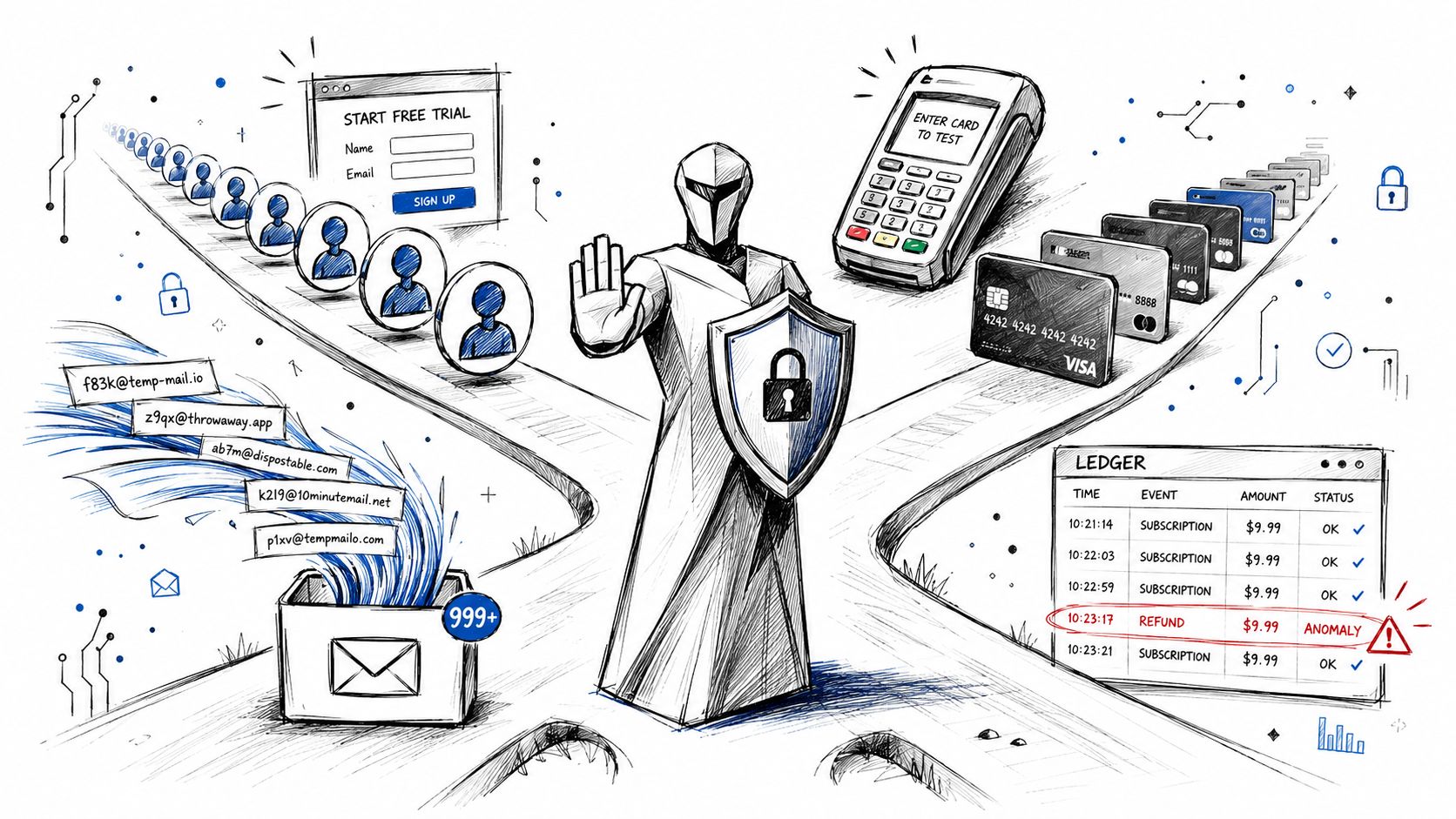
Trials and AI credit farming
Free-trial abuse usually starts with disposable identities and repeats fast. The goal is simple. Get more trial value without paying. In AI products, that can mean trial farming for credits or repeated signups to exhaust usage allowances.
The useful signals aren't just the email address. Reused device tokens, repeated payment artifacts, and persistent account-link history matter more. When the same device keeps returning with new identities, the system can route the event to review or block it before the trial starts. That prevents the product from subsidizing abuse.
Card testing and payment abuse
Card testing often looks like a tiny purchase or a short checkout attempt. The fraudster isn't trying to buy your product. They're testing whether a card is live. If the pattern gets through, the card can be used elsewhere.
That's where device and card fingerprint linkage earns its keep. A single checkout attempt might not look suspicious. A cluster of attempts tied to the same device or payer wallet does. Keeping the evidence and history in one workspace helps reviewers connect those dots faster instead of toggling between tools and exports. A separate fraud prevention e-commerce playbook is useful if your product team is specifically working through payment-stage abuse.
Burner emails and bot signups
Burner emails and bot signups are similar in one way. They're easy to create and easy to abandon. If the system only looks at the email string, it misses the pattern. If it remembers linked identities and device history, it can see that the new account is part of a repeat sequence.
Operational win: consolidated evidence shortens review time because the analyst sees the pattern, not just the latest event.
That's why persistent memory matters more than isolated scoring in signup-heavy products. It helps the product distinguish between a new customer and a reused abuse path. It also gives reviewers reason codes and linked history they can use to keep decisions consistent across cases.
How to Evaluate and Choose Fraud Detection Software
The easiest mistake is to compare vendors by feature list alone. Most tools can say they do real-time detection, AI, and case management. The harder question is whether the system can make a decision your product can trust in production.
Start with the decision style. Ask whether the vendor returns a deterministic allow, review, or block outcome with reason codes, or whether it mostly hands you an opaque score. Then check how deep the memory goes across email, device, and payment artifacts. If the vendor can't connect repeated abuse, it'll struggle with burner churn.
What to ask in a demo
- Decision clarity: Can the system explain why it chose allow, review, or block in plain language?
- Memory depth: How far back can it remember linked abuse across tenants and identities?
- Latency at the edge: What happens at p99, not just in a happy-path demo?
- Review workflow: Can analysts resolve cases without jumping between tools?
- Identity linking: Which identifiers are used, how are they hashed, and how are clusters formed?
The operational cost of false positives matters as much as fraud catch rate. A system that blocks too aggressively can hurt conversion, support volume, and trust. A system that's too loose may let abuse recur through the same paths over and over. The goal is balance, not just detection volume.
The current abuse mix also matters. In 2025, the FBI's IC3 recorded 22,364 complaints citing AI in fraud and $893 million in losses, which is a good reminder that attackers are using automation too (Techlicious on FBI online scam losses). That's another reason a single-signal score is often not enough. Teams need systems that can link identities, devices, and payment artifacts rather than betting on one noisy indicator.
If you want a more vendor-specific comparison process, the best fraud detection software guide is the kind of shortlist framework to use during evaluation.
Conclusion Putting Fraud Detection Into Practice
Fraud detection software is most useful when it behaves like a pre-commit gate, not a post-event report. The gatekeeper model is the simplest way to think about it. The software checks the event, returns a verdict, preserves the evidence, and helps the business decide whether to let the action continue.
The practical sequence is straightforward. Start with the insertion point that carries the highest loss, usually signup, trial start, checkout, or login. Measure how often the system sends legitimate users to review, then tune the rules and memory depth before expanding to more surfaces. Once the decision path is stable, add linkage and persistent memory so repeat abuse has fewer places to hide.
That approach keeps the product team focused on prevention, not cleanup. It also gives engineering a concrete target. Build the gate first, then widen the net.
Portreeve provides an inline screening layer for signups, trials, checkouts, and logins, with allow, review, or block decisions returned in under 100 milliseconds, plus reason codes and per-tenant history. If you're mapping where to place fraud checks in your own product, visit Portreeve to see how that decision flow works in practice.