
Most advice about the best fraud detection software still assumes one platform should cover everything equally well. That's the wrong buying model. A SaaS team fighting free-trial farming has a different problem from a retailer managing chargebacks, and both differ from a product team dealing with account takeover at login.
The more useful question is where abuse starts. If the loss begins at signup, the strongest tool is often the one that can stop the account before it exists. If the loss appears at checkout or after fulfillment, payment decisions, dispute workflows, and commercial guarantees matter more. Recent industry coverage also points to a stronger shift toward real-time fraud detection, with many organizations moving away from batch monitoring and prioritizing AI and advanced analytics for faster decisions, while reported internet-crime losses remain severe in major markets according to the 2025 Digital Fraud Outlook.
This roundup compares seven tools through that operational lens: lifecycle coverage, inline decisioning, identity signals, analyst workflows, integration effort, pricing visibility, and the difference between signal providers, decision engines, and guarantee-based models. You'll also see where Portreeve fits as the inline-gating option for teams that need low-latency allow, review, or block decisions before a signup, trial, login, or checkout commits.
Table of Contents
- 1. Portreeve
- 2. Stripe Radar
- 3. Sift
- 4. SEON
- 5. Arkose Labs
- 6. Fingerprint
- 7. Forter
- Top 7 Fraud Detection Software Comparison
- How to Choose Without Buying the Wrong Layer
1. Portreeve
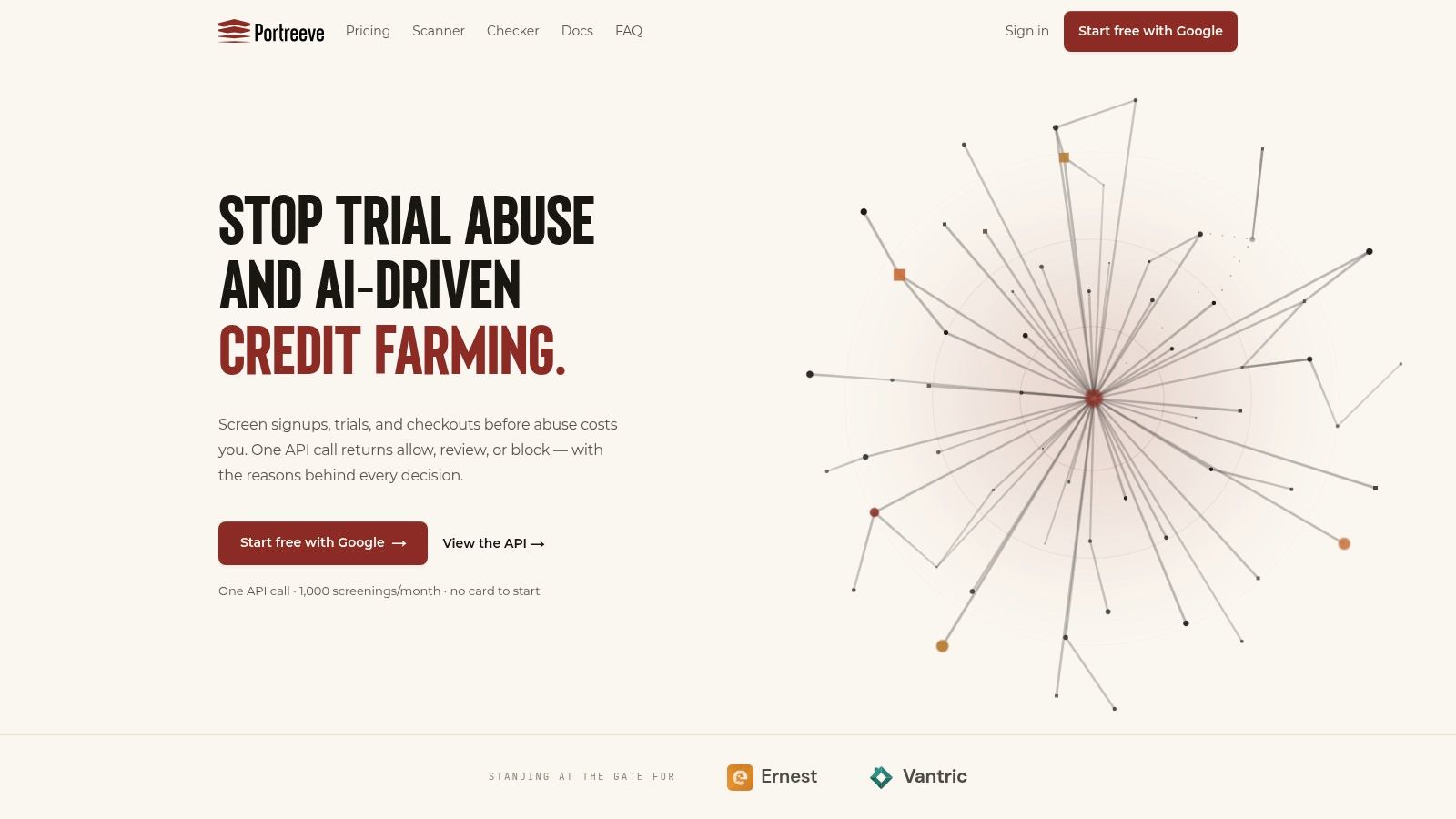
Fraud tools often get compared as if they all solve the same problem. Portreeve only makes sense if your loss starts before an account, trial, login, or payment should be allowed to complete.
That focus matters because signup abuse, free-trial farming, credential-stuffing retries, and low-value card testing all create operational cost before a chargeback ever appears. A platform built for post-event scoring can still leave support cleanup, account takedowns, credit consumption, and manual review with your team. Portreeve is designed for the earlier decision point. Its model is to sit inline, evaluate the event before commit, and return a direct allow, review, or block outcome.
Where it fits best
Portreeve fits front-door controls better than payment-stack optimization. For teams protecting signup, trial start, login, trial conversion, or checkout initiation, that distinction is practical because the product is set up as a decision layer rather than a raw signal feed.
The main product claim is low-latency inline screening through a Verdict API, with implementation through a single API call or webhook workflow, plus a Node SDK and HTTP endpoint. Portreeve also states that responses are typically fast enough for live gating in user flows. That is the right architecture for abuse points where a delayed answer has little value.
Its stronger differentiator is identity linkage over time. Portreeve keeps a per-tenant graph that can connect email addresses, device tokens, card fingerprints, and payer wallets across repeated events. In evaluation terms, that matters more for serial abuse than for one-off high-ticket fraud. Trial farmers and card testers often look benign in isolated sessions. They become obvious when the system remembers linked behavior across attempts.
Decisioning and review workflow
Portreeve returns decisions, not just scores. That changes who can use it effectively.
A risk score still requires your team to define thresholds, route gray-area cases, and explain disputes internally. Portreeve instead outputs an action with reason codes and exposes supporting evidence in a review workspace. For product, trust, and support teams, that usually reduces policy translation work because the operational question is already framed as approve, hold, or stop.
The built-in review queue also deserves attention. Some vendors have strong detection but weak analyst workflow, which pushes teams into spreadsheets, ticket queues, or custom admin tooling. Portreeve keeps screening, evidence review, and cluster marking in one place, so confirmed abuse can inform later decisions across linked identities.
Key strengths are fairly specific:
- Best fit by abuse point: signup, trial, login, and pre-authorization checkout controls
- Decision model: direct allow, review, or block outputs with reason codes
- Identity memory: links repeated behavior across emails, devices, cards, and wallets
- Workflow coverage: includes manual review rather than treating it as a separate system
- Integration effort: lighter than assembling separate device, payment, and rules components for the same gate
Commercial model and trade-offs
Portreeve is one of the more transparent products in this group on pricing. The company advertises a free tier for limited testing and paid tiers based on screened event volume, which is useful for smaller SaaS teams that want to estimate cost before talking to sales. That pricing model also signals what you are buying: screening and decisioning capacity, not a fraud-loss guarantee.
That distinction matters. Portreeve is a decision engine with linked identity signals and review workflow. It is not positioned as a guarantee-backed chargeback program, and it is less tied to a payment processor than products built inside billing stacks.
There are trade-offs. Teams that rely heavily on IP reputation as a primary control may want to examine fit closely, since Portreeve emphasizes other identity keys more heavily. The free tier is suited to evaluation and low-volume use, not broad production coverage. Buyers should also verify how fail-open behavior, retention settings, and reason-code granularity map to their own risk policy before rollout.
For teams whose fraud problem starts before money settles, Portreeve is one of the few options here built around stopping the action at the point of attempt. Product details and pricing are listed on the Portreeve website.
2. Stripe Radar
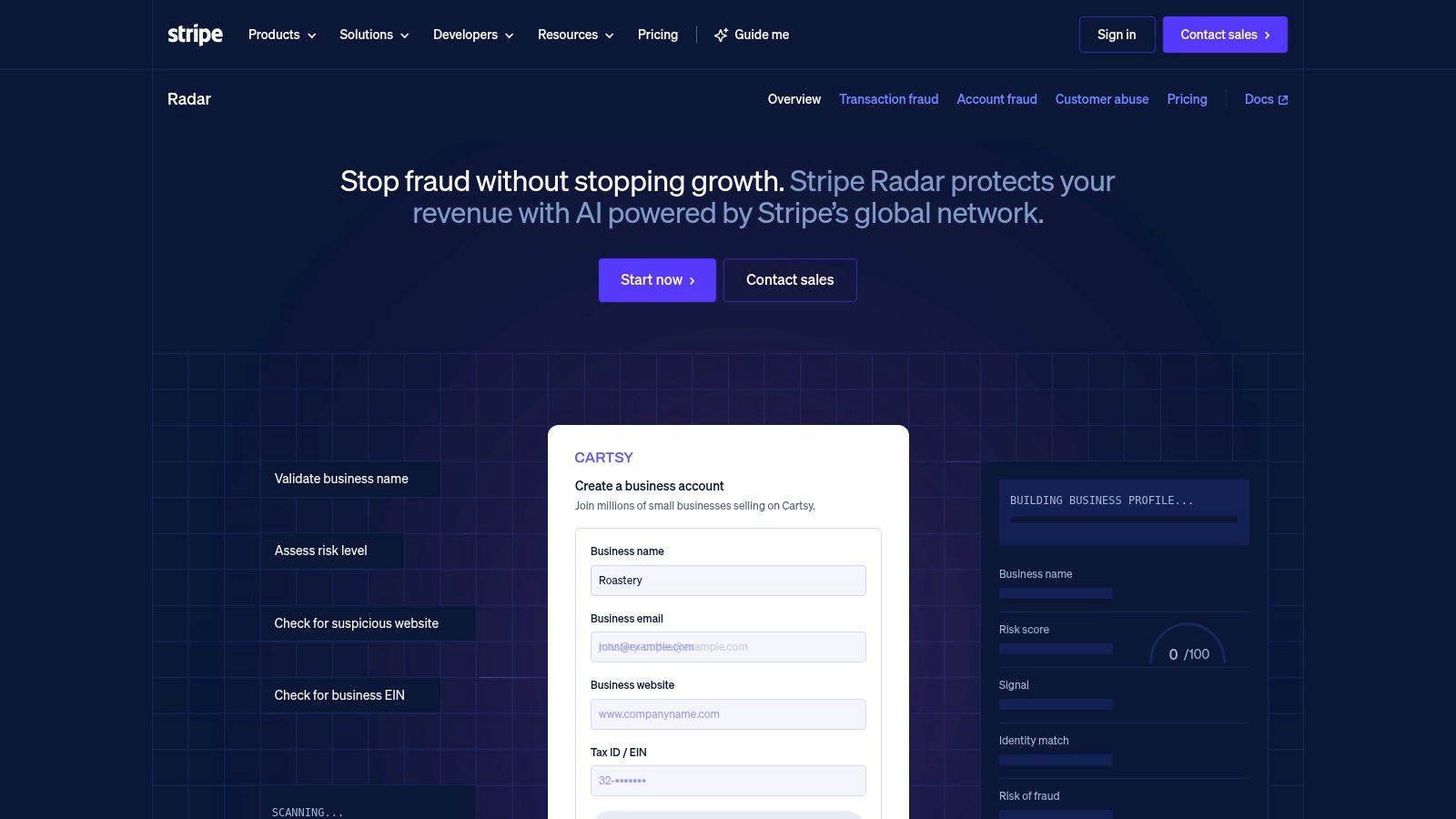
Stripe Radar makes the most sense when Stripe already owns a large part of your billing and payments stack. In that setup, Radar isn't just another fraud vendor. It's the shortest path to getting payment fraud controls, abuse checks, and review workflows into production with minimal additional plumbing.
Its appeal is lifecycle coverage. Stripe positions Radar across signup and onboarding abuse, transaction fraud, disputes, and broader customer abuse patterns, and it can also be used apart from Stripe Payments through separate APIs. For teams already deep in Stripe, that reduces integration drag because fraud operations can sit closer to billing, subscriptions, and dispute handling.
Best fit by abuse point
Radar is a practical choice when checkout, renewal, and payment-adjacent account abuse create most of the loss. It's less compelling if your main problem sits upstream and you want one independent gate for every non-payment event in your product.
That doesn't make it narrow. It makes it opinionated. Stripe's advantage is that it can connect payment decisions to the billing events many SaaS teams already run on its platform.
A few buyer notes matter:
- Strongest fit: Stripe-centered SaaS and commerce workflows.
- Decision model: Risk scoring, rules, review tooling, and broader abuse protections depending on tier.
- Integration path: Easiest when Stripe already processes payments.
- Pricing model: Public plan structure exists, but capabilities vary by tier.
What to watch before buying
The practical caveat is that some of Radar's broader abuse protections sit higher in the packaging. Teams looking for advanced controls around multi-account abuse, bots, or free-trial misuse should check carefully which plan includes what. That's especially important if you're comparing Radar against a vendor that treats signup and trial abuse as first-class use cases rather than adjacent ones.
A lot of teams buy Radar for card fraud, then realize their real loss starts earlier in the customer journey.
That doesn't disqualify Stripe Radar. It just means the best fraud detection software for your business may still be a combination: Radar for payment and dispute decisions, plus a separate front-door control if signup or free-tier abuse drives cost. Stripe's product details and plan options are available on the Stripe Radar product page.
3. Sift
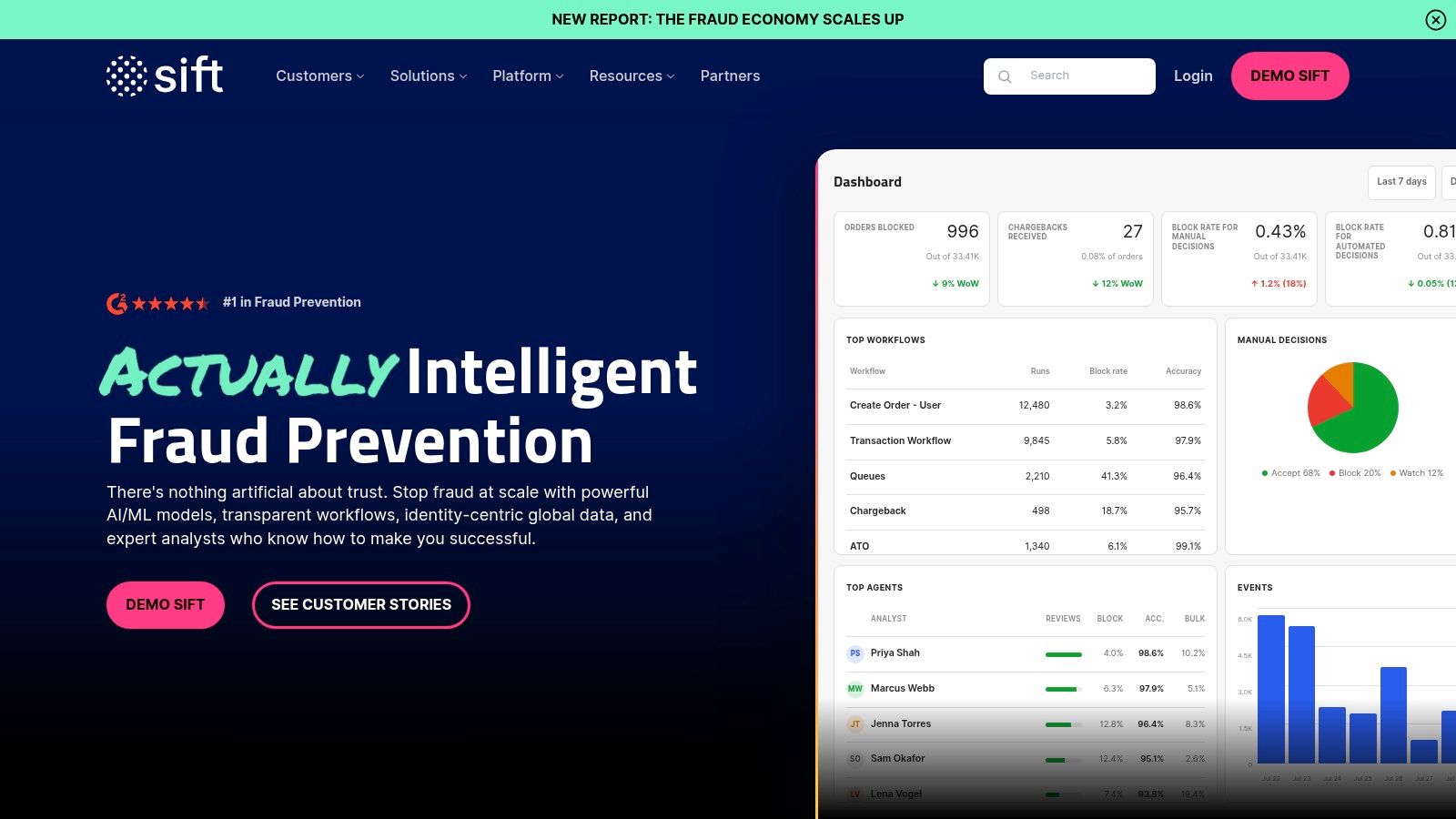
Sift is built for teams that don't want separate products for fake accounts, account takeover, payments, and post-purchase abuse. Its positioning is broader than a checkout tool and more operational than a pure identity-signal vendor. That makes it a serious option for enterprise trust and safety teams that need one platform across account and transaction risk.
The product emphasizes decisioning, automation, and analyst workflows. That's a different buying posture from tools that mainly enrich events with device or payment context. If your fraud team already runs queue-based review and policy tuning, Sift fits that operating model better than lighter self-serve products.
Why Sift often lands with larger teams
Sift's core attraction is breadth across the customer lifecycle. A team can use it for fake signup detection, login and ATO protection, payment risk, and post-purchase abuse without forcing each business unit onto different tooling. That's especially useful when abuse shifts across surfaces instead of staying confined to one event.
It also aligns with where enterprise buying appears to be heading. The fraud detection and prevention market is projected to reach USD 80.01 billion by 2031, up from USD 35.71 billion in 2026, with a reported 17.5% CAGR, and software or platforms are described as accounting for over 71% of the market in 2026, valued at US$27.34 billion according to this fraud detection and prevention market report. That supports a practical conclusion: many buyers now prefer integrated platforms over point solutions, even when implementation takes longer.
The real trade-off
Sift isn't the product I'd put first in front of a founder who wants a card-on-file-free trial gate running this afternoon. It is the product I'd shortlist when fraud operations already look like a program, not a side task.
That means asking harder questions about implementation and ownership:
- Workflow depth: Good fit for teams that need analyst tools, policy controls, and cross-surface orchestration.
- Commercial motion: Sales-led and typically enterprise-oriented, not a lightweight self-serve purchase.
- Coverage strength: Broad from account creation through payment and abuse operations.
- Buying caution: Make sure the platform depth matches your actual team capacity.
If you want a broader sense of how platform-style fraud tools compare with more focused layers, this guide to fraud prevention tools is a useful companion. Sift's own product information lives on the Sift website.
4. SEON
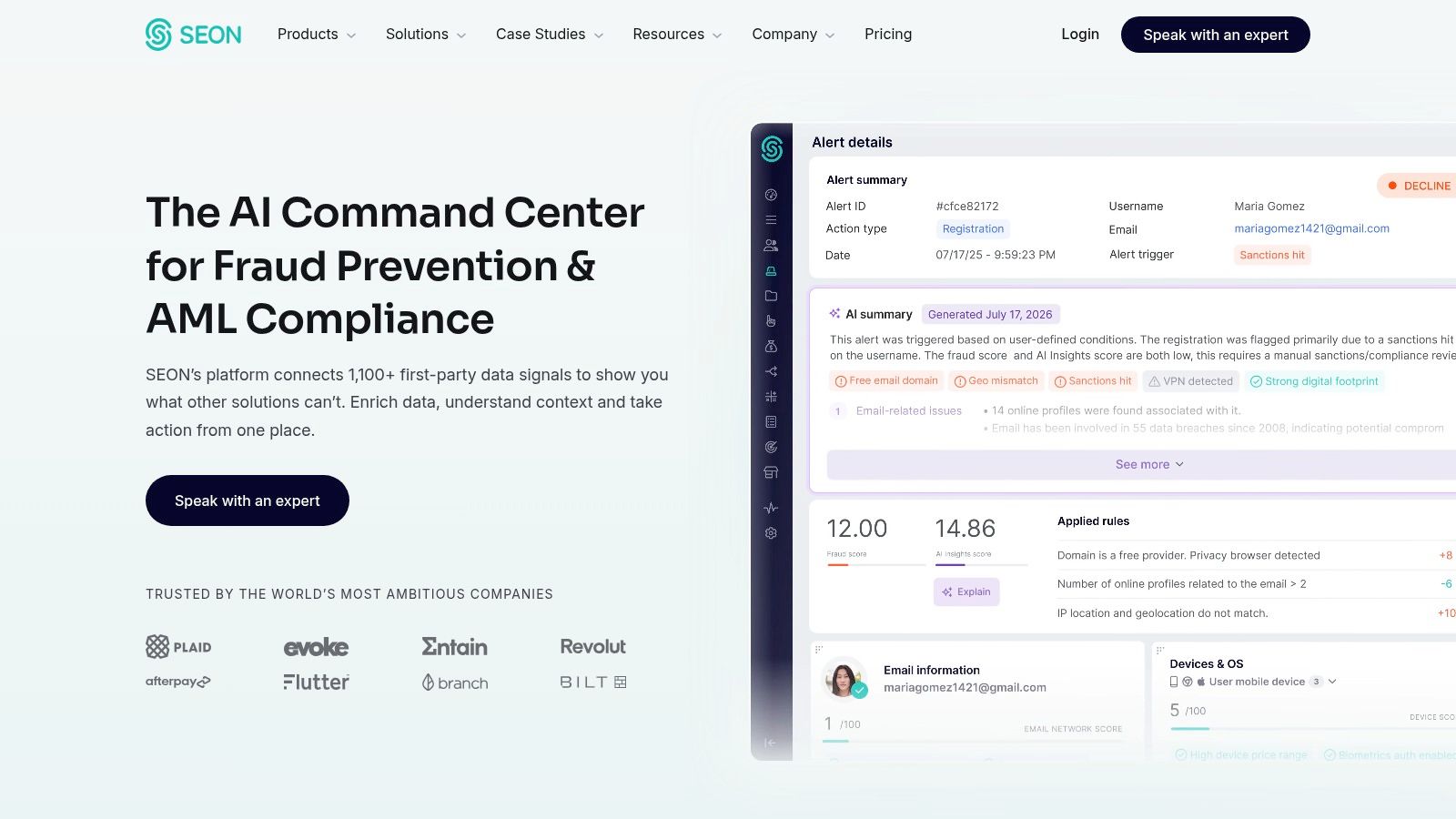
SEON is one of the more accessible options for teams that want API-first fraud tooling without jumping straight into a heavy enterprise rollout. It mixes device intelligence, digital footprint enrichment, rules, case management, and AML or KYC-adjacent capabilities in one vendor relationship.
That combination is appealing for startups and mid-market teams because fraud and onboarding controls often converge operationally. The person evaluating a suspicious signup may also care about identity checks, payout risk, or later payment behavior.
Where SEON fits well
SEON is a good fit when abuse starts at signup, login, bonus or trial flows, and then extends into payment screening. It suits teams that want analysts and developers to share one system rather than bolt together separate enrichment and decision tools.
Its public-facing positioning around fast integration also matters. Products in this tier often win not because they have the deepest possible enterprise workflow, but because teams can get useful controls into production without months of customization.
SEON is often the pragmatic middle ground between a pure signal layer and a full enterprise fraud program.
What buyers should check closely
SEON's strength is range. Its risk is sprawl. When one vendor covers fraud, rules, enrichment, and AML, buyers need to confirm which modules they'll use first and which are future options rather than day-one requirements.
That evaluation usually comes down to a few questions:
- Abuse point: Good for signup, login, and payment checks where identity context matters.
- Decisioning: Rules-based controls and case management are part of the value, not just raw data.
- Integration effort: Generally friendlier for API-led teams than larger enterprise suites.
- Pricing visibility: Better visibility at the entry level than many enterprise competitors, with custom pricing higher up.
The best fraud detection software isn't always the most expansive product. Sometimes it's the one your team will deploy and tune. SEON's current packaging and platform details are on the SEON website.
5. Arkose Labs
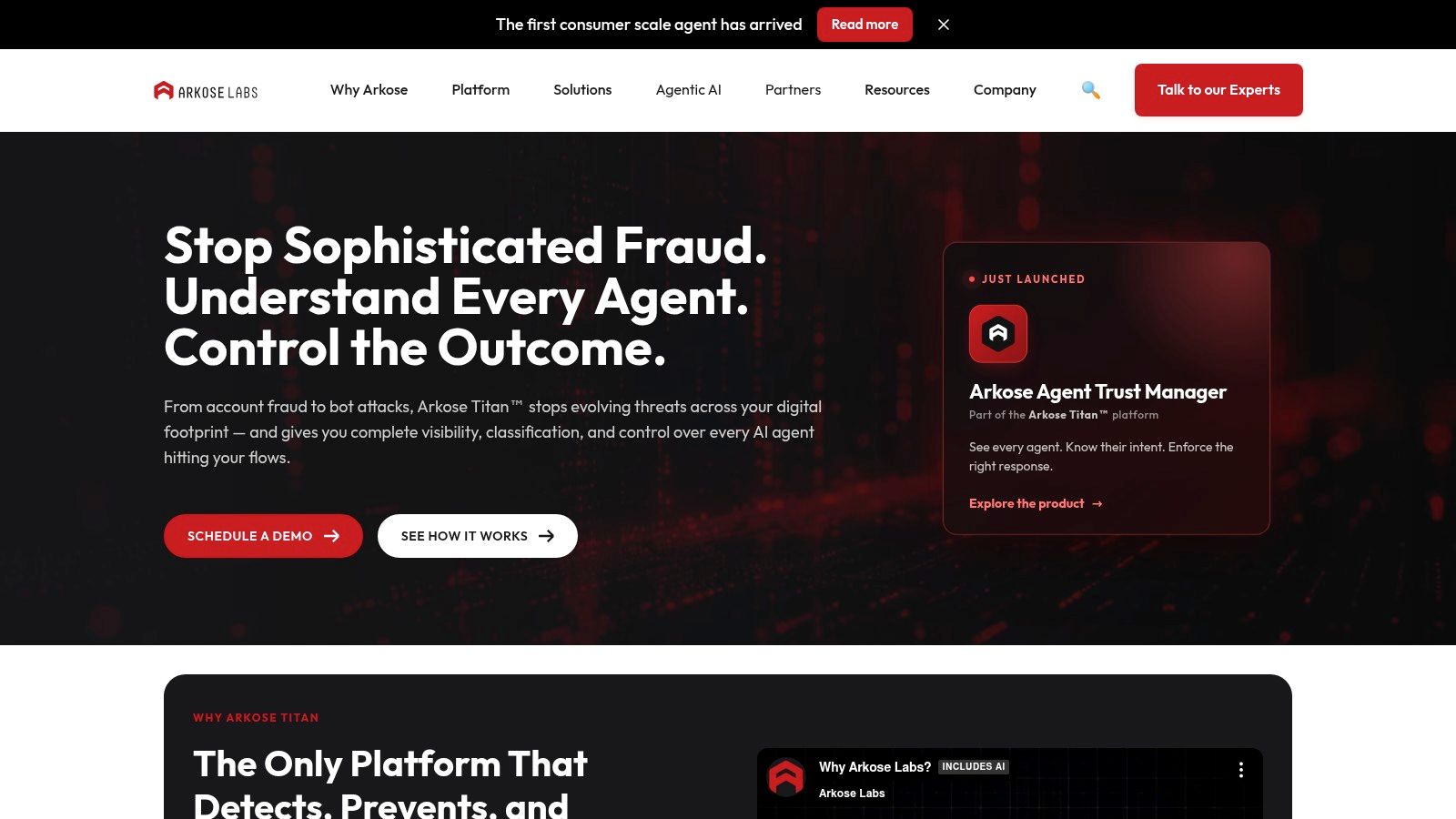
Arkose Labs fits a different buying decision from tools built around checkout approvals or post-purchase disputes. Its main job is to protect the abuse points that get attacked before a legitimate transaction exists: signup, login, password reset, card entry, and other high-volume edge flows where bots or scripted operators can create cost quickly.
That distinction matters because a strong payment fraud model does not automatically stop fake account creation, credential stuffing, SMS pumping, or card testing. Those are throughput problems as much as risk problems. The winning control is often the one that interrupts the attack in real time, links repeat attempts across sessions and devices, and gives operators a way to tune responses without flooding good users with friction.
Where Arkose is strongest
Arkose is most useful upstream. It is a prevention layer for attacks that exploit account creation and authentication workflows, then extends into selected checkout and payment-adjacent events where automation is the core issue.
Compared with platforms centered on transaction scoring, Arkose puts less emphasis on broad commerce decision coverage and more on attack resistance. Buyers evaluating it should look at five things:
- Abuse point: Strong fit for signup, trial creation, login, password reset, card testing, and other high-risk entry points.
- Decision speed: Built for immediate intervention at the point of attack, not later analyst review.
- Identity linkage: Useful where device and session continuity matter more than payment history alone.
- Review workflow: Better for security and fraud teams managing attack patterns than for chargeback teams handling post-purchase disputes.
- Pricing visibility: Usually sales-led, with proof-of-concept and configuration work rather than self-serve pricing.
This changes how Arkose should be compared with the rest of the category. It competes less with guarantee products and more with abuse-prevention infrastructure. If your main loss driver is automated traffic consuming OTPs, promotions, inventory, or authentication capacity, another risk score may add less value than a tool that slows or blocks the attack path itself.
What buyers should check closely
Arkose can be highly effective without being broad. That is the tradeoff.
Teams should confirm whether they need a signal source, a decision engine, or a vendor taking liability on approved transactions. Arkose is primarily the first two in the context of attack prevention. It is not a general chargeback guarantee product, and it should not be evaluated as one.
A practical short list looks like this:
- Best at: Fake signups, credential attacks, bot-driven abuse, SMS toll fraud, and card testing.
- Less suited for: End-to-end post-purchase review, dispute operations, or merchant-of-record style guarantees.
- Integration effort: Worth assessing by flow. Signup and login deployments differ from payment-form protection.
- Commercial model: Enterprise sales motion, often justified when abuse volume is high enough to create measurable operational cost.
Its warranties also need careful interpretation. They support Arkose's position around specific attack classes and service outcomes. They do not turn the product into transaction insurance. Product details are available on the Arkose Labs website.
6. Fingerprint
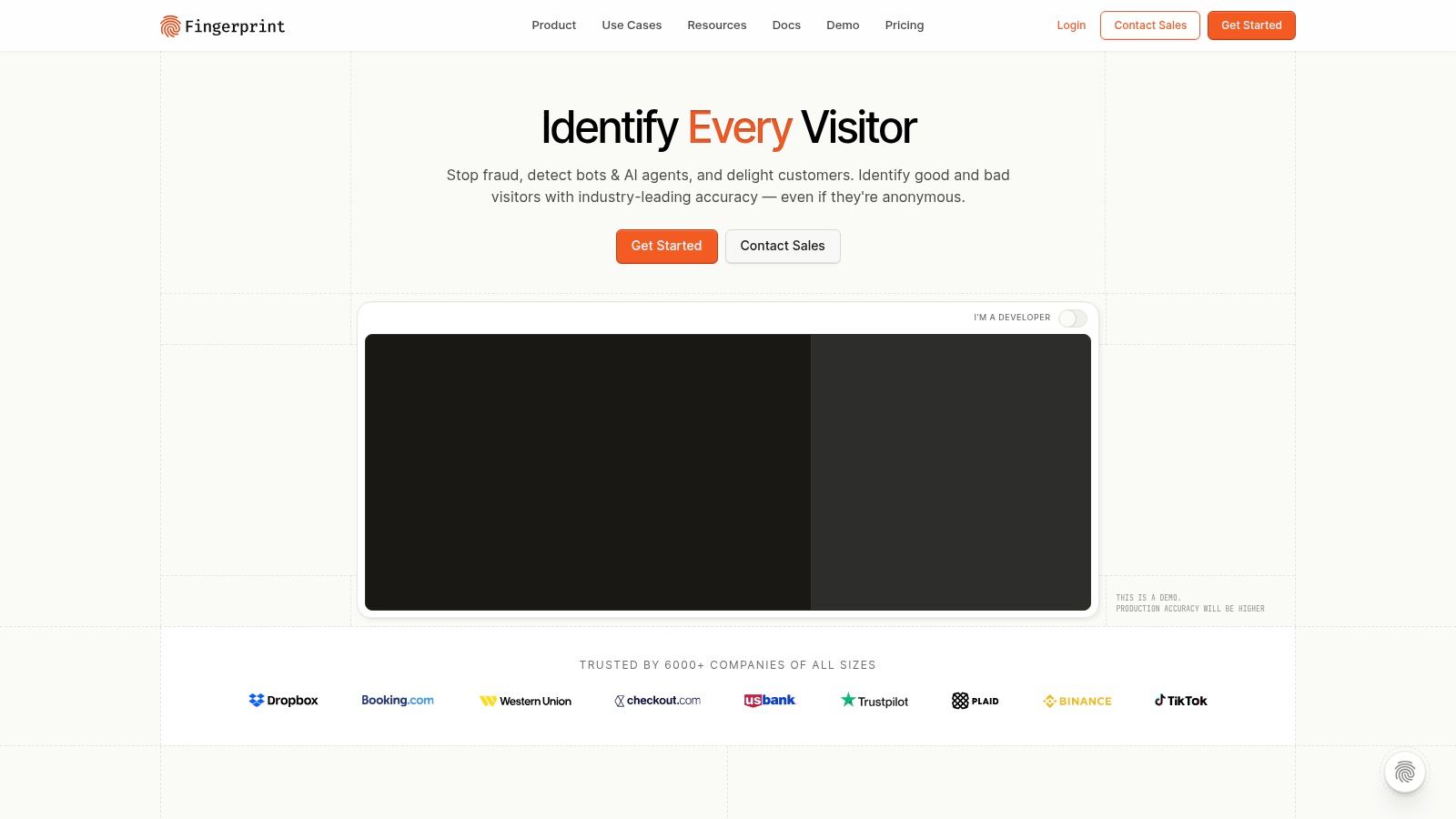
Fingerprint is best understood as a device-intelligence layer, not a full fraud program. That distinction saves buyers a lot of confusion. If you need persistent device memory across sessions, accounts, and attempts, Fingerprint can be extremely valuable. If you need final commerce decisions, chargeback workflows, or analyst case handling, you'll likely pair it with something else.
This is why Fingerprint often appears in mature stacks rather than replacing them. It helps teams answer a narrow but critical question: have we seen this device or visitor context before, even if the account, email, or payment details changed?
Why device memory matters
For signup abuse, coupon misuse, multi-accounting, login risk, and some checkout scenarios, device continuity often reveals what surface-level identifiers hide. A fresh account may not be fresh at all if the underlying environment links back to prior abuse attempts.
That is also why the market's emphasis on growth alone can mislead buyers. Forecasts describe the fraud detection and prevention market in the tens of billions in 2026 and project continued expansion through 2031, but that doesn't tell you whether a vendor can remember repeated low-value abuse across burners, devices, and payment artifacts, as discussed in this fraud prevention market forecast overview. Fingerprint's appeal is precisely that persistent linkage layer.
When to use it and when not to
Fingerprint is a strong addition when your team already has decisions and policies but needs better visitor identity as an input. It is not, by itself, the best fraud detection software for teams that want actioning, review operations, and payment-risk handling in one product.
Device intelligence is often the missing memory layer, not the complete decision layer.
A practical stack pattern is to use Fingerprint inline at signup, login, or checkout, then feed that identity signal into a rule engine or verdict API. If you want more background on that category, this explainer on device fingerprinting is worth reading. Fingerprint's platform details and integration options are on the Fingerprint website.
7. Forter
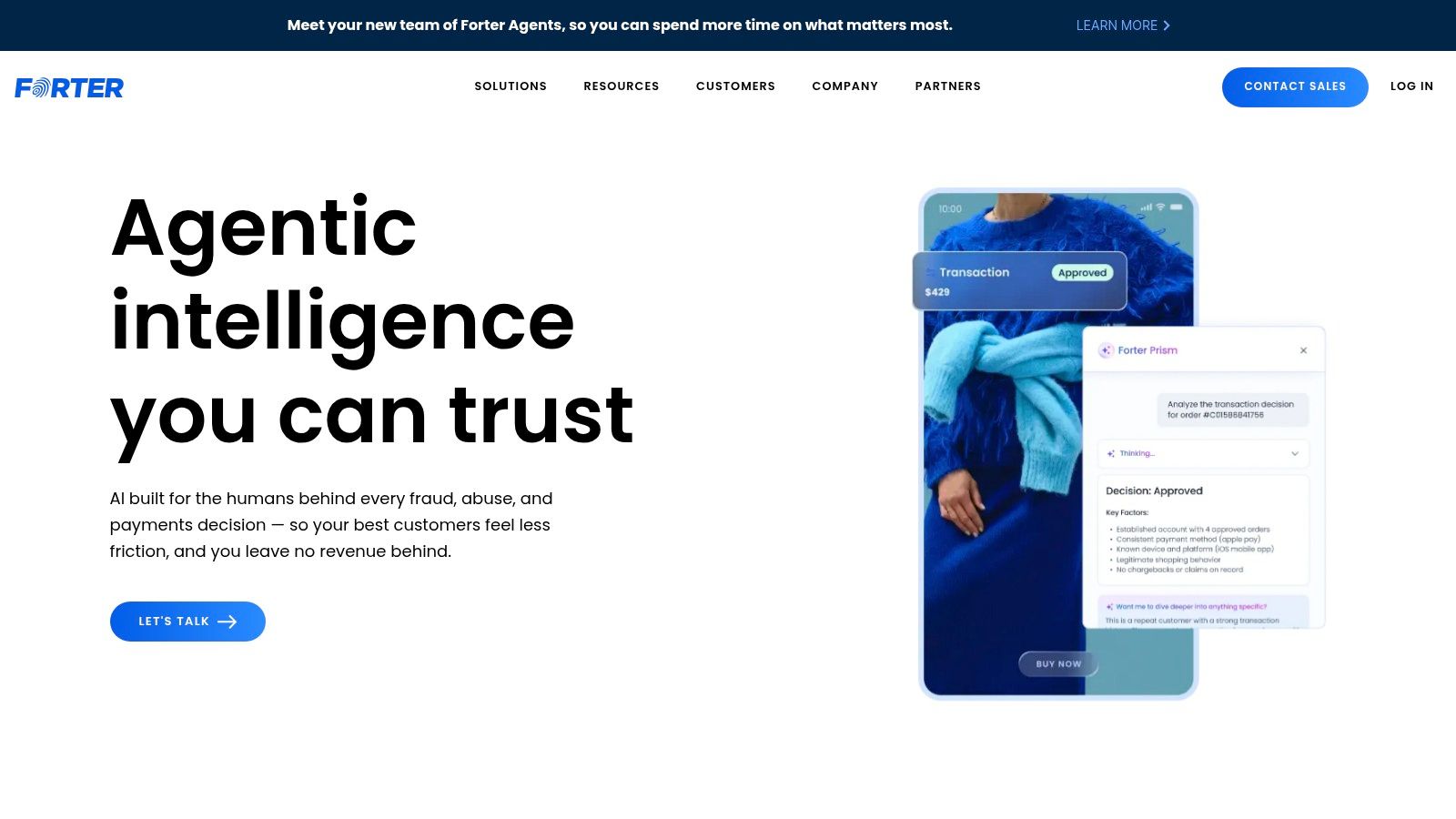
Forter is one of the clearest examples of a decision-as-a-service commerce platform. It centers on approve or decline decisions for payments, then extends into account protection, abuse prevention, dispute handling, and payment optimization. For larger merchants, that bundled model can reduce the need to operate fraud decisions manually.
Its value is easiest to understand at checkout and after purchase. If your business lives or dies by approval rates, false declines, disputes, and 3DS performance, Forter's orientation is closer to your P&L than a signup-only or signal-only product.
Commercial model matters here
Forter also differs because the pricing conversation isn't just about software access. It can involve covered and uncovered models, including chargeback-guarantee style arrangements for some merchants. That's a different budget decision from buying tooling and keeping all risk outcomes in-house.
That model appeals to larger commerce businesses because it changes who owns part of the performance expectation. But it also means you need sharp internal definitions of what you're outsourcing: decisioning, liability, workflow, or all three.
A buyer should pressure-test:
- Primary coverage: Checkout fraud, customer abuse, disputes, and payment optimization.
- Best-fit team: Larger merchants and commerce operations with meaningful dispute volume.
- Commercial complexity: Quote-led, contract-oriented, and often tied to scale.
- Non-cart relevance: Evaluate carefully if your fraud loss happens mostly in SaaS signup or trial events.
Where Forter sits in a shortlist
Forter is compelling when fraud review has become a business function, not just a control point. It is less naturally aligned to product-led SaaS flows where the biggest loss happens before billing.
For teams in online retail or marketplace environments, it belongs on a serious shortlist beside other commerce-focused tools. If your use case is more retail than subscription SaaS, this piece on fraud prevention in e-commerce adds useful context. Forter's own platform and product modules are described on the Forter website.
Top 7 Fraud Detection Software Comparison
| Product | Implementation complexity | Resource requirements | Expected outcomes | Ideal use cases | Key advantages |
|---|---|---|---|---|---|
| Portreeve | Low, single API/Node SDK or webhook | Small dev effort; usage‑based pricing; free tier (1k/mo) | Deterministic allow/review/block inline verdicts; p99 ≈ 90 ms; reduces upstream abuse | SaaS signups, trial farming, card testing, churn/prevention | Per‑tenant abuse graph, clear reason codes, built‑in review queue |
| Stripe Radar | Low if using Stripe; moderate otherwise | Integrates with Stripe billing; tiered plans/pay‑as‑you‑go | Network‑informed risk scoring across lifecycle; reduces transaction fraud & disputes | SaaS using Stripe for billing; full payment lifecycle protection | Large network signals, fast integration for Stripe customers |
| Sift | Moderate–High, enterprise enablement and tuning | Significant implementation and analyst resources; sales‑led pricing | Unified account+payment protection; analyst workflows; real‑time scoring (<150 ms) | Large enterprises needing end‑to‑end trust & safety | Mature console, automation, global intelligence network |
| SEON | Low–Moderate, API‑first, developer friendly | Dev integration; clear starter plan; optional managed services | Fast rule‑based checks, device & footprint enrichment, AML/KYC coverage | Signup/login monitoring, trial/bonus abuse, payment checks | 1,000+ signals, developer docs, managed risk services option |
| Arkose Labs | Moderate, requires tuning and often POC | Implementation + tuning; sales‑led pricing; may need PoC | Blocks bots/automated attacks with adaptive challenges; reduces downstream fraud | Signup/login protection, credential stuffing, card testing | AI‑resistant adaptive challenges; warranties for certain attack types |
| Fingerprint (FingerprintJS) | Low, web/native SDKs, quick rollout | Dev integration; metered API costs at scale | Persistent device identities to detect multi‑accounting and evasion | Augment risk engines at signup/login/checkout | High‑accuracy device IDs and tamper/proxy signals; strong device memory |
| Forter | Moderate–High, commerce integration and onboarding | Enterprise contracts; volume pricing; optional chargeback guarantees | Approve/decline decisions with dispute recovery and optional chargeback guarantees | E‑commerce merchants seeking payment guarantees and dispute automation | Decision‑as‑a‑service, chargeback‑guarantee options, payment optimization |
How to Choose Without Buying the Wrong Layer
The safest way to choose fraud software is to map your loss points before you compare vendors. Write down every place an abusive user can create cost or risk: signup, trial start, trial conversion, login, checkout, and post-purchase. Then match each decision point to the product's actual coverage, not the vendor's broadest marketing language.
That exercise usually reveals that teams aren't buying one thing. They're choosing between layers. Some need a complete decision engine that can return allow, review, or block inline. Some need device intelligence to improve an existing policy stack. Others need bot mitigation, payment fraud controls, dispute workflows, or a guarantee-backed commerce model.
The practical shortlist should also include non-feature requirements. Document your latency budget, review needs, identity-linkage requirements, privacy constraints, failure-mode expectations, integration path, and pricing tolerance. A low-latency inline gate has different engineering requirements from a case-management-heavy enterprise platform, and both differ from a signal vendor that expects you to supply your own actions.
Before rollout, test representative abuse paths and legitimate edge cases. Don't just run obvious fraud examples. Include messy but real scenarios like shared devices, returning customers with changed emails, legitimate travelers, support-assisted retries, and borderline trial conversions. You want to know not only what gets blocked, but what gets sent to review and why.
Measure outcomes that matter operationally: blocked abuse, review volume, false positives, downstream losses, and analyst effort. The best fraud detection software is rarely the one with the broadest slide deck. It's the one that reduces real workload without pushing too much ambiguity onto your team.
For most buyers, the fit summary is straightforward. Portreeve suits deterministic inline gates for SaaS and commerce events. Stripe Radar fits teams already centered on Stripe for billing and payments. Sift makes sense for enterprise trust operations spanning accounts and transactions. SEON is a good option for API-first fraud plus AML-adjacent needs. Arkose Labs is the specialist for automated attacks and hostile signup or login traffic. Fingerprint is the device-intelligence layer when identity continuity is the missing ingredient. Forter is the commerce-focused decision and dispute model for larger merchants that want deeper payment-stage coverage.
If you make one change to your evaluation process, make it this one: stop asking which tool is best in general, and start asking which layer best protects the first moment abuse becomes expensive.
If your team needs to stop abuse before an account, trial, login, or checkout goes through, Portreeve offers an inline screening layer built for that exact decision point. It returns allow, review, or block verdicts with reason codes and linked identity history, so teams can act before cleanup starts. See how it works on Portreeve.