
You're probably dealing with one of two situations right now. Either chargebacks have started creeping up after what looked like a strong sales month, or approval rates are falling because your team tightened rules and accidentally blocked good customers.
That's the trap with most fraud prevention e-commerce setups. They're built like a checkout plugin, but the abuse doesn't start and end at checkout. It starts at signup, shows up again at login, mutates during trial or first purchase, and often becomes most expensive after the payment clears when refunds, disputes, and policy abuse hit ops and margin.
The teams that get this under control stop thinking in terms of a single fraud score at the payment page. They treat fraud as an inline lifecycle decision problem. Every control should answer two questions: where in the lifecycle does it fire, and which KPI does it move? If you can't answer both, you're probably adding noise, review work, or friction without reducing losses.
Table of Contents
- The Checkout That Quietly Cost Six Figures
- Threats Facing Online Stores Right Now
- Building an Inline Fraud Gate Across the Lifecycle
- Device and Payment Fingerprinting That Actually Works
- Designing a Review Workflow Teams Will Actually Use
- Fraud KPIs, Baselines, and Shadow-Mode Testing
- A 90-Day Rollout Plan and the Controls Worth Shipping First
The Checkout That Quietly Cost Six Figures
A familiar pattern looks like this. A mid-market DTC brand launches a promotion, traffic surges, conversion looks healthy, and the team congratulates itself for not letting fraud rules choke revenue during the campaign.
Then the disputes arrive.
The first mistake usually isn't approving one bad order. It's assuming the promo volume explains everything. Fraud rings like traffic spikes because they camouflage velocity. Card testers and stolen-card buyers know exactly when merchants are distracted, support queues are full, and risk teams are under pressure to approve.
What actually gets missed
In practice, the warning signs are usually mundane:
- Address inconsistency: billing and shipping details don't line up in a way that fits the customer story.
- Card clustering: multiple cards map back to the same device or tightly linked identity trail.
- Weak issuer responses: partial AVS matches, failed CVV checks, or authentication results that don't support a clean approval.
- Promo timing: abuse appears right when marketing volume makes manual review harder.
A lot of teams still review suspicious orders as isolated events. That's the wrong frame. Fraud operators rarely behave like one order. They behave like a cluster.
Practical rule: If your analyst has to open five tabs to understand whether five orders are one actor, your review process is already too late.
The practical response isn't “add more rules.” It's to put an inline gate in front of the action that matters, attach a fingerprinting layer that can link repeated behavior, and route uncertain cases into a review workflow with reason codes that make sense to humans.
The playbook most teams wish they had earlier
The reason this matters isn't just the direct payment loss. Merchant reporting shows that merchants worldwide estimate roughly 3% of total e-commerce revenue is lost to payment fraud annually, and about 3% of accepted e-commerce orders later prove fraudulent. The same reporting says 64% of merchants saw first-party misuse increase, with one-quarter reporting increases of 25% or more. It also found merchants faced an average of 3.7 different fraud attack types in 2025, down from 4.2 the year before, which points to a multi-vector problem rather than a single checkout issue, according to the MRC 2026 global e-commerce payments fraud report.
If you want a concrete picture of how card testing hides inside normal order flow, this card testing attack example is the right mental model.
What reduces damage is boring and operational. Gate the event before payment capture. Preserve device and payment linkage across attempts. Give analysts a reproducible verdict trail. Measure the result against chargeback rate, approval rate, manual review rate, and false positives.
That's the frame for fraud prevention e-commerce. It's a lifecycle problem, not a checkout setting.
Threats Facing Online Stores Right Now
The threat mix has widened. Fraud isn't one stolen card problem anymore. It's a blend of payment abuse, account abuse, policy abuse, and automation.
Some of the fastest-growing pressure comes from bot-driven card testing. Signifyd reported that card-testing attacks increased 65% from Q2 2024 to Q2 2025, then rose 175% year over year in early 2026, which is a good reminder that attackers adjust faster than static rules do, according to Signifyd's e-commerce fraud and returns trends.
What's hitting merchants now
The common categories look different operationally:
- Account takeover: compromised credentials, then login from an unusual device or behavior pattern, often followed by address changes or use of stored payment methods.
- Card testing: low-intent checkout attempts designed to validate stolen cards before larger purchases.
- Refund and returns abuse: legitimate orders that become loss-making after delivery through “goods not received” claims, empty-box returns, or policy gaming.
- Promo abuse: serial use of discounts, referral credits, free gifts, or first-order incentives through account cycling.
- Synthetic or low-trust signup activity: accounts created for future abuse, trial farming, resale, or warm-up behavior before checkout.
- Triangulation-style abuse: a buyer appears legitimate, but the merchant processes a card that was stolen elsewhere and only learns that later through disputes.
The undercovered area is still post-purchase abuse. The MRC's 2025 reporting separates post-purchase fraud and abuse from payment fraud, and independent coverage cited there reports that returns fraud remains the most prevalent e-commerce fraud risk while over 57% of merchants saw rising abuse patterns such as false “goods not received” claims. The same reference notes that U.S. merchants in LexisNexis' 2025 study reported an average cost of $4.61 for every $1 of fraud, which is why refund and dispute operations deserve just as much design attention as checkout controls, as summarized in the 2025 MRC global payments and fraud report.
Top E-Commerce Fraud Threats and Lifecycle Stage
| Threat | Lifecycle Stage | Primary Signal | Loss Vector |
|---|---|---|---|
| Account takeover | Login | unfamiliar device, changed behavior, stored payment use | unauthorized purchases, loyalty theft, support cost |
| Card testing | Checkout | rapid retries, linked cards, low-intent baskets | chargebacks, gateway noise, issuer trust damage |
| Promo abuse | Signup and trial | repeated identities, reused devices, burner patterns | discount leakage, acquisition distortion |
| Refund abuse | Refund and post-purchase | repeated claims, policy edge cases, linked histories | margin leakage, labor cost |
| Synthetic signup | Signup | thin identity, repeat device links, low-trust patterns | downstream abuse, trial farming |
| Triangulation-style fraud | Checkout and fulfillment | mismatch between buyer story and order context | post-delivery disputes, inventory loss |
The useful question isn't “what fraud tool do we need?” It's “which stage can still stop this before money, inventory, or support time is committed?”
That's why lifecycle design matters. Signup controls stop account farming. Login controls stop takeover. Checkout controls reduce direct fraud loss. Refund controls catch the abuse that older fraud programs often ignore.
Building an Inline Fraud Gate Across the Lifecycle
An inline gate is just a service that evaluates an event before the action commits and returns a deterministic verdict: allow, review, or decline. The important part isn't the label. It's where you place it and how consistently you can reproduce its decision.
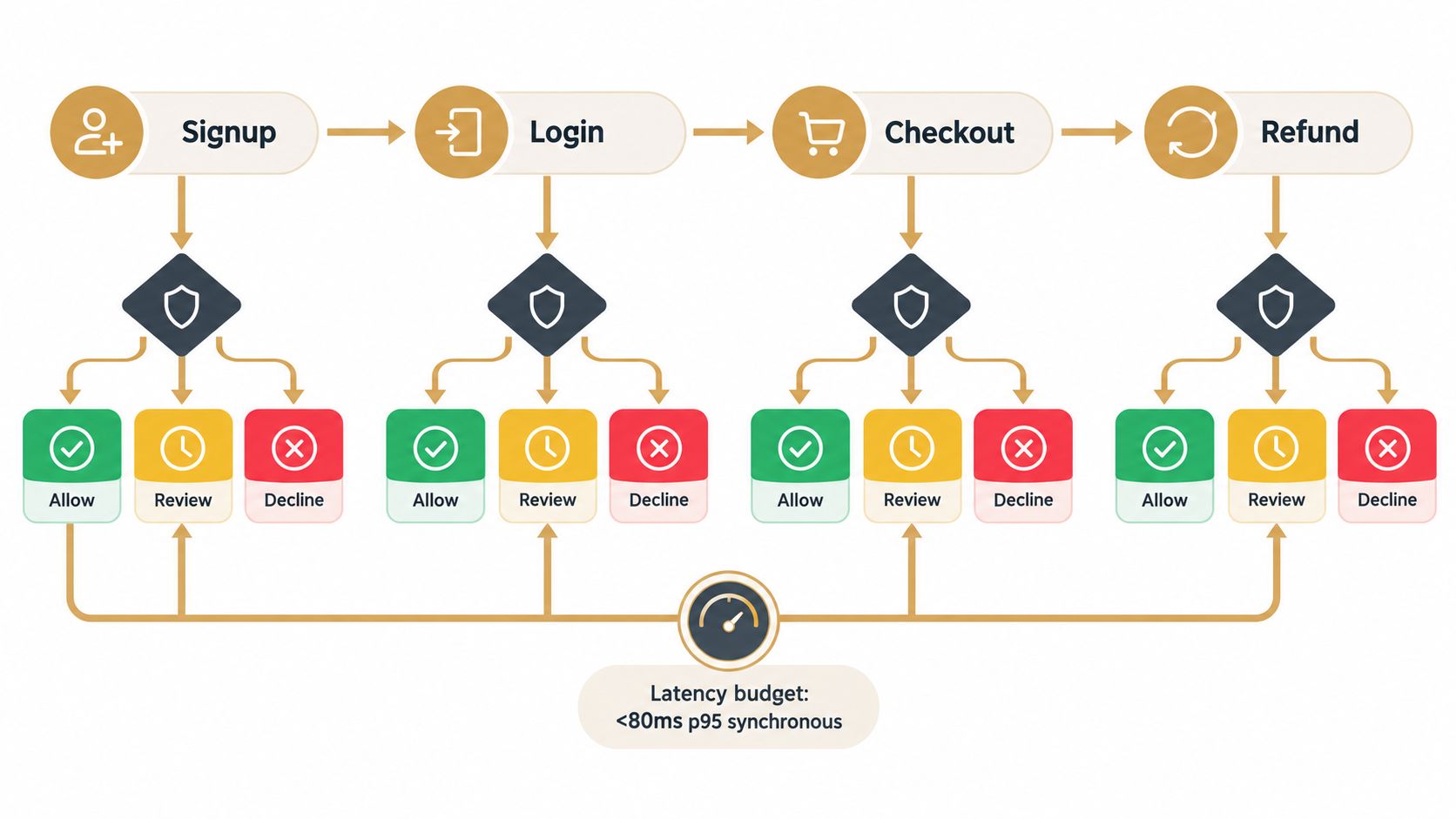
The verdict object
Keep the object small and auditable. A good one usually contains:
- Verdict: allow, review, or decline
- Reason codes: short machine-readable explanations like
new_device,payment_velocity,avs_partial,linked_refund_abuse - Linked identities: the keys that explain why this event resembles prior activity
- Rule or model version: so you can replay decisions later
Black-box scoring sounds impressive until a chargeback spike hits and nobody can explain why yesterday's identical order was approved. Deterministic outputs with reason codes make better ops systems.
Where to place the gate
Put the gate anywhere an irreversible action happens or where cleanup is expensive.
- Signup Evaluate before account creation commits. If risk is high, block or require a stronger step.
- Login Don't just authenticate. Re-evaluate the session. Stored payment methods and account balance make logins valuable targets.
- Checkout Run before authorization or capture. If risk is uncertain, hold for review rather than pushing everything to the processor.
- Refund Screen before money leaves. A large share of abuse is operational, not payment-originated.
A lot of SaaS and commerce teams use an internal verdict service or a vendor that works the same way. For example, Portreeve exposes a verdict API for events like signup, login, trial start, and checkout attempt, returning allow, review, or block with reason codes and per-tenant history. That architecture is useful because it keeps the decision inline rather than turning fraud review into cleanup after the fact.
Latency and failure behavior
You don't have much time. Keep the synchronous path lean and parallelize enrichment where you can. A practical latency target is to stay under the kind of response window users won't feel, then degrade predictably if a provider times out.
What matters most is failure policy. If your risk provider goes dark, you need a known behavior. Teams either fail open and add post-event review, or fail closed for only a narrow class of transactions where loss tolerance is low. Pick one intentionally.
If your engineering team can't replay the same event payload and reproduce the same verdict, the gate isn't ready for shadow mode.
Identity keys that survive the lifecycle
The gate is only as good as the keys it can join over time. Useful examples include:
- Account ID
- Device fingerprint hash
- Card or payment fingerprint
- Email reputation or email age indicator
- Phone number
- Velocity counters on linked payment and network ranges
The point isn't to hoard every signal. The point is to persist the ones that let you recognize repeated abuse when the attacker swaps one surface detail.
Device and Payment Fingerprinting That Actually Works
Most fingerprinting programs fail for one of two reasons. They collect too little and end up relying on IP reputation, or they collect everything and can't explain which signals improved decisions.
Good fingerprinting is a join strategy. You're trying to decide whether this event belongs to a known trustworthy customer, a known bad actor, or an ambiguous cluster that needs review.
What to collect
On the device side, collect stable but privacy-conscious attributes that help distinguish repeated use without pretending any one field is permanent. Depending on platform, that usually includes browser and app characteristics, install identifiers, and interaction signals.
On the payment side, collect the features that tell a transaction story: issuer geography, AVS result, 3DS outcome, token reuse, wallet or card fingerprint, and basic consistency between payer details and order details.
For a deeper walkthrough of how teams implement this in practice, this guide on device fingerprinting is a useful reference.
Fingerprint signals collect correlate ignore
| Signal | What to capture | How to use it | Caveat |
|---|---|---|---|
| Device fingerprint hash | stable browser or app-level identifier | link repeated attempts across accounts and sessions | can reset, so don't treat it as permanent identity |
| Payment fingerprint | tokenized card or wallet-level identifier | catch card reuse, test patterns, and linked orders | processor coverage varies |
| AVS and 3DS result | issuer response and auth outcome | combine with other signals before actioning | weak alone without order context |
| Email signal | age or trust tier indicator | useful for signup, first order, promo abuse | avoid over-blocking new but legitimate buyers |
| Shipping address | normalized address history | link repeat destinations and return abuse | households can share addresses legitimately |
| Phone number | verified or previously seen number | support identity linkage and escalation | recycled numbers exist |
| Raw IP | coarse network context only | use as one minor input, mainly for velocity context | weak as a core identity key |
| Broad geolocation radius | general region mismatch | only useful when paired with stronger identity evidence | travel, VPNs, and mobile networks create noise |
What to ignore or down-rank
The biggest mistake is treating raw IP as identity. It isn't. Shared networks, mobile carrier routing, VPNs, and basic attacker hygiene make standalone IP rules noisy fast.
The second mistake is geolocation theater. “Too far from billing address” sounds sensible until you block travelers, gift purchases, military addresses, or people on corporate networks. Geography can help. Geography shouldn't lead.
What does hold up is correlation. A new device plus new payment plus large first order is stronger than any one of those signals on its own. A single device linked to many cards over a short period is a much better card-testing indicator than an IP flag.
You also need to stay inside your legal and policy boundaries. Fraud teams should coordinate with counsel on GDPR and CCPA implications, retention periods, vendor contracts, and how fingerprint signals are stored and scoped.
Designing a Review Workflow Teams Will Actually Use
Most manual review queues are built like evidence dumps. Analysts get a pile of orders, too much raw data, and almost no structure. That design creates inconsistency, slow decisions, and predictable reviewer fatigue.
The queue should act like a product. An analyst should open a case and know, within seconds, why the order is there and what action is available.
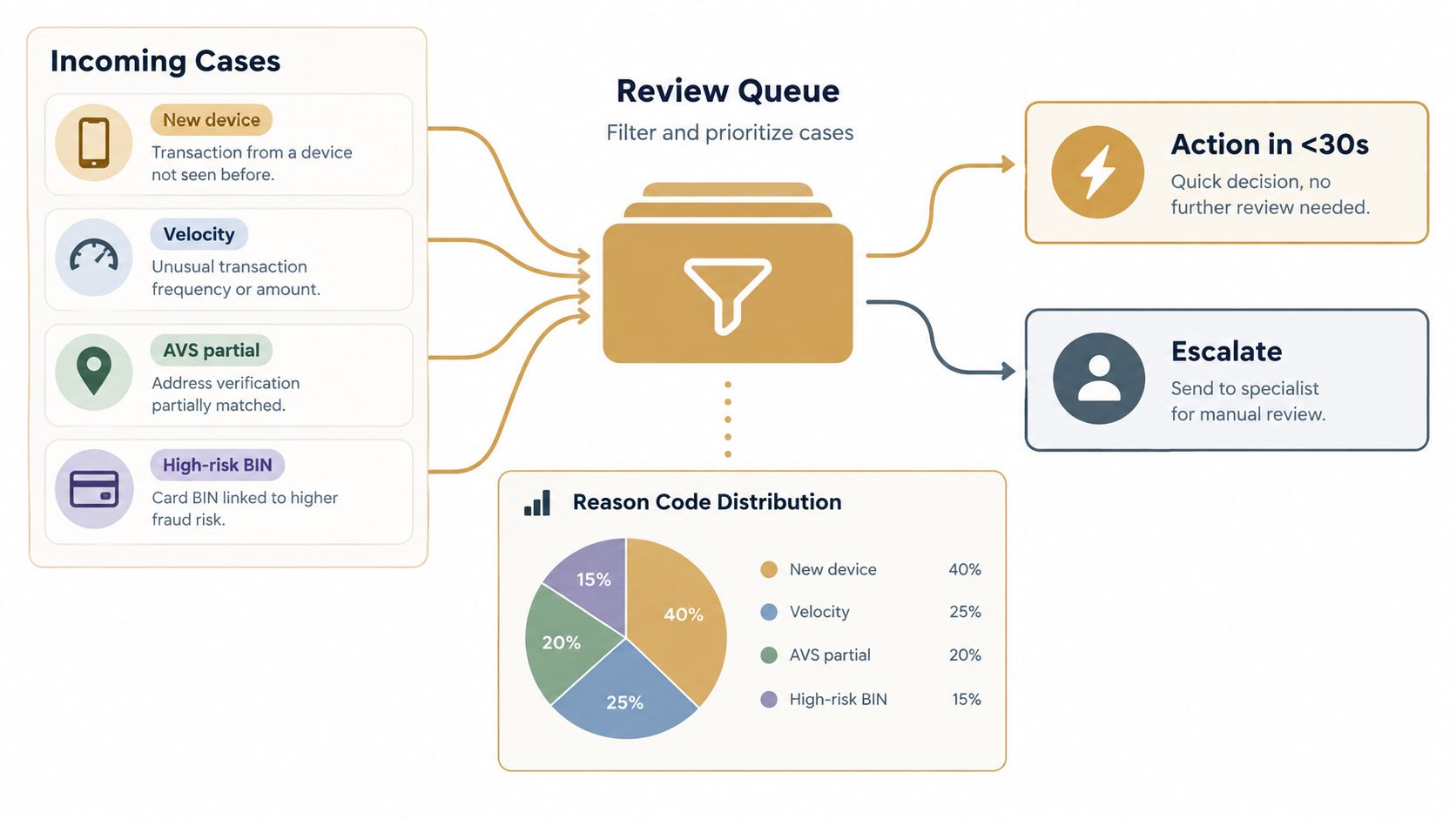
Reason codes first
Every reviewed case needs a small set of reason codes that map to concrete evidence. Good codes sound like this:
- New device on established account
- Payment velocity on linked fingerprint
- AVS partial on high-risk order
- High-risk refund pattern
- Multiple accounts tied to one device
- Fulfillment address linked to prior disputes
These codes should be generated automatically wherever possible. Human reviewers can add nuance, but they shouldn't invent the taxonomy during triage.
A practical pattern is to connect your screening decisions and downstream account actions through a single audit trail. Teams that need to revoke access or automate follow-up after a confirmed abuse finding often end up building event-driven workflows like the one described in this fraud review webhook revoke account guide.
SLA and ownership matter more than most tools
A review queue without SLAs turns into a comfort blanket. You feel like you're controlling risk because cases exist, but the business action has already happened or the customer has already churned.
Set ownership explicitly:
- Risk owns decision policy and queue quality
- CX owns customer contact and edge-case recovery
- Finance owns refund approvals, dispute tracking, and reserve-sensitive escalation
- Engineering owns instrumentation, payload quality, and decision logging
Then split the queue by urgency. A high-risk order waiting too long often becomes an auto-cancel, not because the order is certainly bad, but because operational delay creates fulfillment and support risk.
Build for fast action
The best case view is a single screen with:
- order details
- customer history
- device linkage
- payment evidence
- shipping and refund history
- decision buttons
- analyst notes
- visible reason codes
Good analysts don't need more tabs. They need fewer decisions per case.
Small UI details matter more than fraud vendors admit. Saved filters cut queue thrash. Keyboard shortcuts speed repetitive action. A one-click “refund and block linked identities” path saves real analyst time when abuse is obvious. If you want consistency, optimize for the actual motion of review, not the abstract completeness of the data.
Fraud KPIs, Baselines, and Shadow-Mode Testing
If you can't measure trade-offs, you'll end up arguing in circles with growth, CX, and finance. Fraud controls always move more than one metric at once. A rule that lowers chargebacks can also reduce approval rate. A softer rule can preserve conversion while driving up review cost.
That's why baseline discipline matters more than enthusiasm.
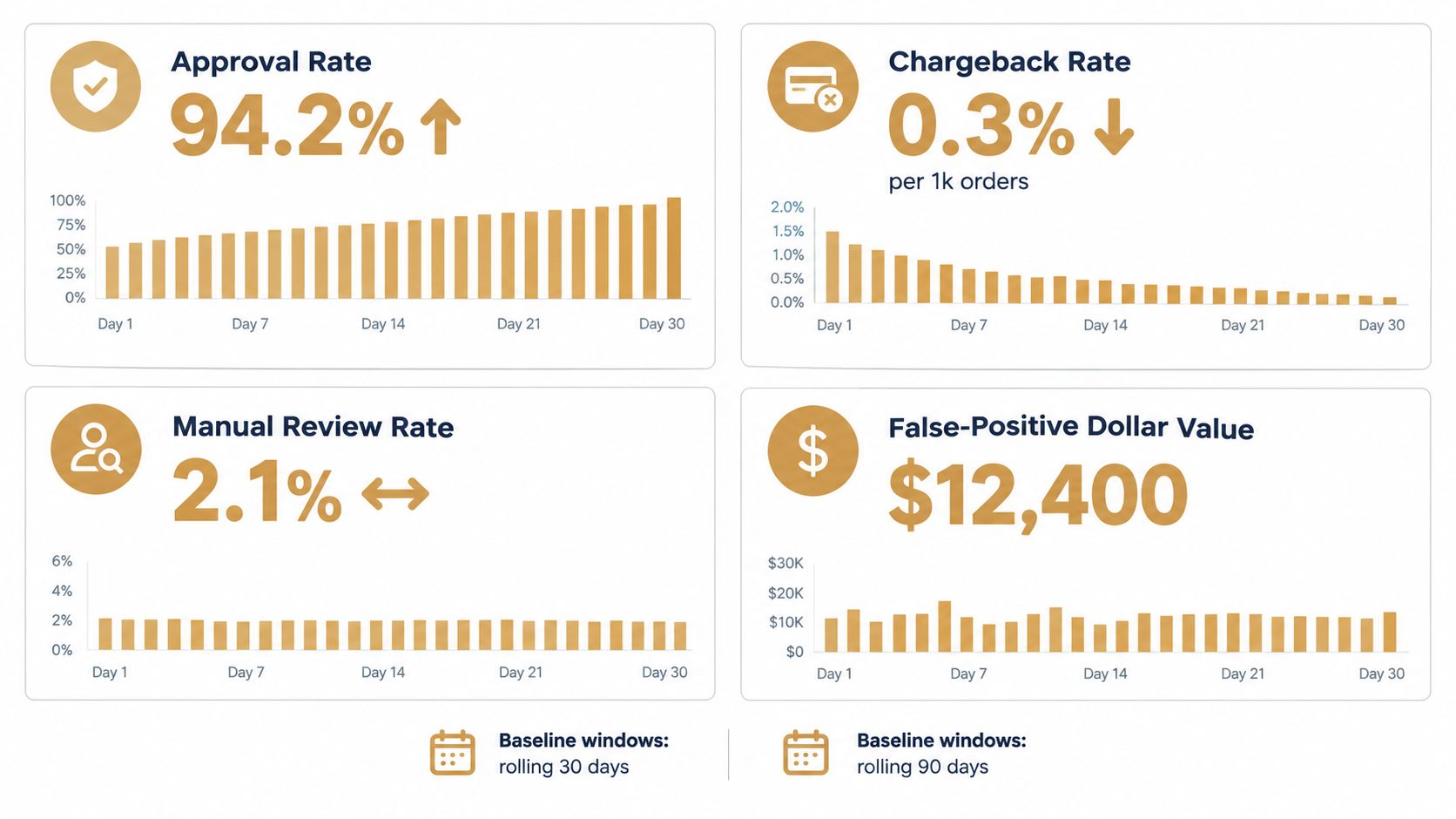
The KPI stack that matters
The most useful operating KPIs are:
- Approval rate
- Chargeback rate
- Manual review rate
- False-positive value
You can add supporting metrics later, but these four keep teams honest. They tell you whether you are approving business, stopping bad orders, overloading analysts, or rejecting good customers.
Industry guidance recommends establishing baseline metrics first, then testing one control at a time for 60 to 90 days, using true-fraud chargeback rate and false-positive rate as primary KPIs. The same guidance recommends comparing approval-rate uplift, projected chargeback rate, manual-review rate, and decision latency in a shadow-mode or parallel run before rollout. It also notes that merchants often screen about one out of five online orders manually, and among those reviewed, roughly one out of seven are ultimately declined, which is exactly why sloppy review design becomes expensive fast, according to the Chargeback Gurus Fraud 101 guide.
How shadow mode should work
Shadow mode means scoring real traffic without taking action. You log the verdict, reason codes, and linked identities, but the customer experience stays unchanged.
Then you compare:
- predicted declines versus later confirmed fraud
- predicted reviews versus analyst outcomes
- segments by country, payment method, product line, and customer tenure
- latency and timeout behavior under real load
Aggregate results lie. One channel can be noisy enough to make a weak rule look strong. Segmentation catches that.
Promotion and rollback discipline
Don't promote a rule because it “feels right.” Promote it when it improves the KPI stack without creating unacceptable friction elsewhere. Roll it back when it degrades good approvals or floods review with low-yield cases.
When chargebacks spike, the retrospective should ask plain questions:
- Did attack shape change?
- Did one identity key stop linking as expected?
- Did a gateway, processor, or auth behavior change?
- Did a promo, product launch, or country expansion alter traffic mix?
- Did the team ship multiple controls at once and lose attribution?
That last one is common. Teams make three changes, see one outcome, and learn nothing.
A 90-Day Rollout Plan and the Controls Worth Shipping First
Already have fragments of a fraud stack. A few gateway filters. Some issuer responses. A spreadsheet for disputes. Maybe a review inbox nobody likes. The quickest way to improve isn't to replace everything. It's to ship controls in the order that gives you cleaner attribution and faster risk reduction.
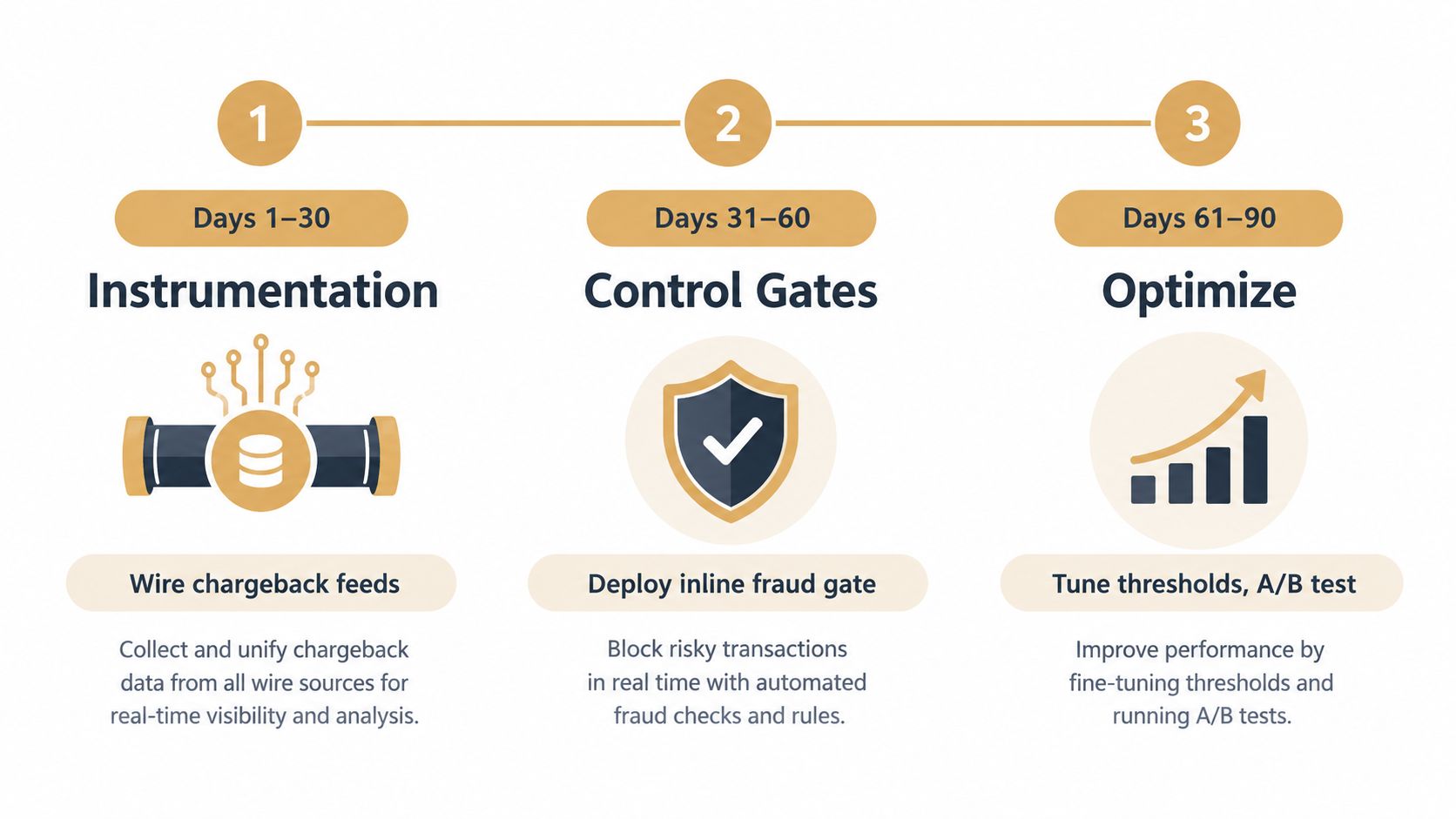
Days 1 to 30
Start with instrumentation. If chargebacks, refunds, declines, and review outcomes don't land in one reporting layer, every later decision gets political.
Ship these first:
- Reason code tagging: every decline and review should carry a machine-readable reason.
- Chargeback mapping: connect dispute reason categories back to the original order and identity cluster.
- Baseline dashboards: track approval, chargebacks, manual review, and false positives by payment method, country, and customer type.
- Refund logging: include who approved it, why, and whether the account had prior abuse markers.
A lot of teams get impatient. Don't skip it. Controls without baselines create folklore, not evidence.
Days 31 to 60
Now ship the highest inline controls. These tend to catch obvious abuse without requiring fancy modeling.
Focus on:
- Velocity controls at signup and checkout
- BIN-country mismatch checks used as a review input, not a blunt decline rule
- AVS and CVV enforcement where your payment mix supports it
- Guest checkout device linkage
- Email-age or low-trust email gating for first order and promo-heavy flows
- Refund approval thresholds with named owners instead of ad hoc support decisions
- Card testing rate limits before the payment processor sees a burst
These controls are not glamorous. They work because they remove cheap attacker moves.
Days 61 to 90
Only after the basics are stable should you add more nuanced linkage and step-up behavior.
At this point, tighten the system with:
- device and payment correlation across events
- 3DS step-up for selected high-risk segments
- review queue SLA tuning
- weekly false-positive sampling
- appeal paths for blocked but legitimate customers
- cluster marking for linked abuse identities
- fulfillment holds for risky but not clearly fraudulent orders
The rollout sequence matters because fraud prevention e-commerce is a balancing act. If you add fingerprinting, review changes, and refund policy changes all at once, you won't know which control moved the numbers.
Ship the controls that remove attacker efficiency first. Ship the controls that add analyst complexity later.
A practical first-wave checklist looks like this:
- Track dispute reasons back to the original event
- Gate signup, login, checkout, and refund separately
- Persist device, payment, email, and address linkage
- Rate-limit card testing and signup bursts
- Step up or review new-device activity on valuable accounts
- Require reason codes in every review decision
- Sample false positives every week
- Document refund approval authority
- Create a one-screen analyst workflow
- Shadow-test every major new rule before full rollout
That order won't solve every fraud pattern. It will make your system legible, which is what lets you keep improving it.
Portreeve offers an inline screening layer for signups, trials, logins, and checkout attempts, with deterministic allow, review, or block decisions, reason codes, and linked identity history. If you're trying to turn fraud prevention from after-the-fact cleanup into a reproducible lifecycle gate, visit Portreeve and look at how the verdict workflow fits into your existing stack.