
Fraud prevention doesn't start with a chargeback, a compromised account, or a support ticket from a customer who can no longer access a product. By then, the most useful decision window may already be gone. SaaS teams need to screen events before signup, trial activation, checkout, or login commits, then connect what happens across identities and time.
The strongest fraud detection case study examples therefore reveal more than a model's accuracy. They show which signals are collected, when the system intervenes, how uncertain events reach reviewers, what mitigation follows, and which trade-offs a SaaS team can replicate. The comparison below treats each approach as an operating pattern, not as a generic vendor success story.
Portreeve is a relevant reference point because it applies an allow, review, or block model to online product events. Its design combines reason codes, linked identity history, and a per-tenant abuse graph, giving teams a way to make an inline decision while preserving evidence for later review.
Table of Contents
- 1. Stripe's Real-Time Payment Fraud Detection System
- 2. AWS Fraud Detector's Multi-Signal Behavioral Analysis
- 3. Twilio Authy's Account Takeover Prevention via Multi-Factor Authentication Velocity
- 4. Databricks' Real-Time Fraud Ring Detection Using Graph Analytics
- 5. Airbnb's Trust Score System for Host and Guest Risk Assessment
- 6. Sift's Machine Learning for Abuse Pattern Recognition Across Verticals
- 7. Mastercard's Decision Intelligence for Real-Time Transaction Approval
- 7-Point Fraud Detection Case Study Comparison
- Build the Fraud Workflow, Not Just the Model
1. Stripe's Real-Time Payment Fraud Detection System
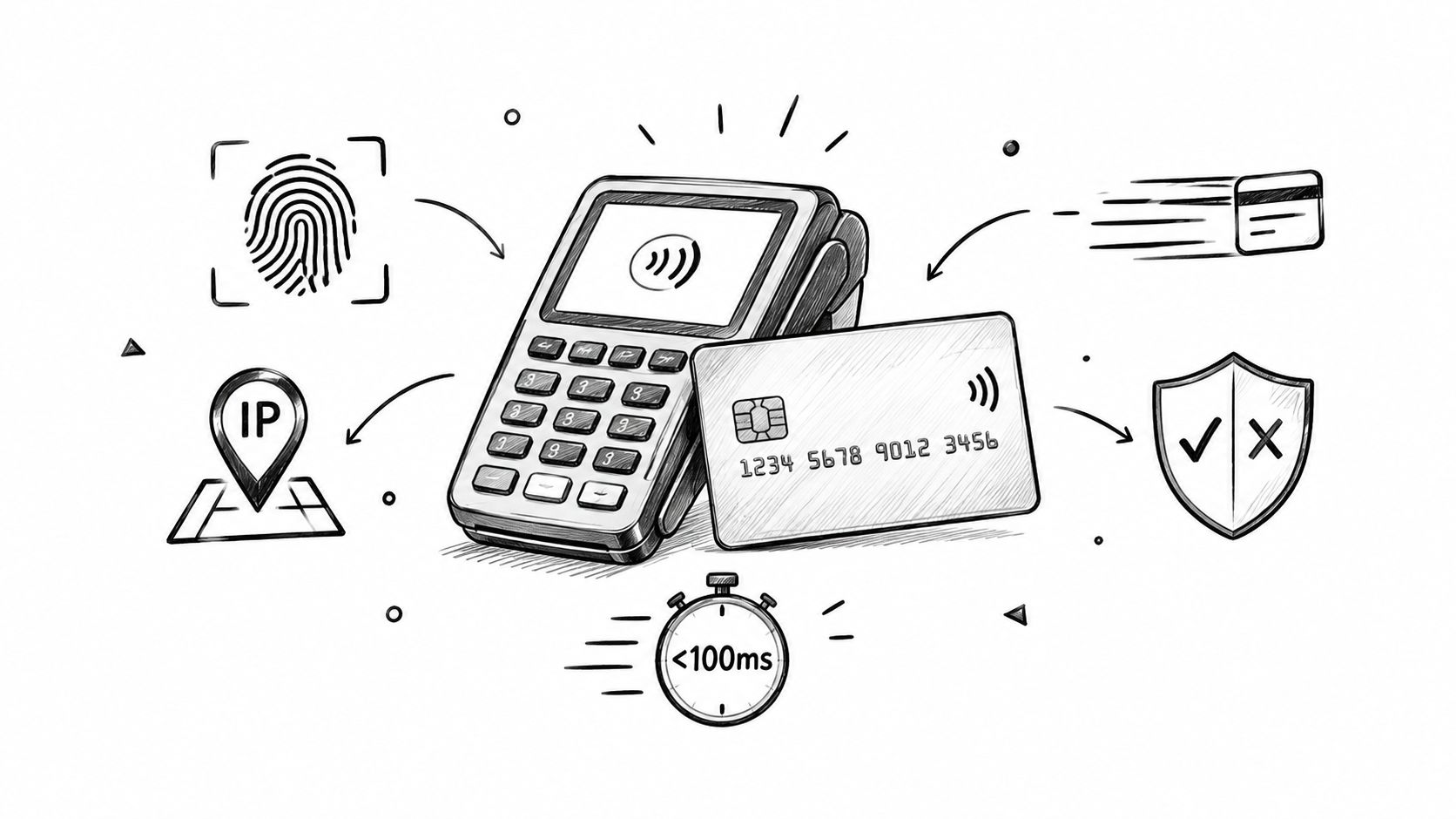
A payment can look legitimate and still reveal coordinated abuse. A Stripe-oriented fraud detection case study examines the checkout event as a decision point, connecting the current attempt to payment history, device context, account behavior, and the velocity of related attempts.
For SaaS teams, card validity is only one signal. A valid card may appear across repeated trial attempts, rapid checkout retries, or coordinated activity involving several accounts. Device identifiers, card fingerprints, IP context, account age, and signup velocity become more useful when connected across identities and time instead of reviewed in separate dashboards.
The scale of reported fraud supports that broader view. The FTC's 2024 Consumer Sentinel data recorded approximately 2.6 million fraud reports, with 38% indicating that the victim lost money, compared with 27% in 2023. Reported losses exceeded $12.5 billion. The FTC's 2024 fraud data also identified bank transfers, payments, cryptocurrency, and credit cards as important parts of the loss picture. The operational lesson is to connect payment artifacts with persistent identity signals before approval.
The SaaS operating lesson
This approach protects the checkout event, links payment and device identities, and intervenes before completion. It also creates a review path for events that fall between approval and rejection:
- Signup velocity: Compare checkout attempts with accounts created from related devices or payment artifacts.
- Card reuse: Treat repeated use of one card fingerprint across new trial accounts as a linkage signal, not automatic proof of abuse.
- Review routing: Send borderline attempts to a queue, allowing analysts to examine related activity before applying a restriction.
- Decision feedback: Use webhook events and adjudication outcomes to refine thresholds and preserve the event history.
The trade-off is measurable. Aggressive payment rules can stop card testing while interrupting legitimate customers. Teams should track prevented abuse alongside false positives, review volume, conversion impact, and appeal outcomes. Portreeve's payment fraud analytics guidance applies the same connected-history principle, treating checkout as part of an abuse sequence rather than an isolated transaction.
2. AWS Fraud Detector's Multi-Signal Behavioral Analysis
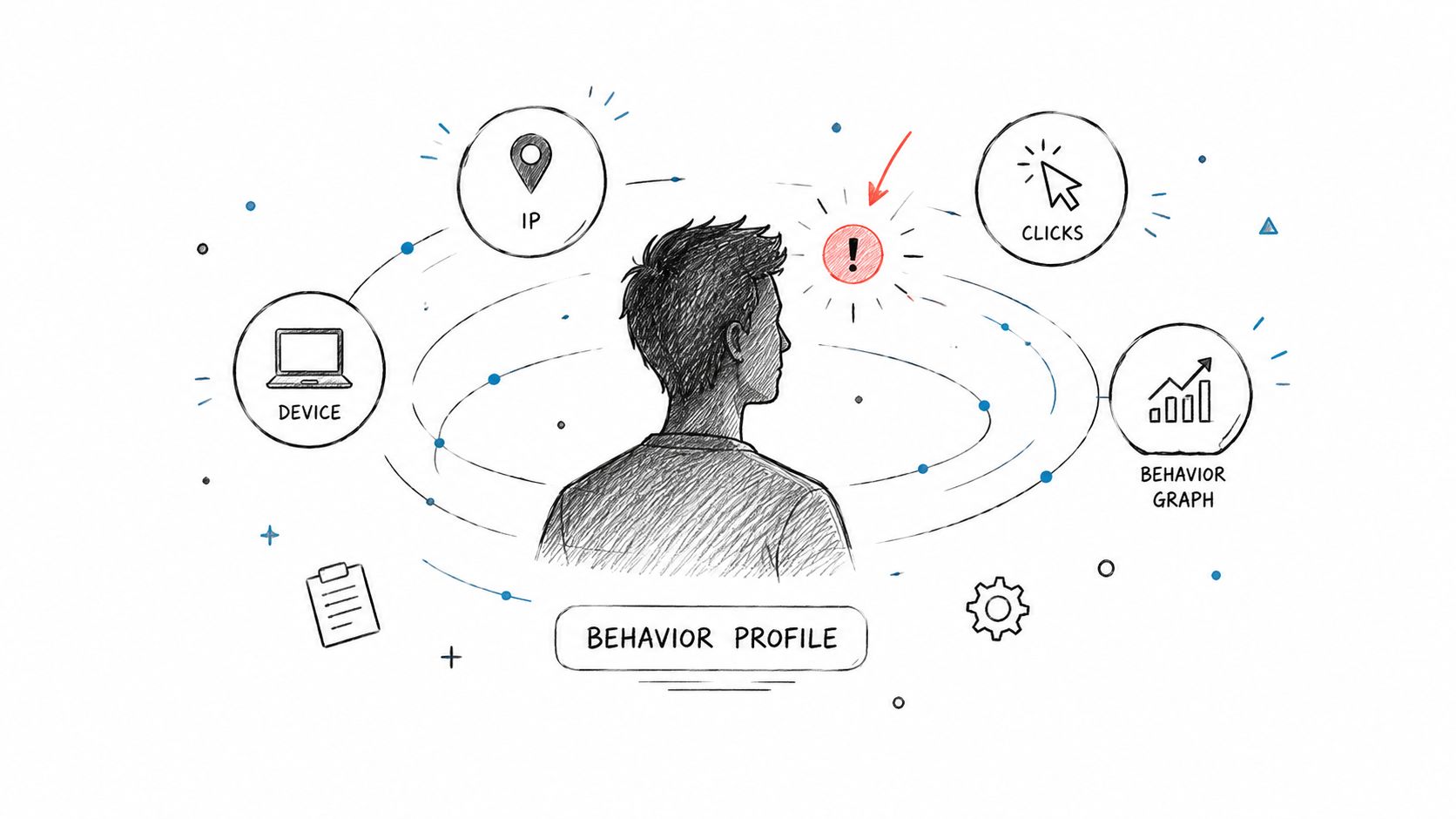
Transaction value rarely explains the entire risk of an event. Behavioral analysis adds context by asking whether the current action resembles the user's previous behavior, whether several identities behave alike, and whether the sequence around an event indicates automation or account cycling.
This pattern applies across signup, login, and checkout. A SaaS team might compare the timing between account creation and trial activation, the sequence of form interactions, device reuse, email changes, or repeated activity across customer accounts. The system doesn't need to treat every anomaly as fraud. It can use the deviation to select a more appropriate next step, such as verification, review, or a temporary restriction.
Historical labeling is central to this approach. Teams need to distinguish confirmed abuse, legitimate activity, unresolved cases, and customer friction. Without that separation, a model can learn that unusual behavior is bad, which risks blocking new users, international customers, or legitimate power users.
Build profiles without losing operational control
Entity identifiers give behavioral systems their memory. Customer IDs, email addresses, device tokens, card fingerprints, and payer wallets can connect events that would otherwise remain in separate logs. Portreeve's behavioral fraud detection approach follows a similar principle, with linked activity supporting an inline verdict and later investigation.
A practical workflow should include:
- Historical labels: Mark confirmed abuse and confirmed legitimate outcomes separately.
- Medium-confidence routing: Send uncertain predictions to reviewers who can add structured feedback.
- Operational monitoring: Watch false-positive patterns by event type, tenant, customer segment, and model version.
- Profile boundaries: Keep identity history scoped to the relevant tenant and apply privacy controls to stored identifiers.
The important trade-off is interpretability. A behavioral model can identify a pattern that a single rule misses, but a reviewer still needs to understand why the system acted. Reason codes, linked events, and an evidence workspace make the decision actionable. They also help product teams determine whether an unusual event reflects abuse, a new customer segment, or a poorly designed onboarding flow.
3. Twilio Authy's Account Takeover Prevention via Multi-Factor Authentication Velocity
A successful login can be the fraud event. Account takeover controls protect the authentication request before an attacker uses valid credentials to reach data, credits, billing details, or administrative controls. That makes the intervention point earlier than payment review and changes which signals deserve priority.
An Authy-oriented case study centers on authentication velocity and sequence. Several requests within a short period, an abrupt device change, unfamiliar location context, or repeated attempts tied to different network identifiers may form a stronger signal together than any single attribute. The detection question is whether the identity, device, and timing still match the account's established pattern. Counting failed logins alone cannot answer it.
The FBI's annual Internet Crime Report illustrates why this decision should precede irreversible account actions. The Internet Crime Complaint Center received 859,532 complaints, with reported losses exceeding $16 billion, while 256,256 complaints included financial losses. The report also identifies account access, personal-data exposure, business email compromise, technical-support scams, and other attack surfaces that can create harm beyond a single payment.
Reduce friction for known users
A login control should distinguish unfamiliar activity from high-risk activity. Device memory can recognize returning users, while geographic velocity and authentication sequences can identify sessions that need stronger verification. A high-risk session might trigger email or phone confirmation, a step-up challenge, or manual review. Immediate permanent blocking should be reserved for evidence that supports that decision.
The operating lesson is to maintain a persistent device graph with clear boundaries. One device connected to several accounts may reflect a workplace, shared environment, or agency. The same relationship may indicate account cycling or coordinated takeover activity. Reviewers therefore need the connected history, not just a velocity score, and teams need tenant-aware controls for identity records.
Portreeve's account takeover prevention guidance treats login as an event that can be screened alongside signup, trial, and checkout activity. That linkage creates a useful review path: a failed takeover attempt can be compared with new-account creation, while a device appearing in both login abuse and resource farming can receive a higher-priority investigation. The SaaS lesson is to intervene at authentication, preserve evidence for review, and apply friction in proportion to the connected risk.
4. Databricks' Real-Time Fraud Ring Detection Using Graph Analytics
Independent event scoring misses relationships. A card attempt may look ordinary, an email may be new, and a device may have no direct fraud label. The combined graph can still show repeated links between identities, devices, payment artifacts, and accounts.
Graph analytics changes the unit of analysis from the transaction to the cluster. For SaaS, that's especially relevant to free-trial farming, AI-credit abuse, card testing, and coordinated bot signups. A persistent graph can connect burner emails to the same device, payer wallet, or card fingerprint, then show how that cluster changes over time.
The longitudinal gap is significant. A 2025 global survey reported that more than 95% of respondents had encountered suspicious or fraudulent activity during the prior year, while 78.65% had encountered AI or deepfake-related targeting. The Veriff Fraud Index frames the issue as an evolving pattern rather than a series of unrelated events.
Propagate evidence carefully
Graph-based decisions need privacy boundaries and explicit propagation rules. Identity keys can be hashed and scoped per tenant. Confirmed abuse can mark a connected cluster, but a shared device or payment artifact shouldn't automatically condemn every related account.
A SaaS implementation can separate:
- Direct evidence: A confirmed chargeback, verified account takeover, or adjudicated abuse event.
- Linkage evidence: Shared device, email, card fingerprint, or payer wallet.
- Temporal evidence: Repeated attempts, rapid account creation, or a sequence that matches known abuse.
- Decision evidence: The exact reason the system allowed, reviewed, or blocked the event.
Practical rule: Propagate confirmed abuse signals, not unverified suspicion.
That distinction is where deterministic rules can complement machine learning. A graph can surface a relationship, while a rule can decide whether the relationship warrants review or a block. Portreeve's per-tenant abuse graph uses configurable memory depth and cluster marking to support this style of operation.
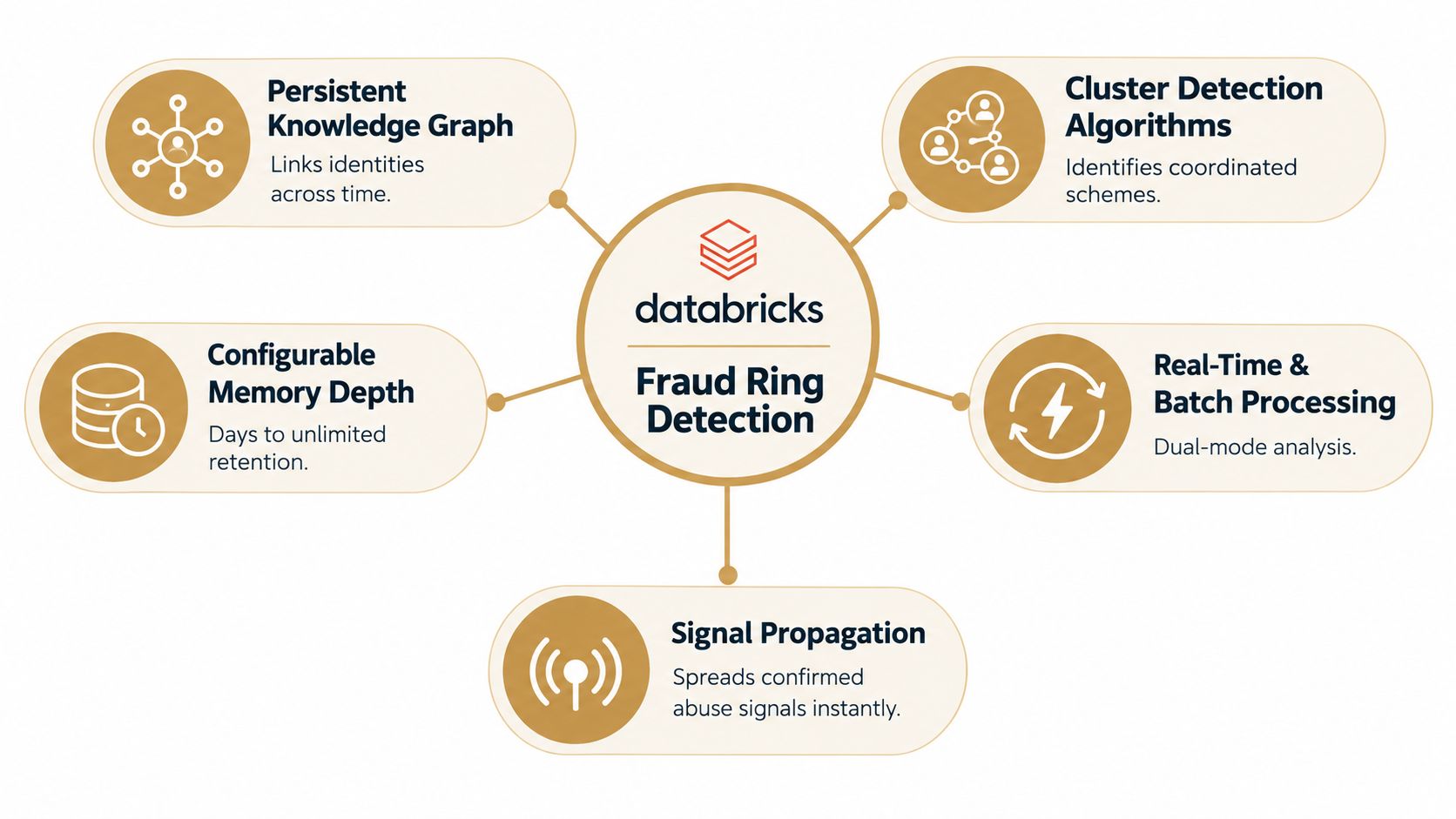
The associated fraud ring detection discussion is useful as a visual prompt for thinking about linked entities, but SaaS teams still need to validate graph signals against their own abuse labels and legitimate-user outcomes.
5. Airbnb's Trust Score System for Host and Guest Risk Assessment
Marketplace fraud creates a two-sided problem. A platform must protect one participant without unnecessarily restricting the other. That makes trust assessment different from a simple payment block, because the decision can affect booking access, supply, demand, communication, and reputation.
An Airbnb-style trust model evaluates the entity and the interaction. For a guest, relevant context could include account history, identity verification, device continuity, payment behavior, and booking patterns. For a host, the platform may need a separate view of listing behavior, account integrity, payout information, and unusual activity. The key design choice is to avoid treating every participant as if they carried the same risk.
Make the decision understandable
Trust scores can support prioritization, but an opaque score isn't a complete operating workflow. Product and support teams need to know whether the decision came from a new identity, repeated account creation, a payment link, a device relationship, or an unusual sequence. That's why a deterministic allow, review, or block outcome with reason codes can be more useful than a number that requires secondary interpretation.
SaaS products can adapt the two-sided logic even when they don't run a marketplace. A free user, trial user, paying customer, administrator, and API consumer may each require a different risk policy. Separate abuse graphs or policy contexts can prevent a signal from one product area from being applied too broadly elsewhere.
The commercial trade-off is customer friction. A 2025 KPMG survey found that only 42% of participating banks supplied false-positive data, and reporting institutions described false-positive rates as significantly high. The KPMG global banking scam survey highlights a measurement problem that SaaS teams should avoid repeating.
A trustworthy case study should publish legitimate-allow rate, review rate, false-positive rate, appeals, and conversion impact alongside confirmed-abuse capture. Otherwise, a platform may call a restrictive policy successful while hiding the customers it incorrectly rejected.

6. Sift's Machine Learning for Abuse Pattern Recognition Across Verticals
Cross-vertical abuse detection is valuable because attackers reuse methods. Burner emails, device reuse, payment-artifact reuse, scripted signups, and credential attacks can appear in ecommerce, subscription products, and marketplaces, even though the business outcomes differ.
A Sift-style approach connects users, devices, and payment methods across time, then uses historical abuse patterns to identify related activity. The SaaS application is straightforward in principle. A user who has already consumed a trial may return with a new email. Several checkout attempts may use different cards from a connected device. A login attack may appear across multiple accounts that share the same infrastructure.
The hard part is policy transfer. A signal that is highly suspicious in a card-testing flow may be normal for an agency managing several customer accounts. A device shared by many people can indicate a workplace, a public network, or coordinated abuse. Machine learning can rank the pattern, but the product still needs tenant-specific rules and review paths.
Combine broad signals with local policy
Inline integrations at signup, checkout, and login reduce the delay between detection and intervention. Custom rules can then express business-specific limits, such as whether a new account can start a trial, whether an account can receive credits, or whether a payment should be held for review.
The strongest operational pattern includes:
- A shared signal layer: Identity, device, payment, and behavioral context remain available across event types.
- Business-specific rules: Each product defines what allow, review, and block mean for its customers.
- Feedback capture: Reviewers mark confirmed abuse and legitimate activity in structured fields.
- Friction measurement: Product teams monitor conversion, abandonment, appeals, and support contacts rather than only blocked events.
A payment processor case study reported a 93% reduction in fraud alerts, a 97% decrease in analyst review time, from approximately 30 minutes per alert to 1 minute, and a 98% reduction in false positives. The vendor-led global payment processor case study offers a useful workflow benchmark, but it doesn't prove that latency alone produced those outcomes. SaaS teams should validate alert volume, analyst minutes, false positives, and automatic resolution separately.
The lesson is not to copy a vendor threshold. It's to measure the complete decision loop.
7. Mastercard's Decision Intelligence for Real-Time Transaction Approval
Payment networks demonstrate the value of making a decision while the transaction is still actionable. A Mastercard-style Decision Intelligence pattern considers the transaction, merchant context, cardholder behavior, geography, and related risk indicators before approving, challenging, or blocking the payment.
For SaaS, the equivalent event may be a trial conversion, a credit purchase, an API upgrade, or a payment capture. The screening layer must return a disposition quickly enough that the application can enforce it before the action commits. If the decision arrives after account creation or resource release, the team has shifted from prevention to cleanup.
Latency alone isn't the objective. The decision must also be explainable and operationally useful. A decline reason that support can't interpret creates customer friction, while a generic “high risk” label gives analysts little help. Reason codes should identify the relevant signal category without exposing sensitive detection logic.
Measure speed and commercial impact together
A real-time fraud detection case study should report more than response time. Teams need verdict latency percentiles, review yield, precision of blocks, recall by abuse type, and conversion segmented by verdict. They should also record degradation windows so they can distinguish model performance from an unavailable screening service.
A real-time banking fraud study reported false positives falling from 2.5% to 0.28% while fraud-detection accuracy improved by 28%. The same study described distributed stream processing as reducing false positives by up to 37% against batch processing and improving detection of complex patterns by 28%. The study on adaptive validation and distributed stream processing presents these outcomes as directional implementation findings, not guaranteed results for subscription products.
That qualification matters. A faster verdict can still be a poor business decision if it blocks valuable customers. Portreeve's model places the verdict before signup, trial, checkout, or login, while retaining a review path for uncertainty. The transferable principle is simple: screen inline, but judge the system on fraud outcomes and legitimate-user outcomes together.
7-Point Fraud Detection Case Study Comparison
| Solution | Implementation complexity | Resource requirements | Expected outcomes | Ideal use cases | Key advantages |
|---|---|---|---|---|---|
| Stripe's Real-Time Payment Fraud Detection System | High, real-time ML, sub-100ms engineering | Large ML infra, transaction data, labeled signals, webhook integration | Prevents payment fraud before capture; reduced chargebacks; evolving model accuracy | Subscription billing, e-commerce checkout, marketplaces | Sub-100ms decisions, adaptive ML, device/card fingerprint correlation, transparent reason codes |
| AWS Fraud Detector's Multi-Signal Behavioral Analysis | Medium–High, pre-trained plus custom models | AWS stack, historical labeled data, Lambda integration, monitoring | Behavioral anomaly detection; reduced bot signups and account abuse | Inline screening at signup/login; account takeover and velocity detection | Pre-built models, entity profiling, easy AWS scaling, multi-signal analysis |
| Twilio Authy's Account Takeover Prevention via MFA Velocity | Medium, MFA flows and device reputation | MFA infrastructure, device tokens, push channels, user education | Prevents account takeover at login; fewer credential abuses | Login protection for SaaS, freemium accounts, step-up auth scenarios | Low-friction push approvals, device memory, temporal/geographic velocity checks |
| Databricks' Real-Time Fraud Ring Detection Using Graph Analytics | Very high, graph infrastructure and clustering | Robust graph storage/compute, long retention, privacy controls | Detects coordinated fraud rings; retroactive and deterministic clustering | Sophisticated coordinated attacks, free‑trial farming, marketplaces | Persistent abuse graph, cluster detection, signal propagation, improves with time |
| Airbnb's Trust Score System for Host and Guest Risk Assessment | High, multi-actor scoring and identity verification | Identity verification systems, cross-entity data, review workflows | Inline blocking of high-risk bookings; two-sided marketplace protection | Marketplaces and platforms with hosts/guests or multi-role users | Unified trust scoring, two-sided verification, manual evidence workspace, transparent thresholds |
| Sift's Machine Learning for Abuse Pattern Recognition Across Verticals | Medium, vendor ML with API integration | API integration into signup/checkout/login, vendor data sharing, tuning | Cross-vertical abuse detection; faster time-to-value for common attacks | SaaS, e-commerce, marketplaces needing turnkey detection | Pre-trained cross-vertical models, persistent graphs, <100ms inline API |
| Mastercard's Decision Intelligence for Real-Time Transaction Approval | Very high, payment-network scale, sub-100ms guarantees | Massive global infra, merchant/cardholder data, regulatory controls | Real-time approve/challenge/block with minimal latency; lower chargebacks | Payment processors, high-volume checkout flows, global subscriptions | Sub-100ms at scale, deterministic decisions, merchant-aware adaptive rules |
Build the Fraud Workflow, Not Just the Model
The seven approaches point to the same operating pattern, even though they protect different events. Payment systems focus on checkout. Authentication systems focus on login. Graph systems focus on relationships. Trust systems focus on the entity and the interaction. Behavioral systems focus on sequences and deviation. None of those perspectives is sufficient on its own for a SaaS product that offers accounts, trials, credits, subscriptions, and APIs.
Start with the event that creates irreversible exposure. For signup, that may be account creation or free-resource allocation. For a trial, it may be activation. For checkout, it may be authorization or payment capture. For login, it may be access to billing, customer data, or administrative controls. Put the screening decision before that action commits.
Then connect identity signals over time. Email addresses, device tokens, card fingerprints, payer wallets, and account identifiers can reveal repeated behavior that event-only detection misses. The FTC's 2024 data showed that fraud losses vary sharply by category, including $5.7 billion in reported investment-scam losses and $2.95 billion in imposter-scam losses from 845,806 reports. The FTC release supports a broader lesson: teams need more than a single transaction-value threshold when patterns and identity relationships determine the eventual harm.
Next, separate certainty from action. A confirmed abuse pattern can justify a block. An unusual but explainable event may deserve an allow. The uncertain middle belongs in review, with enough evidence for a human to make a consistent decision. A queue isn't merely an operational cost. It can preserve legitimate revenue that an aggressive automated policy would reject.
SaaS teams can apply this framework across the main event types:
- Signup: Link new identities to devices, payment artifacts, and prior account history before creating access.
- Trial activation: Detect repeated enrollment, resource farming, and suspicious velocity before releasing scarce credits.
- Checkout: Combine payment signals with signup and device history instead of evaluating the card in isolation.
- Login: Use device continuity, authentication sequences, and linked-account history to decide whether to allow or challenge access.
Portreeve can fit as an inline screening layer across those flows. Its Verdict API returns allow, review, or block decisions with reason codes, while its decision workspace and built-in review queue keep evidence and adjudication together. Its per-tenant abuse graph connects supported identity keys across configurable history, and cluster marking can propagate confirmed abuse signals to related identities and devices.
An implementation sequence should stay practical. Map the irreversible events first. Select the identity keys that your product can collect lawfully and consistently. Start with transparent rules and reason codes. Route uncertain cases to review. Mark confirmed abuse only after adjudication. Finally, measure prevented abuse, false positives, review yield, conversion, appeal outcomes, and verdict latency by event type.
That process produces a fraud system the business can operate, explain, and improve. The model matters, but the workflow determines whether the decision protects the product without driving legitimate customers away.
Portreeve gives SaaS teams an inline way to screen signups, trials, checkouts, and logins with allow, review, or block verdicts, reason codes, linked history, and a built-in review queue. Use those controls to connect fraud signals across events, measure false positives alongside prevented abuse, and evaluate Portreeve for your product's screening workflow.