
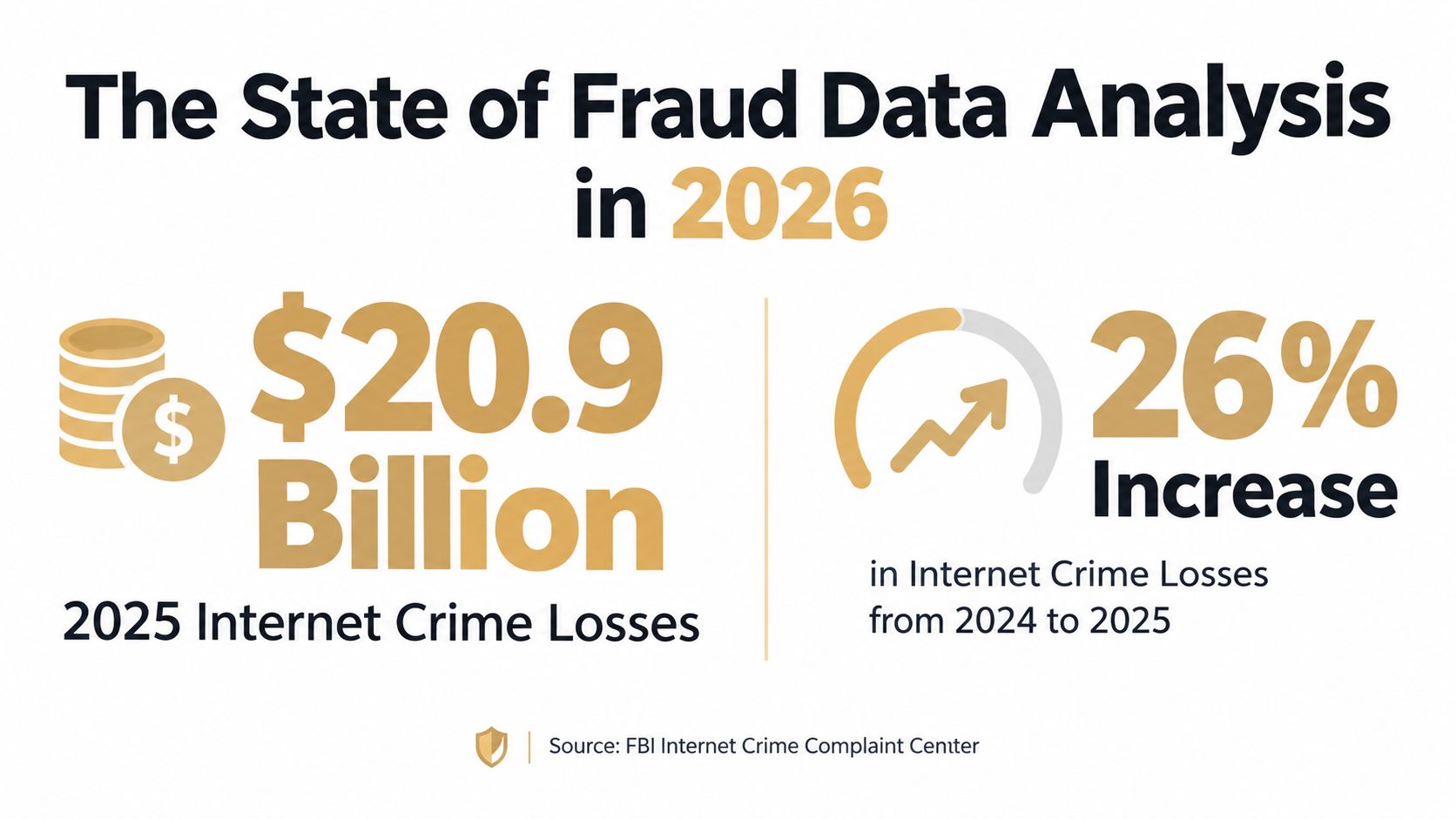
In 2025, Americans reported more than $20.9 billion in internet-crime losses to the FBI. Fraud data analysis works best when teams correlate identity, device, behavior, and payment events before a signup, trial, or checkout is allowed to complete.
That figure changes the role of fraud prevention for subscription businesses. Fraud is no longer a narrow payments concern owned by a risk team after revenue has been booked. It affects acquisition quality, free-tier economics, customer trust, support workload, payment disputes, and the reliability of every conversion metric.
A signup-heavy product can have plenty of data and still make poor decisions. The practical question isn't how many events your system collects. It's whether those events can be joined quickly enough to reveal coordinated abuse before the next action commits.
Table of Contents
- The State of Fraud Data Analysis in 2026
- Building the Fraud Data Pipeline
- Essential Signals for Fraud Detection
- Graph-Based Detection and Relational Analysis
- Detection Approaches for Different Maturity Levels
- Tooling and Integration Recommendations
- The Behavioral Intent Gap in Fraud Analysis
- Practical Checklist and Next Steps
The State of Fraud Data Analysis in 2026
The FBI's Internet Crime Complaint Center recorded more than $20.9 billion in reported internet-crime losses in 2025, a 26% increase from 2024 and the first time annual losses crossed the $20 billion threshold in IC3's history. Investment and cryptocurrency fraud accounted for about $8.648 billion of that total, according to this summary of the 2025 internet-crime statistics. Product teams handling trials, credits, subscriptions, and inline payments are operating inside that environment, whether or not fraud is part of their formal roadmap.
Consider a familiar sequence. A user creates an account with a new email, starts a free trial, consumes an expensive allowance, and disappears before conversion. A row-level system sees an ordinary signup. A stronger system notices that the device, payer wallet, or checkout artifact has appeared across other accounts, perhaps alongside unusual session behavior and repeated trial activity.
More data isn't the same as better analysis
Teams often respond to abuse by logging everything. They add browser fields, payment attributes, session events, referral data, and support notes, then discover that the decision service can't use those signals within the product's action window. Analysts receive large exports without consistent identity keys. Engineers have event volume, but not a reliable way to connect events.
That approach creates the appearance of sophistication without improving the verdict. The useful distinction is between data collection and decision-ready context. A device token that can be linked across sessions is more useful than a long list of unjoined browser properties. A payment fingerprint connected to prior trial activity is more useful than a checkout record viewed in isolation.
Operational rule: collect a signal only when you know how it will change an allow, review, or block decision.
The same principle applies to payment controls. Teams can use this practical guide to payment fraud prevention as a starting point, but payment screening shouldn't be separated from signup and identity analysis. Card testing, burner-email cycling, and free-credit farming often begin before payment capture.
The strongest programs therefore shift the core question from “How much data do we need?” to “Which relationships matter at the moment of action?” That shift leads directly to event design, identity resolution, graph construction, and latency-aware screening.
Building the Fraud Data Pipeline
Fraud data analysis begins with an event pipeline that preserves context. For a subscription product, the minimum useful sequence usually includes account creation, verification, login, trial start, entitlement use, trial conversion, checkout attempt, payment result, cancellation, refund, and dispute events.
Each event should carry a stable event identifier, tenant or product scope, event type, server-side timestamp, and the identity artifacts available at that point. Keep the original event payload for investigation, but also create normalized fields for analysis. An email should have a canonical form, a device token should remain consistent across sessions, and payment references should use a non-sensitive fingerprint rather than raw payment credentials.
Capture the signup-to-checkout path
A workable pipeline has four layers:
- Ingestion: Accept events from the application, authentication service, payment provider, and device SDK. Record the event before downstream enrichment changes its shape.
- Normalization: Standardize timestamps, event names, tenant identifiers, and identity formats. Preserve missing values rather than converting them into a misleading default.
- Feature extraction: Produce features such as prior account linkage, device reuse, payment-artifact reuse, event velocity, and the interval between meaningful actions.
- Decision storage: Save the verdict, reason codes, relevant evidence, and the model or rule version that produced the result.
Timestamp ordering deserves special attention. Client timestamps can be manipulated, delayed, or inconsistent across time zones. Use server receipt time for decision sequencing, retain client time as supporting context, and account for late-arriving payment or dispute events when reconstructing history.
Don't make IP the identity layer
IP addresses can help identify broad network conditions, but they're weak as a primary identity key. Shared networks create collisions, mobile connections change, and privacy tools reduce reliability. A more durable identity map links email, device token, card fingerprint, and payer wallet where those artifacts are available and lawfully processed.
Missing data shouldn't automatically equal high risk. A visitor may not have a payment artifact at signup, and a legitimate customer may use a new device. The pipeline should distinguish “not collected,” “not available yet,” and “explicitly absent.” Those states produce different investigative conclusions.
For implementation details around inline gating and event handling, the real-time fraud detection guide provides a useful reference point. The important architectural decision is memory depth. Keep enough tenant-scoped history to recognize repeated abuse, while applying retention and access controls that match your privacy obligations.
Essential Signals for Fraud Detection
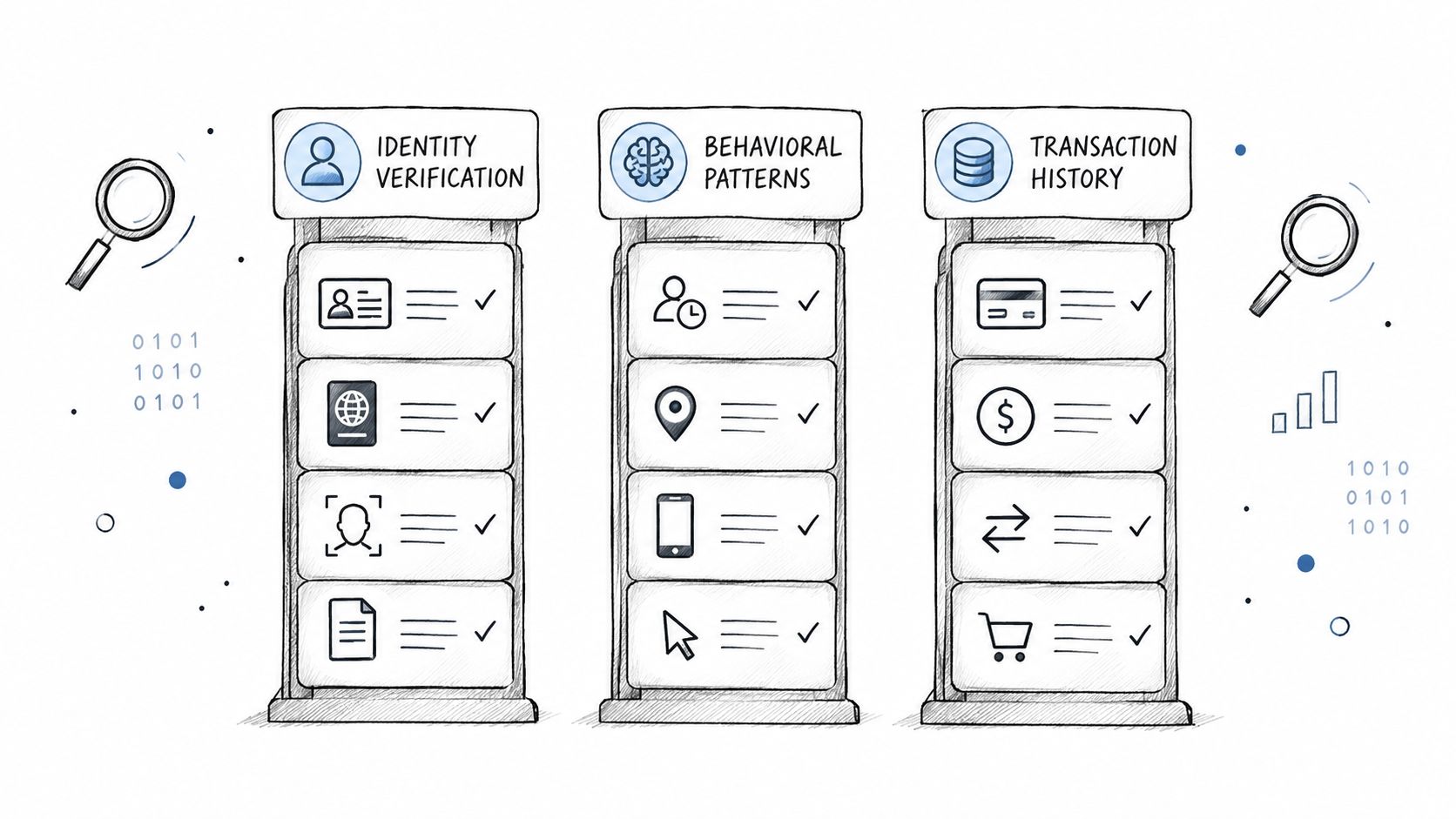
A useful fraud data analysis stack combines three signal families. None is sufficient alone. Device intelligence can be stable but shared, behavioral data can be revealing but noisy, and identity correlation can expose abuse while also creating false links if normalization is careless.
Device signals show persistence
Device signals help answer a practical question: has this environment participated in related activity before? Useful fields can include a persistent device token, browser and platform consistency, automation indicators, tampering signals, and changes between signup and payment.
A device should not be treated as proof of fraud. Households, offices, schools, and privacy-conscious users can legitimately share infrastructure. The value appears when device reuse combines with other evidence, such as multiple unrelated emails, repeated trial starts, or a payment artifact associated with prior abuse.
The device fingerprinting guide explains why persistent device context can strengthen identity analysis, but teams should still document consent, retention, and tenant isolation requirements.
Behavioral signals reveal how the action happens
Behavioral data focuses on interaction rather than identity. Relevant examples include typing rhythm, pointer movement, navigation sequence, session hesitation, sudden paste activity, and the gap between authentication and checkout. These signals can distinguish an ordinary customer from a scripted signup flow, even when the email and payment details appear clean.
Behavioral signals are most useful when they are interpreted as context, not as a universal score. A fast checkout may indicate automation, or it may reflect a returning customer. A long pause may indicate distraction, accessibility needs, or coercion. The correct response is often to route the event for review or request a proportionate verification step rather than block automatically.
Correlation signals connect the evidence
Identity correlation links events across emails, devices, payment artifacts, wallets, and accounts. For subscription products, this is often the highest-value category because abuse tends to repeat across the lifecycle. A new email doesn't necessarily represent a new customer if the same device and payer wallet already connect it to several exhausted trials.
Prioritize signals using three questions:
- Can the signal be collected reliably at the decision point?
- Can the system evaluate it within the product's latency budget?
- Will an analyst understand why it changed the verdict?
Start with stable identity linkage and clear event history. Add behavioral signals where automation or coercion is a material risk. Introduce richer device attributes only when they improve a decision or investigation, not because the vendor makes them available.
Graph-Based Detection and Relational Analysis
Traditional fraud systems inspect rows. Graph-based fraud data analysis inspects relationships. An account becomes a node, while a shared device, payment fingerprint, email, wallet, or transaction becomes an edge connecting that account to other entities.
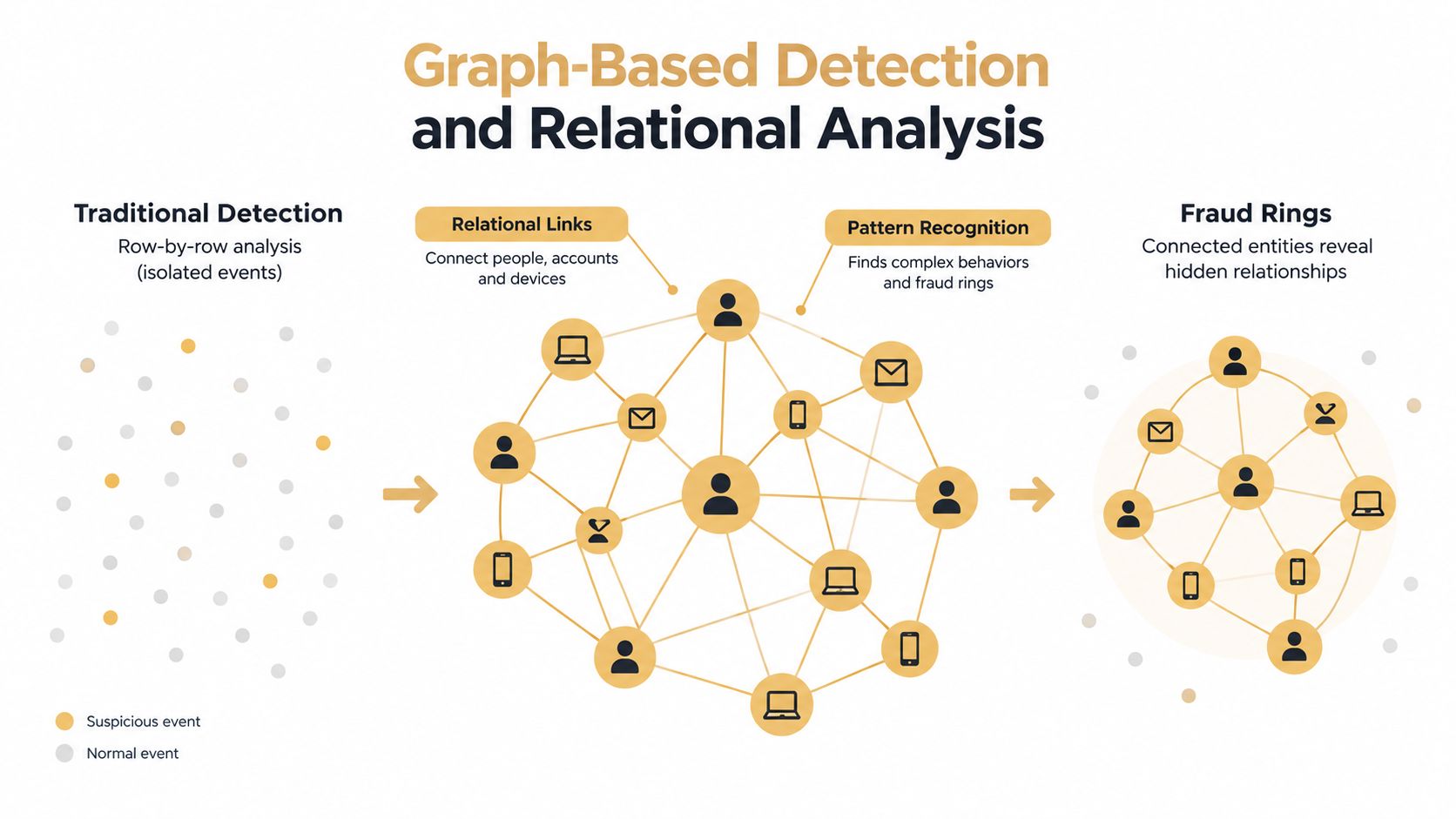
Suppose five accounts each look acceptable in isolation. Each uses a different email, each starts a trial at a different time, and none exceeds a simple signup threshold. A graph can reveal that the accounts share a device token, connect to the same payer wallet, and appear in a sequence of related checkout attempts. The suspicious property isn't one account's score. It's the connected structure.
Why relational patterns matter
Research reviewing graph learning for financial fraud found that transaction networks can model accounts or entities as nodes and transfers or payments as edges. The review also found that graph neural networks are well suited to patterns hidden in tabular data because they capture connectivity and temporal context together, as described in this survey of graph learning for financial fraud.
Complex models aren't always necessary. Dense communities, repeated connected components, and unusual bridges between identity types can surface a ring with relatively simple graph features. This matters for product teams that need an explainable inline decision rather than a research project that takes months to operationalize.
A trial-farming graph might show many email nodes attached to a small group of devices. Card testing may show payment artifacts connected to numerous low-value checkout attempts. Account cycling may show a repeating sequence of signup, entitlement use, cancellation, and re-enrollment. Each pattern gives investigators a different reason code and a different intervention.
Memory makes the graph useful
A graph without history is just a snapshot. The system needs configurable memory so it can connect current activity to earlier events without creating an uncontrolled data lake. Short memory can catch bursts of abuse. Longer memory can expose recurring device reuse and identity cycling that would otherwise look unrelated.
The retention policy should be tenant-scoped and purpose-specific. A financial product may require one history strategy, while a low-cost software trial may use another. Store the relationships that support a decision, protect sensitive identifiers through hashing or tokenization, and make deletion behavior explicit.
Inline screening changes the design trade-off. The graph lookup must be fast enough to precede account creation, trial activation, or payment capture. Heavy investigation can happen asynchronously, but the first gate needs a compact representation of linked history, recent activity, and decisive evidence.
The video below offers a visual introduction to the distinction between isolated events and connected fraud patterns.
Detection Approaches for Different Maturity Levels
The right detection approach depends on the abuse patterns you understand, the data you can trust, and the time available before the product action commits. A small team often gets more value from a clear rule with good reason codes than from a poorly monitored machine-learning model.
| Approach | Latency Impact | Implementation Complexity | Best For | Maintenance Cost |
|---|---|---|---|---|
| Rules and linked-identity checks | Low when features are precomputed | Low to moderate | Known abuse patterns and early-stage products | Moderate, because rules need review |
| Statistical anomaly detection | Moderate, depending on feature retrieval | Moderate | Changing behavior with a usable historical baseline | Moderate to high |
| Machine-learning ensemble | Variable and sensitive to feature and model design | High | Mature teams with labeled outcomes and monitoring | High, including drift and investigation support |
Rules are a foundation, not a failure
Rules work well for explicit conditions. Examples include a device connected to confirmed abuse, a payment artifact repeatedly associated with failed checkouts, or a new account attempting an entitlement path that has already been exhausted by linked identities.
The failure mode is uncontrolled accumulation. Teams add exceptions until nobody can explain which rule fired, then compensate by lowering thresholds and blocking legitimate users. Keep rules narrow, versioned, and attached to human-readable reason codes. Review outcomes by segment rather than judging performance from a single overall approval rate.
Statistical methods add flexibility
Anomaly detection can identify behavior that differs from a tenant's normal pattern without requiring every abuse type to be labeled in advance. It can examine signup timing, event sequences, usage intensity, and connections between identities.
It needs a trustworthy baseline. A product with seasonal launches, new-market expansion, or rapidly changing acquisition channels can make “unusual” look like “fraud.” Use anomaly results to create review candidates and investigative leads before allowing them to impose hard blocks.
Ensembles require operational discipline
An ensemble can combine rules, graph features, behavioral indicators, and supervised models. That flexibility helps mature fraud operations, but the model is only useful if the team can explain decisions, monitor drift, retrain from reliable outcomes, and keep the serving path within its latency budget.
A practical upgrade path is incremental. Start with deterministic controls, add linked-identity history, introduce anomaly features, and then test machine learning against the existing baseline. Upgrade when the current approach produces a specific, measurable operational problem, not because a more complex model sounds more advanced.
Tooling and Integration Recommendations
A fraud tool should fit the product flow rather than force the product flow to fit the tool. Evaluate it at the point where signup, trial activation, login, or checkout is still reversible. An after-the-fact dashboard may help investigations, but it can't prevent an entitlement from being issued or a payment from being captured.
Test the integration contract
Ask vendors and internal teams to demonstrate the complete path:
- SDK coverage: Confirm that browser and server events arrive with consistent identifiers and that the integration handles retries without duplicating decisions.
- API response design: Require a deterministic allow, review, or block outcome, not only an opaque risk score that another team must interpret.
- Reason codes: Check that every decision includes concise evidence, such as linked device history, repeated payment-artifact use, or automation indicators.
- Review workflow: Verify that investigators can see the event, connected identities, prior verdicts, and final disposition in one workspace.
- Async support: Use webhooks for payment outcomes, disputes, manual decisions, and confirmed abuse that may arrive after the initial gate.
- Propagation controls: Look for cluster marking or an equivalent mechanism that can carry a confirmed abuse signal to linked identities without blocking an entire unrelated customer population.
Protect users while the service degrades
A low-latency decision service still needs a failure policy. Decide which actions can fail open, which require review, and how the application discloses degraded state to operators. The safest approach isn't identical for every event. A login may need a different fallback from a high-cost trial activation.
Privacy needs equal attention. Identity keys should be hashed or tokenized, scoped to the correct tenant, and accessible only to the people and systems that need them. Don't use cross-customer history without an explicit legal and product basis.
For a subscription team evaluating inline screening, Portreeve provides verdict decisions for signup, trial, login, and checkout events, with reason codes, linked identity history, a review queue, SDK and HTTP integration options, webhooks, and tenant-scoped abuse graphs. Compare those capabilities with the controls already available in your payment processor, identity provider, analytics warehouse, and case-management system.
The Behavioral Intent Gap in Fraud Analysis
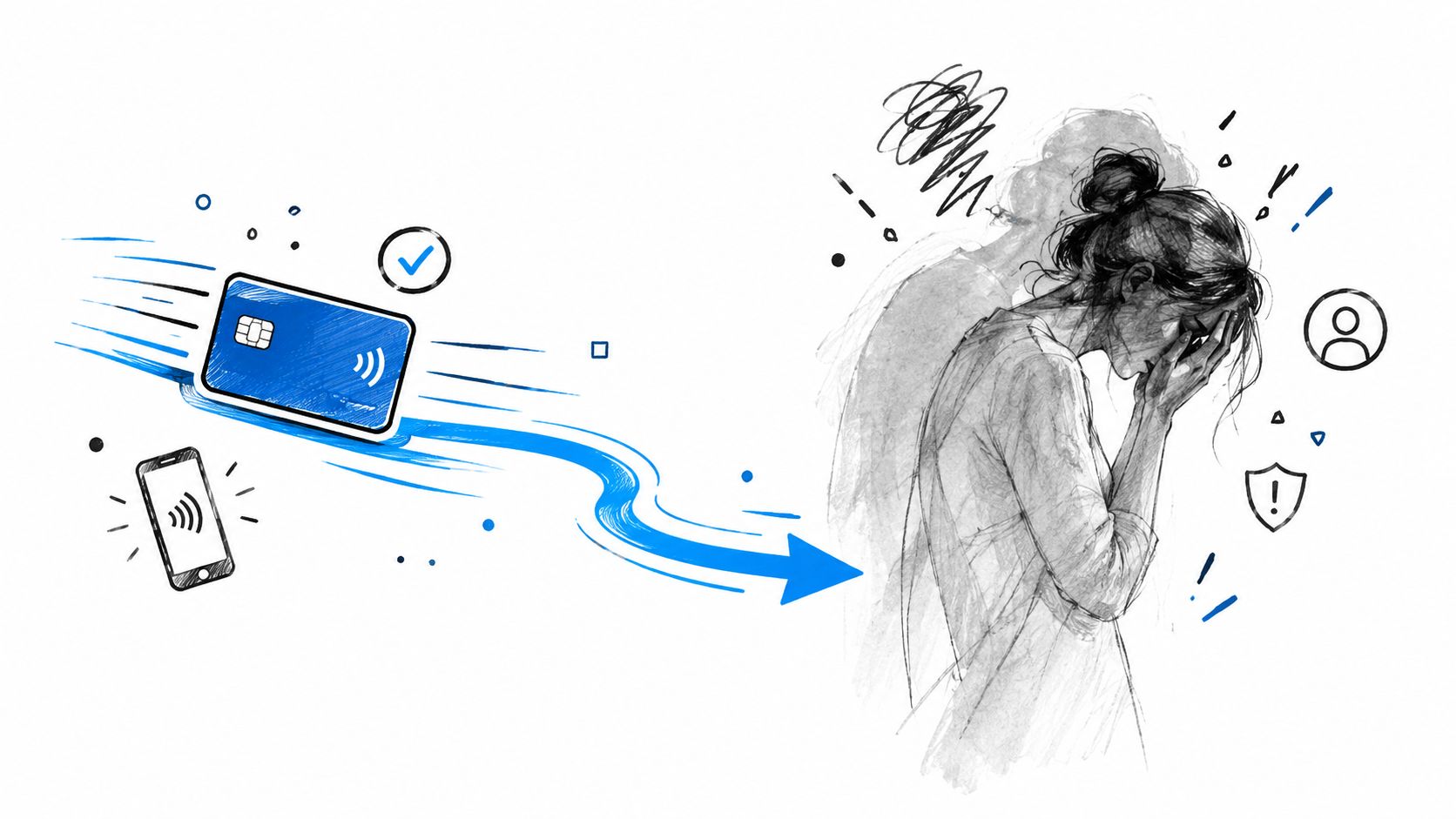
Transaction monitoring assumes the person initiating a payment is also the person choosing it freely. That assumption breaks in authorized-payment scams. A victim may use a valid account, a trusted device, and a legitimate payment method while a scammer directs the session in real time.
The 2026 research on deception in the AI age says traditional transaction monitoring misses this category because the payment itself can look authorized. It reports that institutions detect only 10% to 15% of annual losses and recover 2% to 5% of identified amounts, partly because real-time payments leave little recovery window. Those figures point to a gap in intent analysis, not a mere shortage of transaction fields.
Session context is the missing layer
A product may not know whether a customer is on a phone call, but it can observe context around the action. Long hesitation before entering sensitive information, repeated navigation away from a payment screen, sudden changes in typing behavior, remote-control indicators, and a new payee combined with unusual login context can all become review signals.
These signals need careful treatment. A stressed customer isn't necessarily fraudulent, and accessibility needs can produce unusual interaction patterns. Use behavioral context to delay, confirm, or escalate a payment where the risk justifies friction. Don't turn a single hesitation event into an automatic rejection.
The broader lesson is uncomfortable: more fraud data won't solve a problem if the decisive signal is behavioral intent. Teams that only optimize card-testing rules and account-takeover detection may still miss a customer being manipulated through a valid flow.
Start with fields your product already owns. Record meaningful session transitions, preserve event order, make unusual payment changes visible to reviewers, and establish a feedback loop for confirmed scam outcomes. You can add richer signals later. Waiting for a perfect behavioral model leaves the most difficult fraud category outside the analysis.
Practical Checklist and Next Steps
Fraud data analysis improves when teams turn broad goals into operational controls. Start with the event path, then add linkage, decision logic, and review discipline.
- Map the irreversible actions: Identify where account creation, trial activation, entitlement use, and payment capture become difficult to undo.
- Standardize identity keys: Link normalized emails, device tokens, payment fingerprints, and payer wallets while keeping IP as supporting context rather than the core identity.
- Create reason codes: Make every decision explainable to an engineer, analyst, support agent, and product manager.
- Build tenant-scoped history: Retain enough linked activity to catch recurring abuse, with explicit retention, deletion, and access policies.
- Use a review queue: Route ambiguous cases to people instead of forcing every uncertain event into allow or block.
- Measure outcomes: Track confirmed abuse, legitimate-user friction, review resolution, payment disputes, entitlement consumption, and the quality of analyst feedback.
- Test degradation: Decide how each event behaves when the screening service, identity provider, or payment processor is unavailable.
- Revisit the graph: Add confirmed abuse to linked clusters carefully, and check whether the resulting connections remain relevant as customer behavior changes.
The most important misconception to remove is that complex models automatically outperform well-constructed features. Graph structure, clean timestamps, durable identity keys, and transparent decisions often produce more operational value than a complex model fed by fragmented data.
Industry evidence also points to data fusion as a continuing constraint. The 2026 anti-fraud technology benchmarking report reports that 34% of organizations use unstructured data in fraud analytics, 54% combine internal and external data sources, and participation in data-sharing consortiums fell from 35% in 2024 to 28% in 2026. Better linkage inside your own product is the practical starting point, even while broader collaboration develops.
Portreeve gives subscription product teams an inline screening layer for signup, trial, login, and checkout events, returning allow, review, or block decisions with reason codes before actions commit. Visit Portreeve to evaluate its verdict API, linked abuse history, review workflow, and integration options for your fraud data analysis program.