
Card-not-present fraud made up 73% of card-fraud value in 2016 and 80% by 2019, with €1.50 billion in card-not-present fraud value alone. That's why payment fraud prevention has to happen inline, at checkout and login, before the chargeback lands.
A lot of teams still treat fraud like a disputes problem. That's a mistake. In subscription products, the actual damage starts when a bad actor gets through the front door, turns your checkout into a test bench, or abuses your refund policy while looking like a normal customer.
Table of Contents
- The Real Cost of Payment Fraud in 2026
- Fraud Types That Hit Subscription Products Hardest
- How Inline Verdict Engines Actually Work
- Building a Checkout Flow That Stops Fraud Without Killing Conversion
- The First-Party Misuse Problem Most Guides Ignore
- Engineering the Integration Without Slowing Down Checkout
- Your 30-Day Fraud Prevention Action Plan
The Real Cost of Payment Fraud in 2026
A subscription SaaS can look healthy right up until card testers find the trial endpoint. A $49 monthly product can wake up to a chargeback spike, a reserve notice, and a launch team scrambling to patch checkout rules while support handles angry customers and finance tries to explain why the month's numbers changed under their feet.
The direct loss is only the visible part. The hidden cost includes manual review time, false declines, customer churn from over-tight rules, and the slow reputational damage that makes legitimate payments harder to approve. Once a fraud pattern has poisoned your checkout, the gateway doesn't care that your team was “working on it.” The processor reacts to risk, not intent.
Practical rule: if you only look at chargebacks after settlement, you're already late.
The payment stack now punishes weak prevention in several ways. Merchant risk controls can trigger reserves, higher review rates, and broader friction for good customers. On the card-network side, fraud thresholds and dispute pressure can turn into operational churn fast, especially when the same abuse pattern keeps repeating across cards, emails, and devices.
The bigger mistake is assuming every fraud loss is a stolen-card problem. The merchant reality is broader. Fraud now shows up in login abuse, trial farming, refund abuse, account cycling, and abuse of “free” flows that were never designed with an adversary in mind. Juniper Research's projection, as cited by McKinsey, puts online payments fraud at more than $362 billion between 2023 and 2028, and Visa projected global eCommerce fraud losses of $33.2 billion in 2025 rising to $43.6 billion by 2027 McKinsey's payments risk overview. That scale is why payment fraud prevention is an operating discipline, not a cleanup task.
The right response is architectural, not theatrical. You need rules, device binding, identity linkage, and deterministic outcomes before authorization. Anything else is just expensive optimism.
Fraud Types That Hit Subscription Products Hardest
Subscription businesses attract fraud because the product shape is convenient for abuse. Low-friction trials, recurring billing, account creation, and refunds all create places where a bad actor can move faster than a manual team can react.
Card testing
Card testing is the cleanest example of machine-driven abuse. Bots fire many small authorizations, often against trial or low-value checkout flows, to see which stolen cards still work. JPMorgan recommends watching velocity by email, billing details, IP, and device, then using device fingerprinting to catch one device probing many cards JPMorgan's card testing guidance.
The log pattern is usually obvious once you know what to look for. You'll see repeated tiny attempts, many failures, and the same fingerprint hitting different card numbers in rapid sequence. That's not a customer struggling to type in a number. That's a script trying to find a live credential before the issuer wakes up.
Account cycling and promo abuse
Account cycling is the free-tier version of the same game. A single actor creates repeated accounts to harvest referral credits, free trials, or introductory offers, then abandons each identity once the value is extracted. Stripe describes this as multi-account abuse and notes that bad actors use multiple accounts to reuse promotional coupons or spread stolen-card activity across accounts Stripe's Radar expansion notes.
The fingerprint here is churn, not volume alone. One device, many new emails, short-lived sessions, repeated signups, and the same payment artifact reappearing under fresh identities. That's a pattern you stop with linkage, not with prettier copy on the pricing page.
Refund and policy abuse
Refund abuse is where many guides go weak. A user behaves like a legitimate buyer, then uses your own policy against you. They request refunds early, dispute authorized charges, or repeatedly push edge cases until your support team gives up.
First-party misuse is where it becomes more damaging than classic stolen-card fraud. The 2026 Merchant Risk Council report says 64% of merchants saw increasing first-party misuse, 57% saw more refund or policy abuse, and one-quarter saw increases of 25% or more. Those aren't side cases. They're the new center of gravity for subscription risk MRC's Global Payments and Fraud Report.
A good fraud rule doesn't just ask, “Is this card real?” It asks, “Is this person trying to game the business?”
How Inline Verdict Engines Actually Work
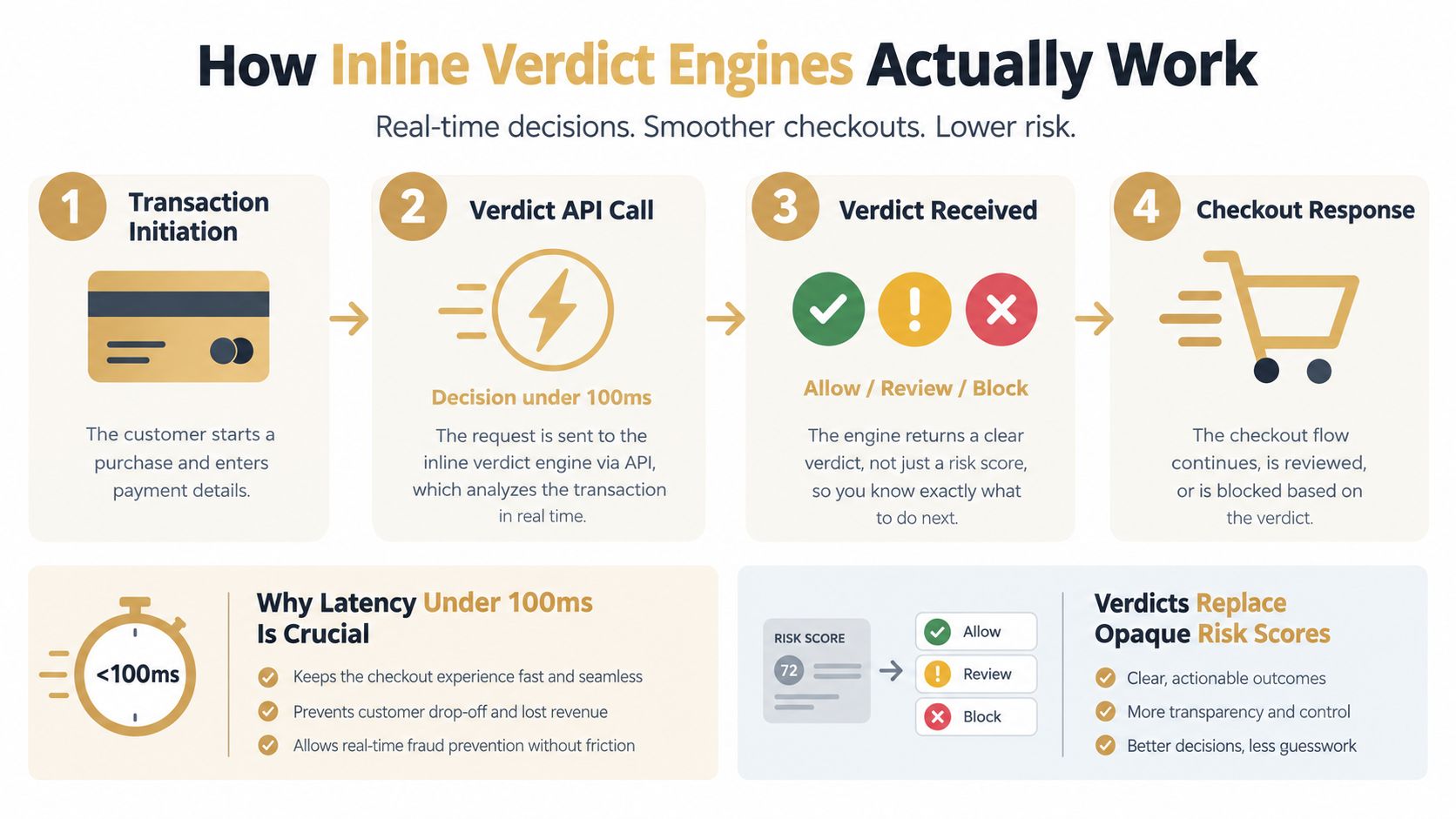
An inline verdict engine sits between the user action and the payment processor. The checkout or login event fires, the engine evaluates the event payload, and the system returns a decision, usually allow, review, or block. If the decision comes back too late, you've already authorized the bad event and turned prevention into cleanup.
The latency budget matters because checkout is synchronous. Under-100 ms is the practical target if you want to keep the user experience intact and still make a live decision before capture. That's why teams that run risk checks as a separate afterthought end up with messy retries, broken flows, and risk decisions nobody trusts.
Verdicts beat raw scores
A score is a number. A verdict is an action. Engineering teams shouldn't have to interpret a vague score in the middle of a payment flow when the system can return a deterministic outcome with reason codes attached.
That's the main operational advantage. The decision engine owns the scoring logic, the rules, and the linkage, while your app consumes a simple response and routes the user accordingly. If a case needs human eyes, the verdict can map directly into a review queue. If it's clean, the transaction moves on without unnecessary friction.
Operational rule: if a clean customer has to wait on a risk committee, your fraud stack is too slow.
What the request needs
A good inline call includes the event type, account details, payment metadata, device fingerprint, and any linked identity signals you already have. You're not trying to recreate the entire customer profile in the checkout service. You're trying to send enough context for the verdict to be useful on the first pass.
Portreeve is one example of this kind of screening layer. It evaluates signup, trial, checkout, and login events before they commit, returns a deterministic outcome with reason codes, and keeps event history tied to identities inside an abuse graph. For a deeper comparison of screening models, see fraud detection software approaches.
Building a Checkout Flow That Stops Fraud Without Killing Conversion
The wrong way to build checkout is to throw every control at every customer. That creates friction, hurts conversion, and still misses the patterns that matter. The right way is staged control, where cheap signals resolve first and expensive friction is reserved for higher-risk traffic.
Start before the card form. Email age, domain reputation, and account history tell you a lot before you ask for payment details. A fresh email on a disposable domain with a brand-new account should not get the same path as a returning buyer with a stable device and known history.
When the card is submitted, AVS and CVV should be mandatory. They're basic, but basic isn't optional. On top of that, 3D Secure 2 should be conditional, not blanket-applied. Stripe's 3DS guidance notes that enabling 3DS on a segment typically carries an expected authorization-rate drop of 2–5%, so you use it where the risk justifies the friction Stripe's 3D Secure guidance.
The control stack in order
- Pre-form signals: email reputation, account age, device reuse.
- Form submission checks: AVS and CVV.
- Inline risk decision: allow, review, or block.
- Selective step-up: 3DS2 only for the riskier cohort.
- Velocity throttles: repeated attempts per card, device, or account.
That ordering matters. Device fingerprinting and email signals should resolve before any synchronous decision call, because the user shouldn't wait on a slow risk pass if the transaction is clearly clean. A fast path for good users is part of fraud prevention, not a luxury.
| Control | Stage | Signal Captured | Conversion Impact | Deploy When |
|---|---|---|---|---|
| Email age and domain reputation | Before card form | Disposable or fresh identity patterns | Low | Always |
| AVS and CVV | Card submission | Address and card verification | Low to moderate | Every transaction |
| Device fingerprinting | Checkout page | Reused device, bot-like repetition | Low | Always |
| Velocity rules | Before auth | Attempt bursts by card or device | Moderate when tripped | As soon as abuse appears |
| 3DS2 | Step-up on risk | Issuer-authenticated challenge | Moderate, sometimes higher | High-risk cohorts only |
A few controls are free in practice, meaning they cost engineering effort, not user friction. Velocity logic and device linkage fall into that bucket. Others have a real conversion cost, especially step-up authentication. Use them surgically. Blanket friction is lazy fraud work.
The First-Party Misuse Problem Most Guides Ignore
Classic stolen-card fraud is easier to describe, which is why so many guides keep centering it. Subscription teams face a different problem: customers who look legitimate at checkout and abusive after the fact. That calls for different signals and a different review model.
What to detect
Refund abuse is not the same as a customer asking for help. Friendly fraud is a dispute on an authorized charge. Refund abuse is policy exploitation. Promo abuse is when one person farms sign-up bonuses or free tiers across accounts until the funnel stops making economic sense. For a fuller breakdown of that pattern, see que es fraude.
These patterns are hard for older fraud models because they do not always look hostile in isolation. The transaction can be clean. The device can be stable. The card can be valid. The signal lives in the sequence, not the snapshot.
What intent looks like
Behavior over time tells the truth. Dispute history across the same email and device matters. So does refund-to-revenue ratio by cohort and the velocity of account creation from the same payment instrument. You are looking for customers who keep crossing the line between normal use and policy gaming.
Good intent detection does not punish every customer who refunds. It isolates the accounts that refund like a business model.
Stripe's Radar expansion notes that modern fraud systems now target multi-account abuse, pay-as-you-go abuse, and bot-driven payments, which matches the broader pattern subscription businesses are fighting Stripe's Radar expansion notes. The point is not to chase every edge case. It is to stop repeated abuse from passing as ordinary churn.
Why this changes the operating model
First-party misuse needs a separate review queue, separate reason codes, and separate ownership. Finance sees the refund. Support sees the complaint. Risk has to see the pattern. If no one owns intent-based abuse, the company keeps approving the same bad behavior because each individual case looks defensible.
Engineering the Integration Without Slowing Down Checkout
The integration pattern should be boring. Checkout fires once, the verdict comes back fast, and the payment processor only sees the traffic you want to process. Anything that adds serial API calls or forces your app to guess at low-confidence scores will hurt both latency and trust.
Synchronous first, asynchronous later
The first transaction should be synchronous. You want a live decision before authorization because that's the only way to stop card testing and account abuse in real time. After you've seen enough history on lower-risk traffic, you can move some review work to webhook-based post-capture handling, but only for flows you're comfortable reconciling later.
If you're using Stripe, wire the logic around PaymentIntent confirmation so a block or review verdict stops the authorization before capture. If you're on Adyen, use the equivalent payment authorization hooks and merchant risk signals to keep the decision inside the same checkout window. Keep your idempotency keys tight so retries don't create duplicate payment attempts or duplicate fraud decisions.
What to log and route
- Reason codes should map to actions, not to vague dashboards.
- Review verdicts need a human queue with a named owner.
- Block verdicts should short-circuit the payment flow cleanly.
- Low-confidence cases should not stall the entire checkout path.
The integration mistakes are predictable. Teams call too many services in sequence. They fetch device data too late. They let a verdict wait on features that should've been cached. Then they blame the vendor for checkout slowdown when the problem is architectural sloppiness.
For a practical reference on how a fraud stack can sit inside payment infrastructure, review fraud prevention for e-commerce. The main lesson is simple. If the processor is the last place you make a fraud decision, you've already accepted too much risk.
Your 30-Day Fraud Prevention Action Plan
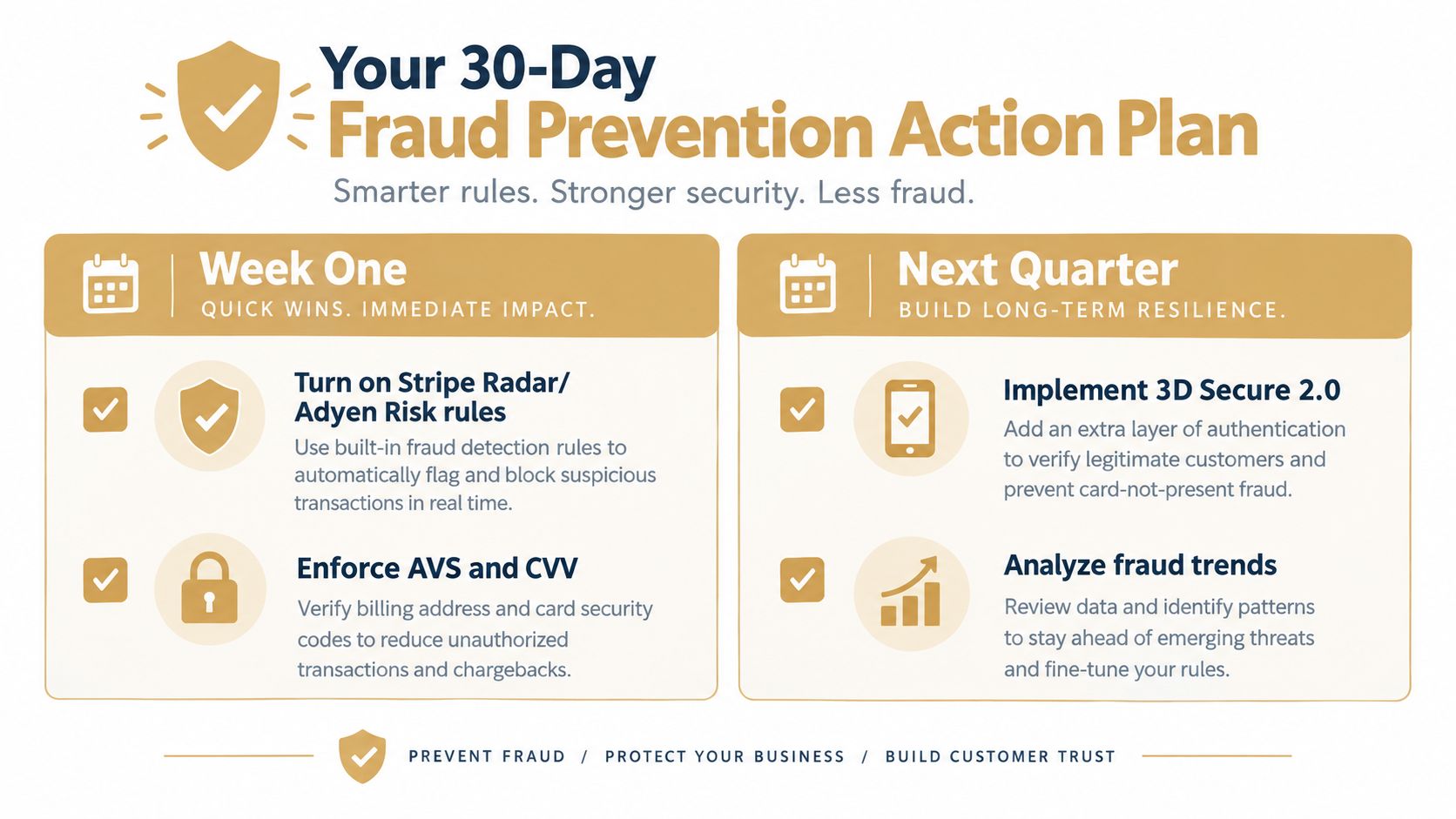
Week one is about stopping obvious abuse without redesigning your stack. Turn on your processor's default fraud controls, enforce AVS and CVV on every transaction, and add basic velocity rules for repeated declines and repeated device use. If you already have a high-risk checkout cohort, route those transactions to step-up authentication first instead of blanketing every buyer.
Week two is where you add a real decision layer. Wire a synchronous verdict call into checkout so the system can return allow, review, or block before capture. That one change turns fraud from a report you read later into a live gate you control now.
Week three is manual review discipline. Build the queue, name the owner, and set an SLA. If a case lands in review and nobody touches it, your “fraud team” is just a holding pen for customer frustration.
Week four is measurement. Instrument chargeback, refund-abuse, and review-rate dashboards so you can see drift before it becomes a crisis. If you don't measure intent-based abuse separately from classic fraud, the numbers will lie to you.
30-day priorities
- Week One: enable processor defaults, AVS, CVV, and basic velocity limits.
- Week Two: add inline verdict gating with a synchronous allow/review/block path.
- Week Three: create manual review ownership and escalation rules.
- Week Four: build dashboards for disputes, refunds, and false declines.
Next quarter is when you harden the system. Add deeper device intelligence, custom scoring for your own abuse patterns, and dedicated first-party misuse logic. That's where the genuine advantage lies once the obvious holes are closed.
Portreeve gives subscription teams an inline screening layer for signups, trials, checkouts, and logins, with allow, review, or block decisions in under 100 milliseconds. If you want to gate fraud before payment capture and keep the decision logic tied to the event itself, visit Portreeve and see how it fits into your checkout flow.