
Fraud is intentional deception used to obtain money, goods, services, or other value, and INTERPOL estimated global financial fraud losses at USD 442 billion in 2025. In modern SaaS, that includes far more than stolen cards, it reaches trial farming, AI-enabled impersonation, synthetic identities, and first-party policy exploitation.
The popular advice is simple: add a payment-fraud tool, block suspicious cards, and review chargebacks later. That advice fails when the abuse begins before payment. A user can drain AI credits, cycle through free trials, impersonate another person, or manipulate refunds while appearing legitimate at the checkout step. By the time a chargeback arrives, your product may already have absorbed the infrastructure cost, support burden, and lost capacity.
For a SaaS founder, the useful question behind que es fraude isn't only “What legal definition applies?” It's “Which person, account, device, payment artifact, or behavior is misrepresenting intent, and where can I stop the loss before the action commits?”
Table of Contents
- Redefining Fraud for the Digital Economy
- The Anatomy of a Modern Fraud Event
- How AI and Synthetic Identities Changed the Game
- Navigating the Gray Zone of First-Party Abuse
- Moving Beyond Static Rules to Entity Linking
- Implementing Inline Screening for SaaS Products
Redefining Fraud for the Digital Economy
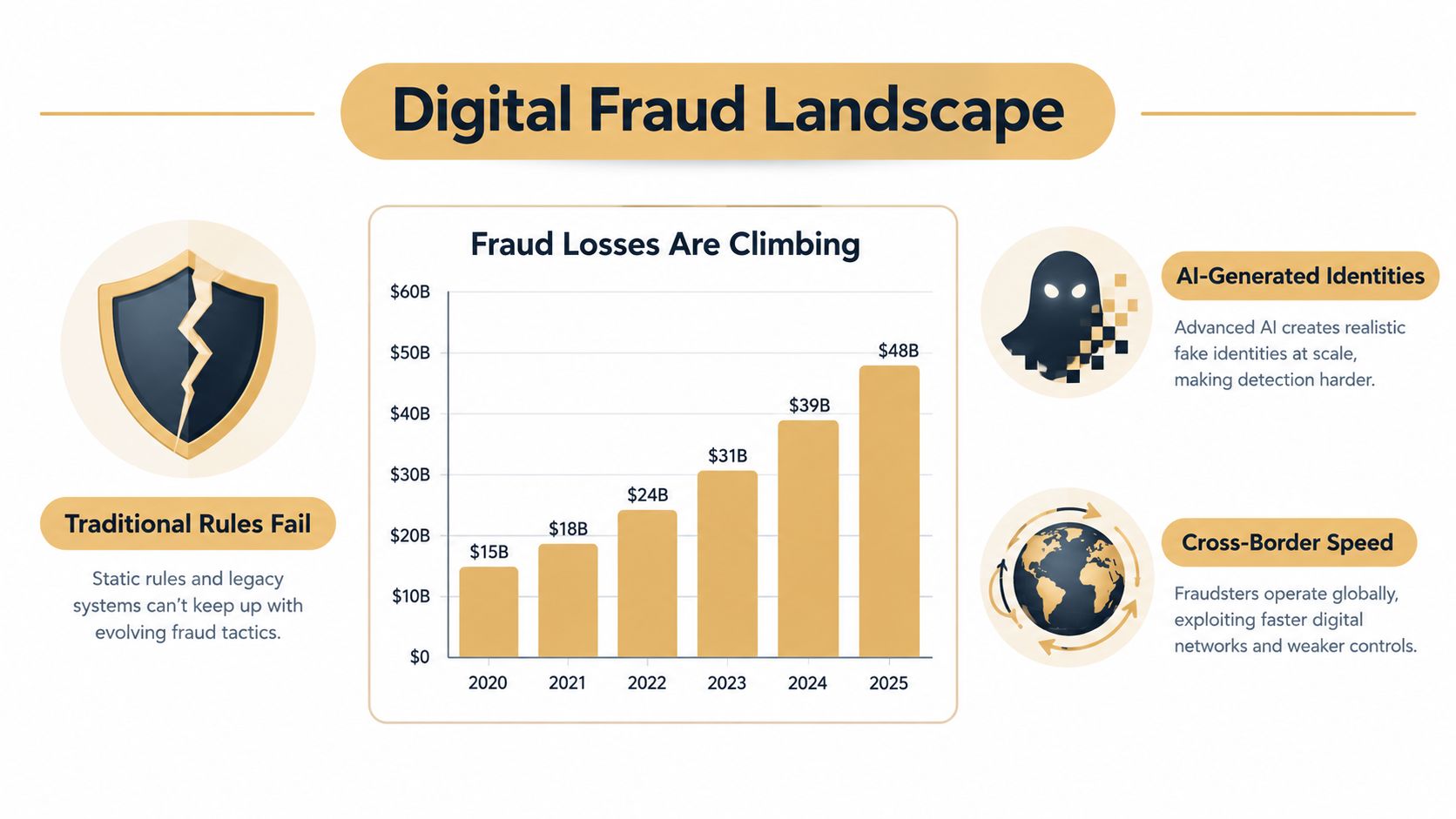
Fraud has a legal core, but product teams need a definition they can operate. Fraud is a coordinated pattern of intentional deception that extracts value from a system, including money, services, account access, promotional credit, data, or scarce infrastructure. That covers stolen payment credentials and the customer who repeatedly creates accounts to consume a benefit they know they are not entitled to.
A narrow payment-focused definition misses how abuse works in SaaS. INTERPOL's Global Financial Fraud Threat Assessment identifies investment fraud, advance-payment fraud, romance fraud, business email compromise, impersonation fraud, and phishing among prevalent global types. These schemes cross borders and channels, so card authorization is only one event in a longer abuse sequence.
The legal definition is necessary but insufficient
Historically, fraud meant intentional deceit or trickery used to make another person surrender something of value. A legal history summary from EBSCO Research Starters on fraud describes four elements in the modern framework: a material false statement, knowledge that the statement is false, reliance by the victim, and resulting damages.
That framework helps lawyers and investigators establish responsibility. It does not tell a growth team whether to allow a signup from a device tied to repeated trials, or whether to route a refund request for review. Product controls need behavioral evidence, entity linkage, recurrence, and intent signals, even when the final legal classification remains uncertain.
Practical rule: Treat fraud as a lifecycle problem. Review onboarding, login, trial access, resource consumption, payment, refunds, and account recovery as connected events.
A SaaS product can absorb abuse before a customer pays. One actor may create several accounts to multiply a free allowance, automate requests that exhaust shared capacity, combine a real identity with a disposable email, or use a borrowed payment method. A single stolen card may be only one part of the pattern. The same actor could have farmed trials first, consumed compute, and tested which controls respond.
Why founders should care early
Fraud affects more than revenue. It distorts acquisition data, wastes compute, increases moderation workload, creates unfairness between customers, and damages trust when legitimate users encounter abuse or account takeover. Victims can also experience psychological trauma and shame, which makes prevention a trust and safety responsibility rather than a finance-only task.
The operational question is whether the evidence shows misrepresentation, unauthorized use, policy manipulation, or coordinated extraction of value. That framing supports earlier controls across signup, access, usage, payment, and recovery. It also leaves room for proportionate review, because gray-zone behavior may violate product policy without meeting the threshold for a criminal case.
The Anatomy of a Modern Fraud Event
Fraud rarely arrives as one suspicious transaction. In a digital product, it is usually a sequence: a false claim, a control that accepts it, value extracted from the product, and an attempt to hide the relationship between those events.
A user may submit a synthetic identity at signup, pass a weak verification check, consume promotional credits, attach a payment method, and abandon the account before the signals connect. Another actor may take over an established account and use its history to initiate purchases. Both patterns involve account trust, access, and product resources, not only a compromised card.
Start with the underlying deception
The Merchant Risk Council glossary defines fraud in practical financial terms as intentional deception or misrepresentation used to obtain value. It separates that conduct from a chargeback, the payment-network process that reverses a transaction. The distinction affects system design. A chargeback is an outcome or recovery mechanism, not a complete detection strategy.
Controls that begin after a dispute are late by design. Screening should evaluate evidence before account creation, trial activation, resource allocation, checkout, and login. Post-event dispute handling remains necessary, especially for recovery and case review, but it cannot carry the entire fraud program.
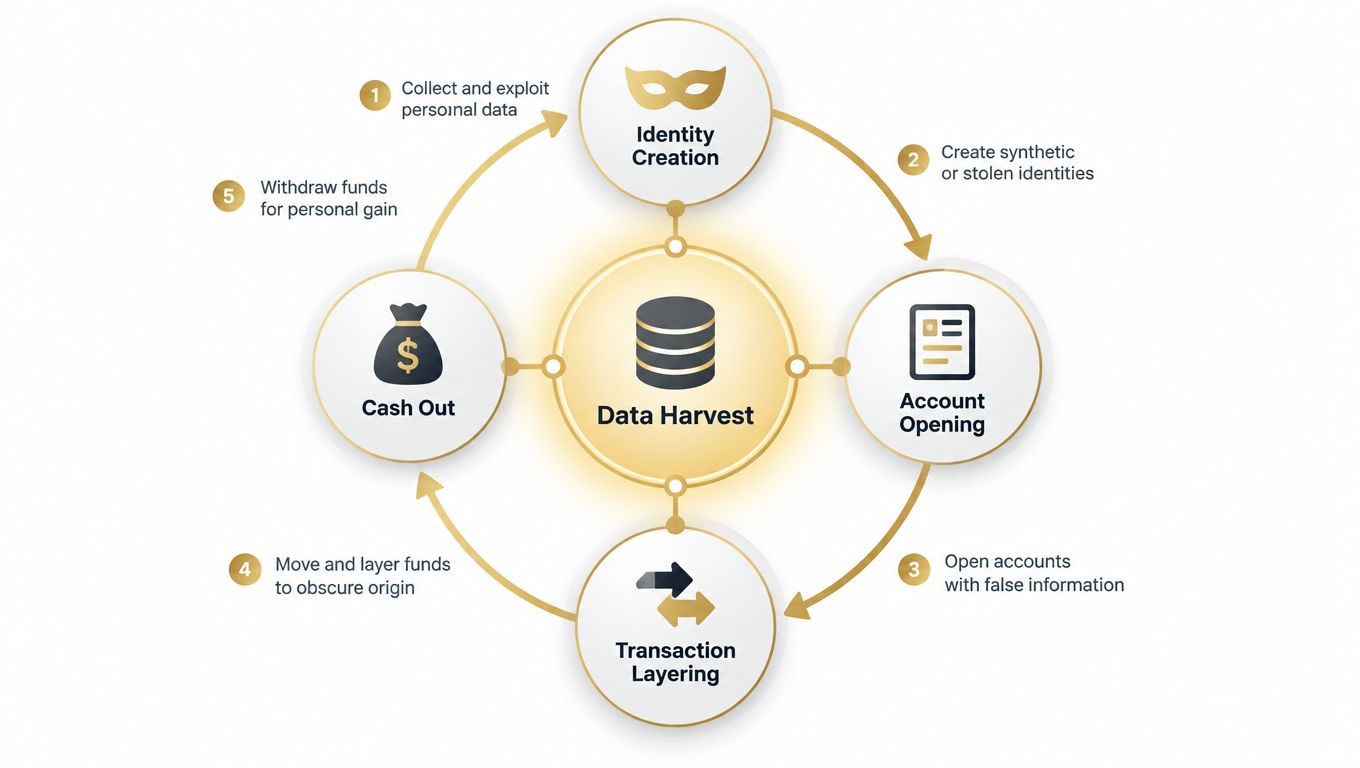
Identity misuse now extends beyond names and government identifiers. The Merchant Risk Council glossary describes identity-theft markers that may include biometric data, device or routing identifiers, and other unique signals used to impersonate someone or open accounts without authority. In practice, those signals need to be assessed alongside device history, payment details, account relationships, and behavior. A genuine identity signal does not prove that the current user has the right to use it.
Build controls around the causal chain
A practical event model asks four questions:
- What was represented? Record the identity, eligibility, ownership, payment authority, or intended use asserted by the user.
- What evidence supports it? Compare the claim with device history, account relationships, payment artifacts, and earlier decisions.
- What value is at risk? Count money, free resources, AI credits, inventory, support time, and restricted functionality.
- What happens next? Preserve the decision, reason code, linked entities, and later outcome so adjudicated cases improve future decisions.
The model exposes a common operational failure: signup, authentication, payments, growth, and support sit in separate systems, while the attacker experiences them as one product. Entity links, event timing, and repeated resource use can reveal a coordinated pattern before a single event appears conclusive. That is also where proportionate review matters, because policy exploitation may require intervention even when criminal intent remains unproven.
How AI and Synthetic Identities Changed the Game
Generative AI has lowered the effort required to impersonate a person, tailor a social-engineering message, or create plausible identity material. The result isn't just “more fake documents.” It's a broader shift toward convincing, adaptive behavior that can move through signup, support, login, and checkout with speed that static checks struggle to match.
The TransUnion H1 2026 fraud trends update reported that 26% of consumers across 18 countries and regions lost money to digital fraud in the last year, with a global median loss of $1,671. The same report shows why consumer-facing products should treat digital fraud as a routine operational risk rather than a rare edge case.
Why document checks no longer settle the question
A document can be genuine while the person using it isn't the rightful owner. A face can appear authentic while being generated or manipulated. A user can also combine real information from several people into a synthetic identity that passes isolated checks but looks inconsistent when viewed across events.
Experian's reporting on AI and fraud notes that 60% of businesses say fraud losses increased, while 60% of consumers have heard of AI-generated fake images or videos used in scams. These figures point to two different pressures: businesses are absorbing more loss, and users are becoming more aware that visual authenticity is no longer reliable evidence by itself.
The practical response isn't to discard verification. It's to stop treating verification as a single decisive moment. A legitimate user should produce a coherent history across device, account, payment, behavior, and support interactions. An attacker may produce convincing individual artifacts while failing that consistency test.
For a deeper treatment of the identity layer, see this guide to synthetic identity fraud.
Europol says generative AI is being used to tailor social-engineering tactics and conceal online fraud schemes. That matters for SaaS because attackers can target free trials, AI credits, and account recovery before a payment processor sees anything suspicious.
Look upstream from checkout
A product that protects only checkout misses the value that attackers can extract earlier. Trial farming, scripted signups, credential stuffing, and AI-credit abuse all target account creation or login. Those events should carry their own controls, with decisions based on linked history rather than a single email address.
The useful signals include repeated enrollment, unusual event velocity, device reuse across identities, payment-instrument reuse, and behavior that diverges from normal customer journeys. None is conclusive alone. Together, they can justify an allow, review, or block decision before the platform commits scarce resources.
Navigating the Gray Zone of First-Party Abuse
Classic fraud usually involves stolen credentials, impersonation, or an outside actor deceiving a business. First-party abuse is harder because the customer may be real, authenticated, and aware of the product rules. The user exploits a loophole, disputes a legitimate transaction, cycles through promotional offers, or misrepresents circumstances to obtain a benefit.
That doesn't mean every policy violation is fraud. A customer who misunderstands a trial condition may need education. A customer who repeatedly creates accounts after receiving the benefit, uses several linked payment artifacts, and conceals the connection presents a different risk. Intent, recurrence, and coordinated behavior provide stronger evidence than a single disputed action.
LexisNexis risk research says first-party fraud doubled in the last year. The same source describes a market in which identity and fraud patterns are shifting, while Mastercard's 2026 reporting says stolen credit card records available for sale dropped by almost 20% in 2025 even as payment fraud became more complex. Those signals support a practical conclusion: fewer obvious stolen-card indicators doesn't mean less abuse.
Compare the behavior, not just the label
| Signal Type | Classic Criminal Fraud | First-Party / Policy Abuse |
|---|---|---|
| Identity | Stolen, synthetic, or impersonated identity | Often a genuine customer identity |
| Stated intent | Deliberately false from the beginning | May begin legitimately, then exploit a rule |
| Typical target | Money, credentials, goods, or account access | Trials, refunds, credits, discounts, or service usage |
| Strong evidence | Credential misuse, impersonation, linked devices, unauthorized payment | Recurrence, velocity, account cycling, repeated exceptions, contradictory explanations |
| Best response | Block, investigate, preserve evidence, and manage recovery | Apply graduated friction, review context, and enforce policy consistently |
Set a boundary your team can defend
A fair policy distinguishes mistakes from deliberate exploitation. Give support teams access to the same linked history that risk analysts use, then define escalation criteria in advance. A first occurrence with a plausible explanation may deserve a warning or one-time accommodation. Repeated behavior across connected accounts should move toward review or restriction.
The first-party fraud analysis is useful for framing this distinction. The key operational point is that intent rarely appears as a confession. Teams infer it from repeated decisions, concealment, linked identities, and the effort a user makes to preserve access after a benefit has been consumed.
Don't force every gray-zone case into a criminal-fraud label. Use evidence to choose a proportionate action, and keep the reason for that action auditable.
Moving Beyond Static Rules to Entity Linking
Static rules still have a place. A rule that blocks a known compromised payment artifact or impossible account state can be fast and easy to explain. The problem begins when a team treats a short list of isolated rules as a complete detection system.
Attackers change emails, rotate sessions, vary names, and distribute activity across accounts. If the system stores only the current event, every new account looks new. Entity linking gives the system memory, connecting activity through stable or semi-stable relationships such as email, device token, card fingerprint, and payer wallet.
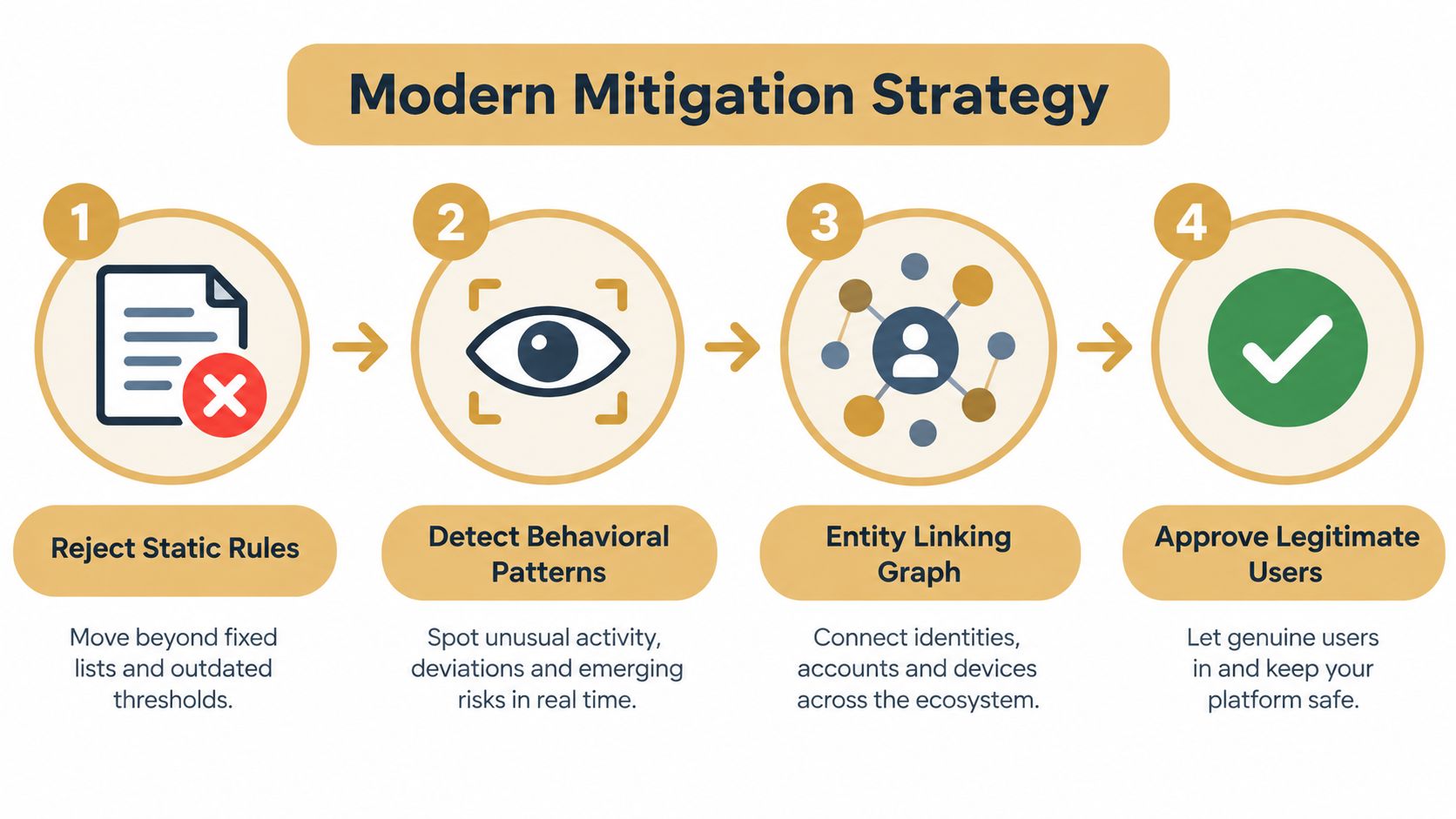
Connect evidence before making the decision
A useful graph doesn't need to identify a person in the abstract. It needs to answer product questions:
- Account relationship: Has this device or payment artifact appeared on other accounts?
- Event relationship: Did several identities start trials or attempt checkout in a compressed sequence?
- Outcome relationship: Were linked accounts previously blocked, refunded, or confirmed as abusive?
- Behavior relationship: Does the current flow resemble automation, credential stuffing, card testing, or resource farming?
This approach resists burner-email churn because the email is only one node in the history. It also helps analysts distinguish a shared household device from coordinated abuse by examining the surrounding events and decisions.
Independent research on financial identity verification finds that biometric and behavioral authentication combined with anomaly detection can outperform rule-based approaches, while also creating trade-offs involving explainability, demographic bias, and cross-jurisdiction data governance. The lesson isn't to replace rules with an opaque model. It's to combine useful detection with auditable evidence and clear reason codes.
For an implementation-oriented overview, see fraud detection software.
Prefer decisions people can inspect
A risk score may rank events, but a reviewer still needs to know what happened. Use explicit outcomes such as allow, review, or block, then attach the evidence that produced the decision. That makes appeals faster, policy tuning safer, and post-incident analysis more reliable.
A good screening layer also records what happened after the decision. If a reviewed account becomes confirmed abuse, the linked entities should be marked according to policy. If a blocked customer is later validated as legitimate, the system needs a way to correct the history without permanently poisoning related users.
Engineering principle: Detection can be probabilistic, but enforcement should be explainable. Analysts need a reason they can verify, not just a number they can't interpret.
Implementing Inline Screening for SaaS Products
The best place to stop abuse is immediately before the product commits the value. For SaaS, that usually means screening signup, trial start, AI-credit allocation, checkout, and login, not just reviewing payment disputes after the fact.
Start with an inventory of irreversible or expensive actions. Account creation may trigger welcome messages, storage, and support work. Trial activation may provide access to compute or premium features. Checkout may create fulfillment obligations. Login may expose an established account to takeover. Put a decision gate in front of each action that creates meaningful exposure.
Use a graduated decision flow
A practical flow looks like this:
- Collect evidence before commitment. Capture the event type, identity keys, device context, payment artifacts, and relevant history.
- Link the event to prior activity. Check whether connected identities have consumed trials, triggered reviews, or produced confirmed abuse.
- Return an explicit verdict. Allow ordinary users, route ambiguous cases to review, and block high-confidence abuse.
- Preserve reason codes. Store the evidence used so support and risk teams can explain the outcome.
- Feed adjudication back into policy. Confirmed cases should strengthen linked-entity controls, while false positives should improve exceptions and review guidance.
The gate should be fast enough to sit inside the user journey. It also needs a failure policy that product and risk teams agree on. Some businesses may fail open during a service degradation to protect conversion, while others may temporarily restrict high-cost actions. The important point is to disclose the state and make the trade-off intentional.
Audit your exposure before buying more tooling
Pull recent examples from each lifecycle stage and ask where the business first lost value. If the answer is “after a chargeback,” examine whether the same account, device, or payment artifact appeared earlier in signup or trial events. If the answer is “support discovered repeated refunds,” connect support outcomes to the risk history instead of leaving them in a separate system.
Measure operational quality qualitatively at first. Are reviewers seeing enough evidence? Can they explain a block? Do legitimate users have a clear appeal path? Are free-tier resources reaching intended customers? These questions often reveal more than a dashboard filled with unexplained scores.
Portreeve is one inline option for this workflow. Its screening layer evaluates signups, trial starts, checkouts, and logins, then returns allow, review, or block decisions with reason codes and linked event history before the action commits.
If your current program starts at chargeback review, move one control upstream this week. Choose the most expensive abuse path, map its entities and decisions, add an auditable gate before value is released, and review the outcomes with product, engineering, support, and finance.
Portreeve provides inline screening for SaaS signups, trials, checkouts, and logins, with linked identity history, review workflows, and reason-coded allow, review, or block decisions. Visit Portreeve to evaluate how an upstream abuse screen could fit your product's lifecycle.