
A signup looks clean. The email verifies, the device behaves normally enough, the user starts a free trial, and a small payment later succeeds. Nothing in that first session screams fraud.
Then a few weeks later, support sees a pattern. Several “different” customers are using near-identical workflows. A failed card on one account matches the card fingerprint on another. Trial accounts that looked unrelated connect back to the same device. The names differ, the email addresses differ, and the payment details shift just enough to dodge basic rules. What looked like routine product growth turns out to be one synthetic actor cycling through your signup, trial, and checkout flow.
That's why SaaS and payments teams need a better answer to the question what is synthetic identity fraud. It isn't only a credit-bureau issue. It's a product-abuse issue that shows up inline, inside the events your app already handles every day.
Table of Contents
- Introduction Why Synthetic Identities Slip Past Onboarding
- What Synthetic Identity Fraud Really Means
- How a Synthetic Identity Is Built and Aged
- Synthetic Identities Versus Other Fraud Types
- Why Synthetic Identities Are So Hard to Detect
- Real World Examples and Cost of Synthetic Fraud
- How SaaS and Payments Teams Can Prevent Synthetic Fraud
Introduction Why Synthetic Identities Slip Past Onboarding
A new user signs up, confirms an email, starts a trial, and clears a small card check. The account looks ordinary enough to enter your funnel with everyone else.
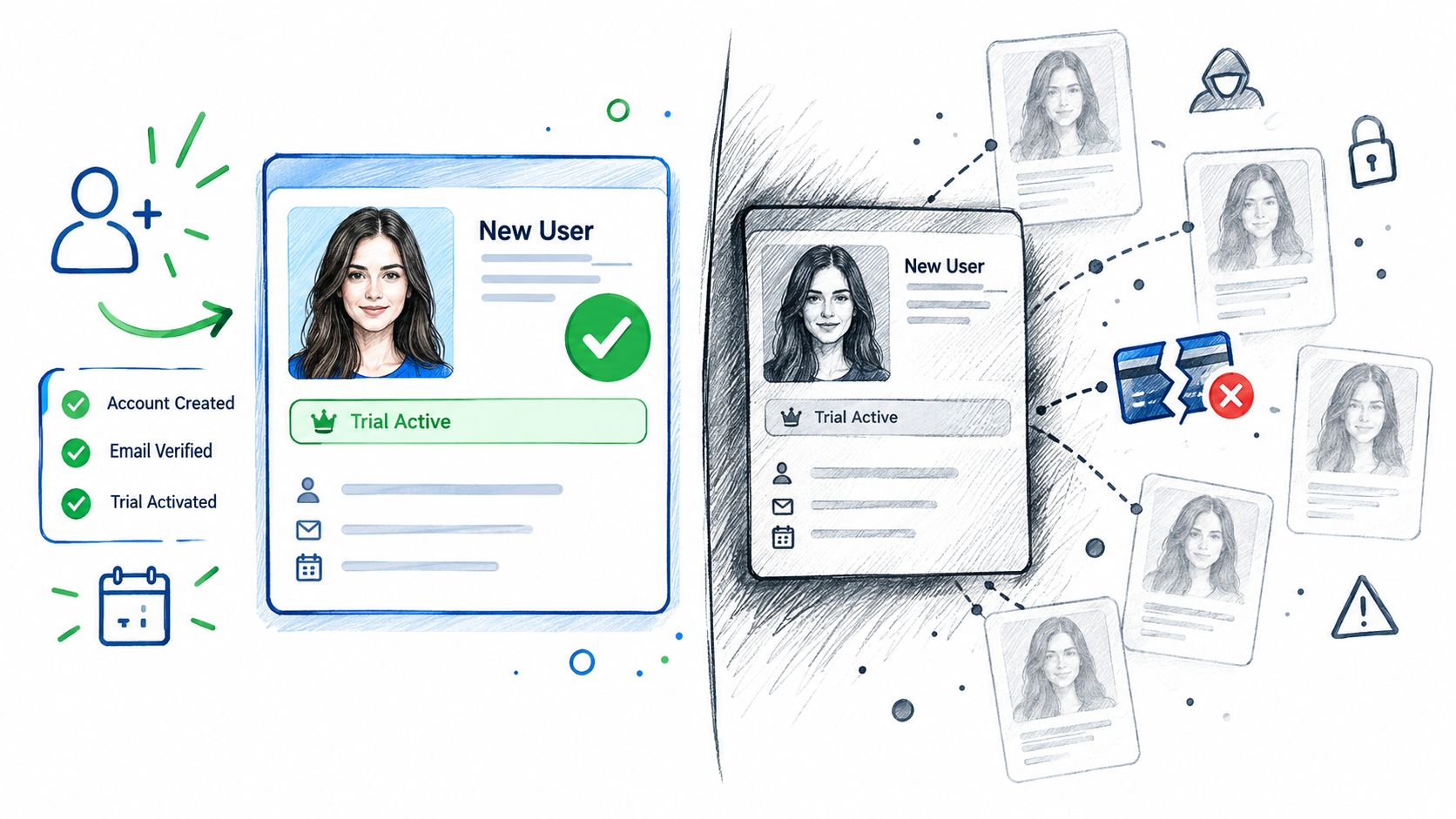
The problem often appears later, after the same operator has opened several accounts, used product capacity, tested payment methods, or built a thin layer of account history. By then, the abuse no longer looks like one bad signup. It looks like routine growth with a few strange edges.
Why the first event often looks fine
Synthetic identities slip through onboarding because each individual piece can pass a basic check on its own. The email inbox exists. The card can authorize. The name matches the form format. The session behavior may stay calm enough to avoid obvious risk rules.
That creates a blind spot for SaaS and payments teams. Many onboarding systems inspect fields one by one, almost like checking whether each brick in a wall looks solid. Fraudsters win when the wall as a whole is fake but each brick looks acceptable in isolation.
A synthetic operator does not need a perfect identity. They need one that survives the first few decisions.
Why this matters for product and payments teams
Synthetic identity fraud is often framed as a credit-bureau problem, but product teams usually meet it much earlier. They see it in free trials, promotional abuse, card testing, multi-accounting, and low-noise checkout activity that looks normal until you connect the accounts.
That last part is where many teams get tripped up. A single signup rarely explains much. The useful signal appears in the links across signups. Reused devices. Shared card fingerprints. Email patterns that rotate just enough to look new. Billing details that shift slightly while the operator behavior stays consistent.
In other words, the fraud is not hiding in one field. It is hiding in the relationship between fields, events, and accounts.
Why late recognition is expensive
Synthetic abuse usually has no obvious victim calling support on day one. That changes the operating pattern. Instead of a clear stolen-account report, you get scattered clues across onboarding, trial usage, payments, and support queues.
By the time the pattern is visible, the attacker may already have consumed credits, triggered manual review work, created failed-payment noise, or opened more accounts from the same underlying setup. The cost comes from delay as much as from chargebacks.
Single-event checks still matter. They just miss the main question. For synthetic identity fraud, the better question is whether this “new” customer is new once you connect the email, device, payment, and behavior around the account.
What Synthetic Identity Fraud Really Means
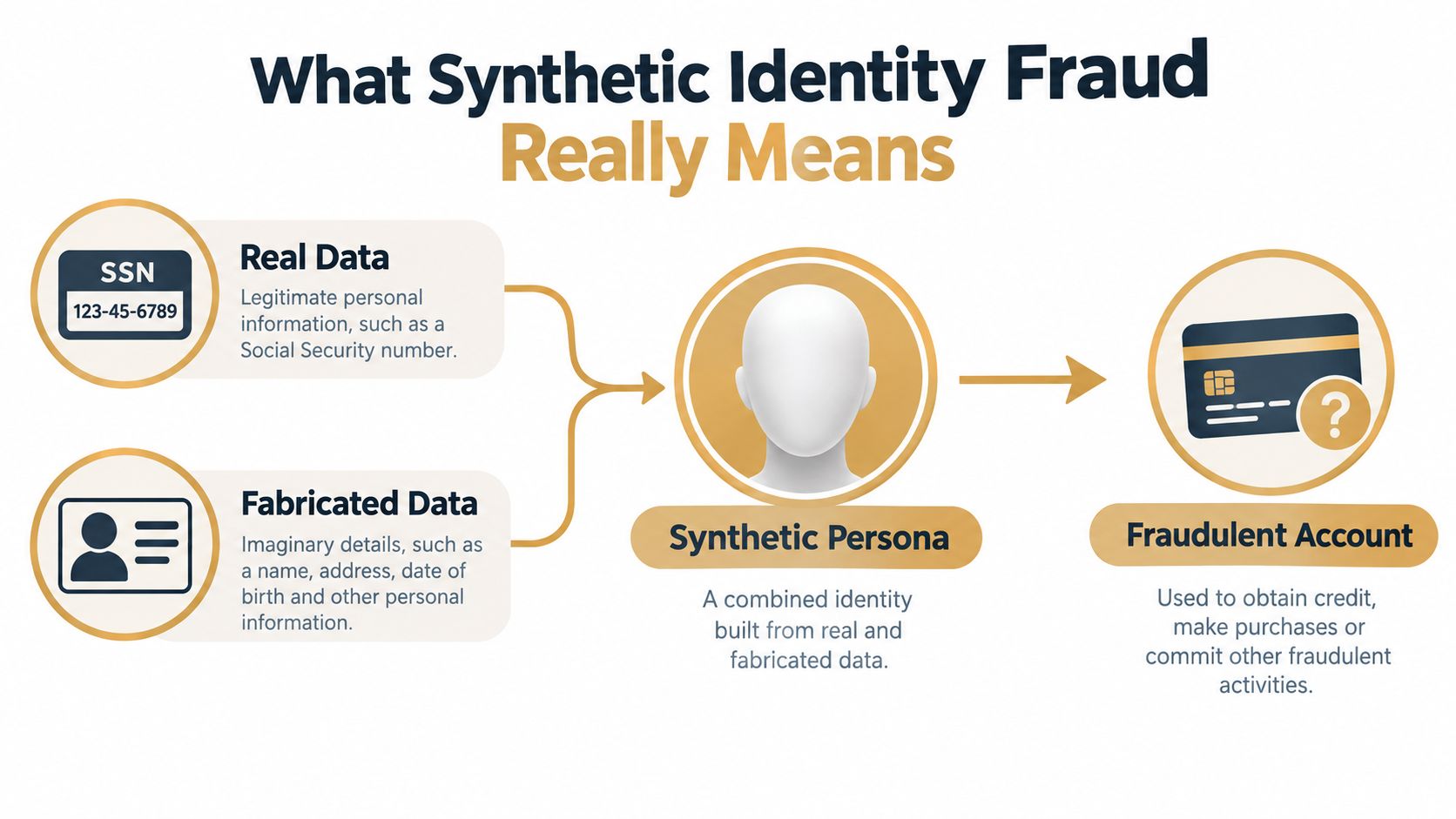
The simplest way to think about a synthetic identity is this: someone assembles a customer persona the way a counterfeiter assembles a believable prop. Some pieces are real. Some are invented. Together, they create something that looks coherent enough to pass.
A blended identity, not a copied one
Synthetic identity fraud is not just stealing Jane Doe's identity and pretending to be Jane Doe. It's closer to creating a new fictional person using a mix of valid and fabricated details.
The U.S. Government Accountability Office defines synthetic identity fraud as combining real information, such as a legitimate Social Security number, with fictitious information, such as a fake name or date of birth, to create a new identity that is then used to evade safeguards or commit fraud.
That distinction matters. In traditional impersonation, the fraudster borrows an already-existing identity. In synthetic fraud, the fraudster manufactures a new one.
Why basic validation misses the point
Many checks answer only narrow questions:
- Is the email syntactically valid
- Does the payment method work
- Does the date format make sense
- Does the ID fragment belong to a real system
Those checks can all return “yes” while the overall identity is still fake.
A synthetic identity works because it is internally consistent. The fraudster doesn't need every element to be real. They need the combined profile to survive enough screening to get an account open and start building trust.
One practical way to frame it for product teams is this: synthetic fraud is often less about fake fields and more about fake personhood.
A team that deals with fake account patterns in online products already knows this feeling. The account record may look tidy. The behavior across multiple records is what exposes the problem.
What the fraudster controls
The synthetic persona usually includes contact points and account access controlled by the attacker. That can include:
- Email access: So they can verify accounts and receive resets.
- Phone or messaging access: So they can clear secondary checks if needed.
- Payment artifacts: So they can start small, test acceptance, or rotate instruments.
- A persistent device or setup: So they can manage many identities over time.
Here's a useful explainer before going deeper into the lifecycle:
The important mental shift is simple. Don't ask only, “Is this data valid?” Ask, “Do these events belong to a real, distinct customer, or to a fabricated persona that keeps resurfacing under new labels?”
How a Synthetic Identity Is Built and Aged
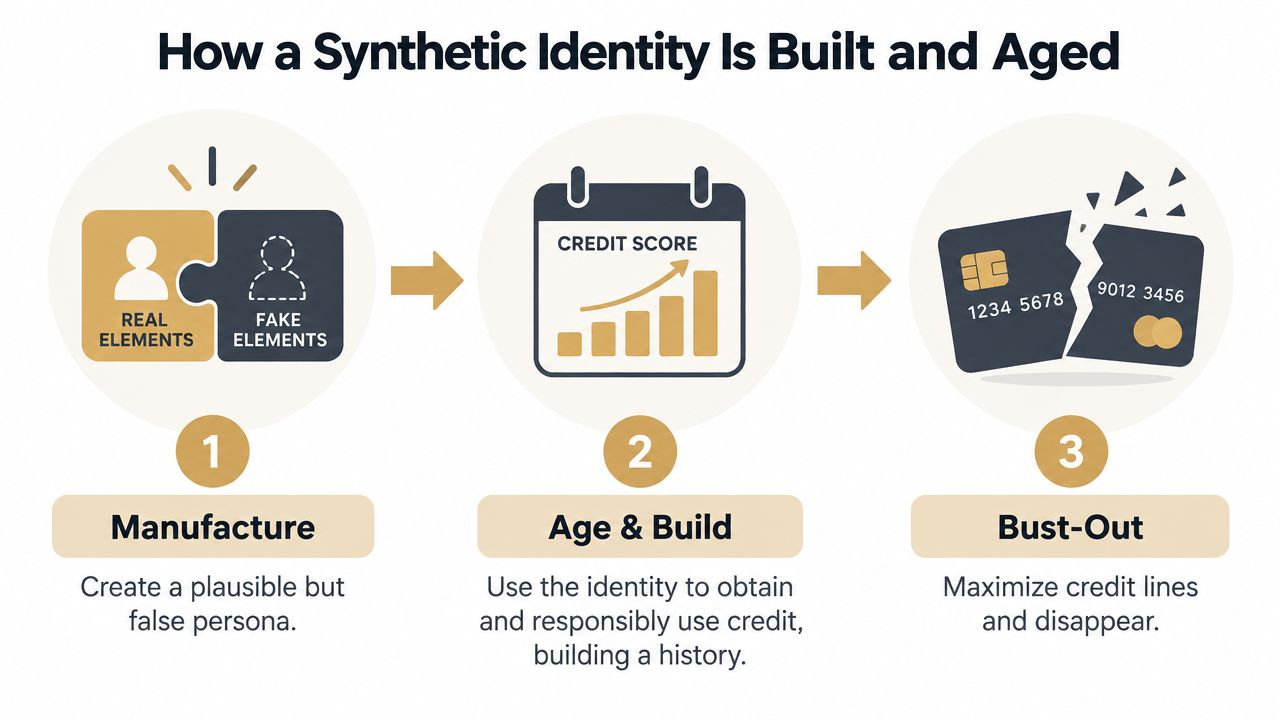
Synthetic identity fraud usually follows a long game. It doesn't begin with the final theft. It begins with patient construction.
Stage one is manufacturing
The first stage is identity manufacturing. The fraudster blends real identifiers with invented attributes to produce a profile that can survive early review. The exact ingredients vary, but the goal stays the same: create an identity that looks ordinary enough to enter a system.
In a SaaS context, that can mean a believable name, a fresh email account, a stable device setup, and a payment method that can pass an initial check. In credit contexts, it can include a legitimate identifier mixed with fabricated personal data.
The trap for defenders is obvious. Field-level checks often answer only whether each part appears valid on its own.
Stage two is aging and trust building
The second stage is credit building, or more broadly, history building. The synthetic identity is used carefully. It may make low-risk transactions, pay on time, avoid noisy behavior, and let trust accumulate.
That long-horizon pattern is central to the fraud. According to a benchmark summary of synthetic fraud behavior, the pattern often appears in a three-stage lifecycle of identity manufacturing, credit building, and bust-out, and the strongest signals are often linkage-based rather than single-field based, such as shared devices across unrelated accounts, robotic interaction patterns, and connected infrastructure (synthetic identity lifecycle and linkage signals).
Practical rule: if an identity can become more believable simply by surviving your system for a while, then your controls need memory, not just entry checks.
For product teams, “aging” doesn't always mean formal credit building. It can mean repeated trial starts, clean-looking logins, low-volume usage, or small successful checkouts before abuse expands.
A related operational clue is disposable contact infrastructure. Teams that track disposable email domain abuse in signups often see how quickly a plausible first event can stop looking plausible once the same setup appears across account clusters.
Stage three is monetization
The final stage is the bust-out. That's when the attacker turns accumulated trust into value. In lending, that often means maximizing available credit and disappearing. In SaaS or payments, it can mean converting aged accounts into payment abuse, resource extraction, promo abuse, or coordinated checkout attempts.
The key operational lesson is timing. If your process waits for obvious loss events, you're acting after the synthetic identity has already matured.
A U.S. Federal Reserve hosted white paper cited by the GAO noted that traditional identity-fraud models failed to flag 85% to 95% of potential synthetic identity fraud applicants, and independent industry estimates reported U.S. unsecured credit synthetic identity fraud losses reached about $2.94 billion in 2025, up from $1.80 billion in 2020, implying roughly 16% annual growth over that period (GAO forum and linked synthetic fraud estimates).
That's why cross-event correlation matters so much. A valid-looking first application doesn't tell you whether you're seeing one customer. It may only tell you the attacker assembled a convincing first impression.
Synthetic Identities Versus Other Fraud Types
Fraud teams often lump several problems together because they all show up around account creation. That creates bad controls. The response you need for a synthetic identity isn't the same as the response for a bot burst or a stolen card test.
The quickest distinction
A synthetic identity is a constructed persona. A stolen identity is a real person being impersonated. Bot signups are often about automation volume. Card testing is usually about payment instrument validation.
Those can overlap, but they aren't the same problem.
How Synthetic Identity Fraud Compares to Related Abuse
| Fraud Type | Identity Source | Victim Complaint | Typical Time Horizon | Primary Signal |
|---|---|---|---|---|
| Synthetic identity fraud | Blend of real and fabricated attributes | Often absent or delayed | Longer horizon, with trust built before monetization | Linkage across accounts that look unrelated on the surface |
| Stolen identity fraud | Real person's existing identity | More likely, because a real victim may notice | Can be immediate or short | Mismatch between customer behavior and known identity owner |
| Bot signups | Often low-effort or fabricated account details at scale | Usually none at the identity level | Short burst | Automation patterns at signup and repeated scripted behavior |
| Card testing | Usually driven by stolen or uncertain payment credentials | Cardholder disputes may appear later | Short burst or repeated checkout attempts | Payment artifacts and repeated authorization behavior |
Where teams usually misclassify the problem
The most common mistake is treating synthetic identities as just “better fake accounts.” That's incomplete. Many fake accounts are disposable and noisy. Synthetic identities are often managed more carefully and can survive longer because they're designed to look coherent.
Another mistake is assuming every synthetic attack starts with visible bot behavior. Sometimes it does. Sometimes it doesn't. A patient operator can look far more like a small cluster of normal users than a classic automation wave.
If the only question you ask is “Was this signup automated?”, you can miss the harder question: “Is this apparently distinct customer actually part of a linked abuse identity that keeps returning?”
This is also why victim-driven detection is weak here. With stolen identities, a real person may complain. With synthetic identities, there may be no immediate person raising a hand. The account can sit until it has enough history to become valuable.
Why Synthetic Identities Are So Hard to Detect
The hard part isn't defining synthetic identity fraud. The hard part is detecting it early enough to matter.
Traditional checks look at records, not relationships
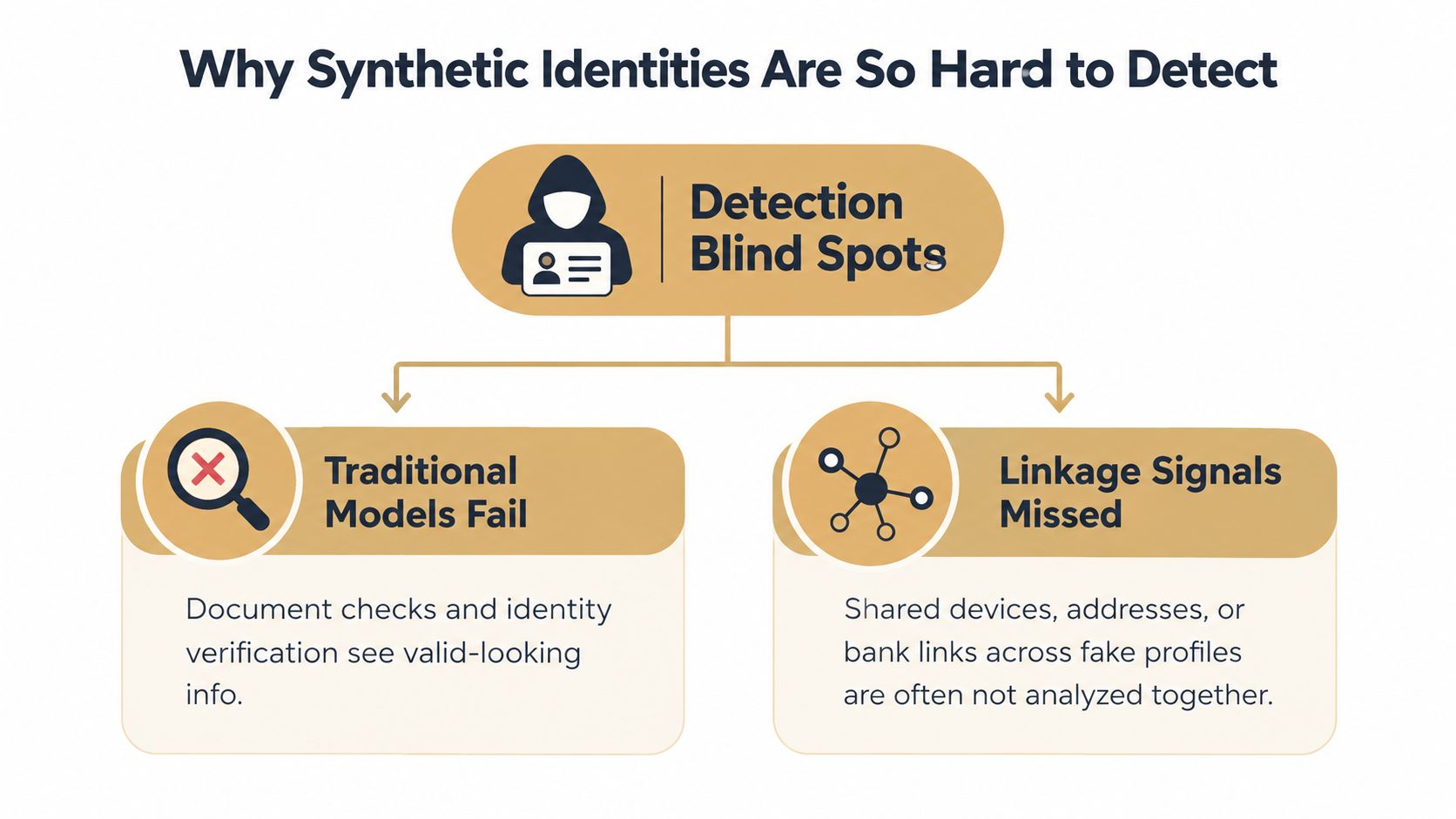
Most onboarding systems inspect the record in front of them. They validate a field, score a document, or verify that a payment method can be used. That approach helps with obvious fraud, but it struggles when the profile is assembled to look normal.
A synthetic identity can pass because each individual element clears its own narrow test. What those checks usually don't ask is whether the same device, payer, or interaction pattern has appeared behind a string of “different” accounts before.
The strongest signals are connective
The most useful signals in synthetic fraud tend to come from linkage. Not one field. Not one event. The links between events.
High-signal examples include:
- Shared devices across unrelated accounts: Different names and emails, same underlying environment.
- Repeated payment artifacts: New accounts that keep converging on the same card fingerprint or payer wallet.
- Robotic interaction patterns: Surface identity changes, but the way the actor moves through signup or checkout stays unusually consistent.
- Connected infrastructure: A cluster of accounts that behaves as if one operator controls them.
A global fraud report from LexisNexis said synthetic identities appear in 11% of fraud globally, an eight-fold year-over-year increase, and that LATAM accounts for 48.3% of the synthetic-fraud share in its data. The same reporting noted that fraudsters now invest months to establish synthetic identities, which is why one-time velocity rules lose value and persistent cross-event linkage becomes more important (LexisNexis Cybercrime Report press release on synthetic identity patterns).
Why memory matters more than one-time rules
A velocity rule can catch bursts. It can't reliably catch an actor who spaces activity out, varies names, rotates emails, and returns later with the same underlying setup.
That's where teams need historical memory. If you can only evaluate the event in front of you, then every fresh label gets a fresh chance. If you retain linkage across events, the system can recognize that today's “new” account is really yesterday's actor in a new wrapper.
Good synthetic fraud detection often feels less like checking identity documents and more like tracking recurring fingerprints of control.
For SaaS and checkout flows, this means evaluating signup, trial start, trial conversion, checkout attempt, and login as connected events rather than isolated moments. The signal may be weak at any one point. The pattern across those points is often much stronger.
Real World Examples and Cost of Synthetic Fraud
A familiar SaaS pattern goes like this. A user signs up for a free trial with a clean-looking email, uses the product lightly, and never causes enough friction to trigger review. Two weeks later, another "new" account appears with a different name, a different inbox, and a different card. Viewed one account at a time, both look acceptable. Viewed together, they reconnect through the same device, browser setup, IP history, or payment artifact.
That is synthetic fraud in product terms. The problem is not only that one identity is fake. The problem is that one operator can keep wrapping the same underlying control surface in new account labels.
Three examples product teams actually see
In a trial flow, the goal is often extraction rather than immediate payment fraud. One person creates a string of accounts, spaces them out, and rotates profile details enough to avoid simple duplicate checks. If your system only checks whether the current email has used a trial before, each fresh email gets a fresh chance. If you link signups across device and network history, the pattern changes from "new user" to "repeat extractor."
Promo abuse works the same way. A checkout may accept a first-purchase discount, referral credit, or onboarding coupon because each record appears distinct. The loss is easy to miss because it hides inside acquisition metrics. Marketing sees more signups. Product sees more activations. Finance sees lower quality revenue later, after credits, chargebacks, refunds, and support time have already piled up.
At checkout, synthetic behavior often appears as payment misuse with a long runway. Some accounts convert normally and behave well at first. Later, failed payment clusters, shared cards across multiple identities, or reused billing elements reveal that the accounts were never independent customers. The names changed. The controller did not.
What the cost looks like in practice
For SaaS and payments teams, the cost is usually operational before it becomes headline fraud loss.
You lose trial inventory, promotional budget, support time, and reviewer attention. You also pollute the data used to judge growth. A product team may believe onboarding is improving because more accounts make it through signup. In reality, a larger share of those "customers" may be linked to the same abuse ring cycling through different wrappers.
The credit market still matters because it shows how profitable synthetic identities can become once they age. Recent reporting on unsecured U.S. credit projected synthetic identity fraud could exceed $3.1 billion in 2026, up from $1.8 billion in 2020, with roughly 16% annual growth. The same reporting found that deepfake document fraud makes up 80.10% of AI-enabled fraud, while synthetic identities account for 12.31%, which is a useful reminder that synthetic abuse often sits inside a broader identity-building workflow rather than acting alone (2026 reporting on AI-enabled fraud mix and synthetic identity losses).
Why this section matters for detection
Single-field checks miss the pattern because the pattern lives in the links.
A trial account can look fine until you connect it to prior signups from the same device. A converter can look fine until the card token or billing fingerprint shows up across multiple identities. A login can look routine until the same environment keeps re-entering under new names.
That is the shift from bureau thinking to product-abuse thinking. Synthetic identity fraud is not only a problem of false personal details at onboarding. For SaaS, trials, and checkouts, it is often a repeated account-control problem that only becomes visible when you connect emails, devices, sessions, and payment artifacts across time.
How SaaS and Payments Teams Can Prevent Synthetic Fraud
The prevention move is straightforward in concept, even if execution takes discipline: make decisions inline, and make them with memory.
Put gates at the moments that matter
For most products, the key control points are:
- Signup: Decide whether to allow account creation, route to review, or block before the record is committed.
- Trial start: Check whether this “new” user is linked to prior trial abuse.
- Trial conversion: Re-evaluate with payment artifacts and account history included.
- Checkout attempt: Treat payment as part of identity, not just a billing event.
- Login: Watch for account cycling and re-entry from linked abuse clusters.
These shouldn't be separate mental models owned by separate teams. They're all identity decisions.
Favor deterministic outcomes over vague scoring
A practical workflow is usually simpler than teams expect:
- Allow when the event has no meaningful abuse linkage.
- Review when the event has partial signals that need human context.
- Block when the event is strongly connected to confirmed abuse.
Reason codes matter because reviewers and product owners need to know why the system acted. “Shared device with prior blocked trials” is far more useful than a generic medium-risk score.
Build around linkage keys you can actually use
For inline product abuse, the most durable evidence usually comes from combinations of:
- Email history
- Device identity
- Card fingerprint or payer wallet
- Cross-event event history within your own tenant
That's also why teams invest in tools and workflows that support device fingerprinting for fraud prevention. Device continuity helps expose returning operators even when names and email accounts change.
One operational option is Portreeve, which screens signups, trials, checkouts, and logins inline, returns allow, review, or block decisions with reason codes, and keeps per-tenant history in an abuse graph so linked identities can be evaluated together.
Operational test: if a confirmed abusive actor can come back tomorrow with a new email and get treated like a brand-new customer, your system still thinks in records instead of relationships.
The aim isn't perfect certainty at signup. It's earlier recognition, cleaner review queues, and fewer cases where abuse is only obvious after the product has already granted value.
Portreeve gives SaaS and payments teams an inline screening layer for the exact moments where synthetic identities tend to slip through: signup, trial start, checkout, and login. If you want to see how deterministic allow, review, and block decisions work with linkage across emails, devices, and payment artifacts, visit Portreeve.