
Most payment fraud guides still talk as if the main problem is a stolen card getting used somewhere it shouldn't. That advice is already stale. In subscription products, the harder problem is often a legitimate user being pushed, manipulated, or tricked into making a payment that looks normal until it's too late, while the fraud losses keep moving earlier in the funnel.
Table of Contents
- The Fraud Problem Has Changed
- Understanding Payment Fraud Losses
- Inline Screening vs Batch Detection
- Core Components of Fraud Detection Architecture
- Measuring Detection Effectiveness
- Real-World Fraud Scenarios for SaaS Products
- Implementation Guidance for Payments Teams
- Building a Fraud Detection Strategy That Works
The Fraud Problem Has Changed
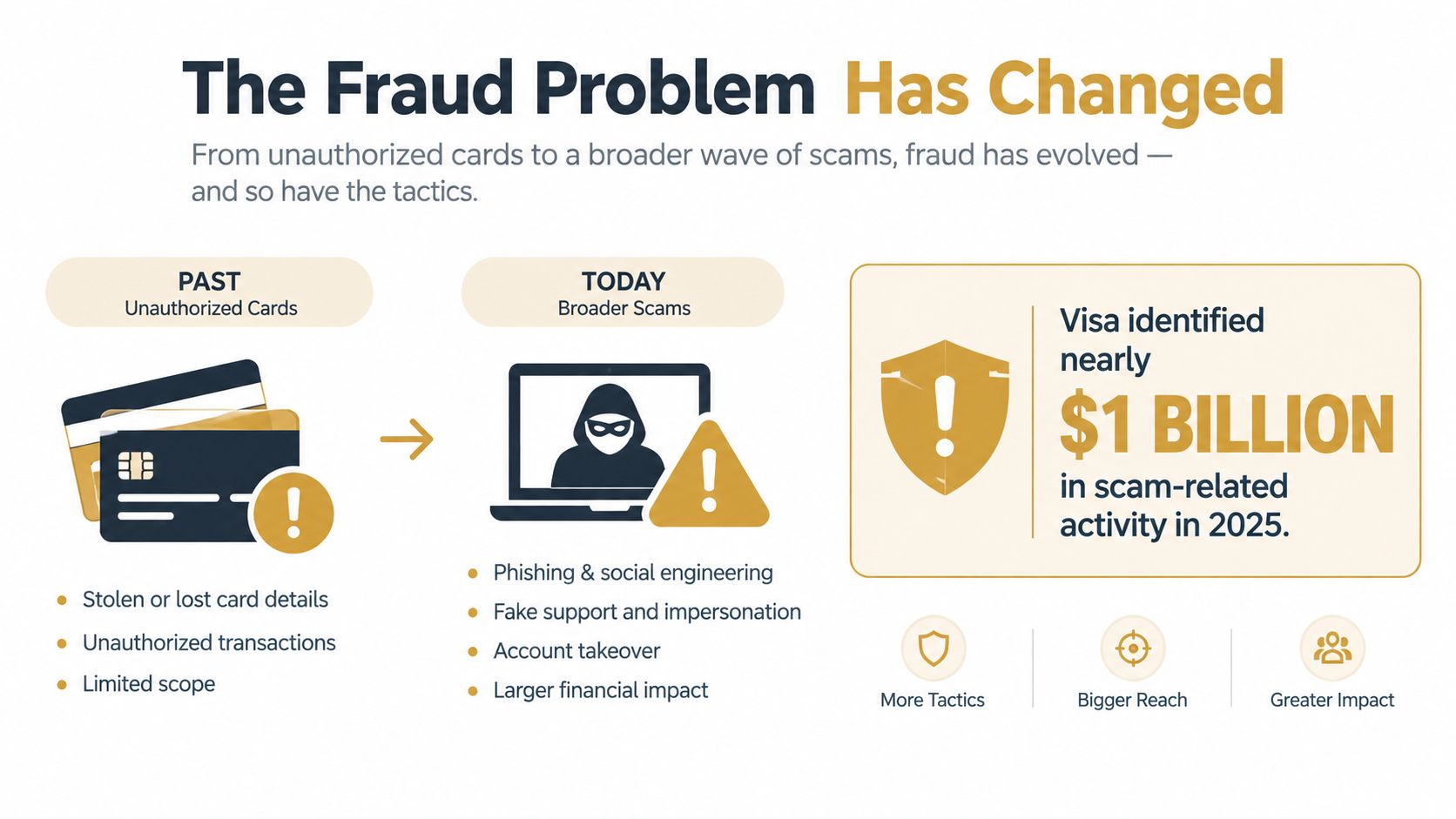
The biggest mistake teams make is treating lower card fraud as proof that exposure is shrinking. The shape of the problem has shifted. Visa identified nearly $1 billion in scam-related activity in the latter half of 2025 and called scams the largest consumer-payment-fraud category, while also reporting that device-token fraud declined 9.6% (Visa threat report).
That shift matters because stronger controls often change attacker behavior instead of ending it. Once stolen-card abuse gets harder, attackers move toward impersonation, phishing, smishing, and fake-refund flows. Open Banking UK's Q1 2026 data showed authorized-push-payment fraud represented more than two-thirds of reported open-banking fraud cases (Open Banking fraud monitor). Authorized does not mean safe.
Why subscription businesses feel this shift first
SaaS teams do more than process payments, they grant access. A manipulator who gets through signup, trial activation, or checkout can create cost before any chargeback appears. If you only look for stolen cards, you miss the harder operational question, separating a legitimate but unusual user from a socially engineered one.
Practical rule: if a payment decision happens after the user has already created an account, started a trial, or consumed credits, you are usually detecting damage, not preventing it.
That is why pre-transaction screening matters more now than post-authorization chargeback review. The decision point has moved earlier, and the fraud playbook has moved with it.
Understanding Payment Fraud Losses
Small fraud rates still create large losses once transaction volume scales. In the European Economic Area, industry-reported fraud across credit transfers, direct debits, card payments, cash withdrawals, and electronic-money transactions totaled €4.3 billion in 2022 and €2.0 billion in the first half of 2023 (ECB). That is real money leaving payment flows across several instruments, not a theoretical risk.
Tiny percentages, real damage
The same ECB data shows why raw percentages can mislead. In the first half of 2023, fraud involving cards issued in the EEA represented 0.031% of total card-payment value and 0.015% of payment volume, while credit-transfer fraud was lower by value at 0.001% but higher by volume at 0.003%. Fraud exposure varies by instrument, so one payment type does not explain another.
The U.S. picture points the same way. Federal Reserve data for 2023 found fraud losses equaled 17.6 basis points of covered card-transaction value, or $17.63 per $10,000 processed, and card-not-present fraud accounted for 54.3% of overall fraud losses (Federal Reserve). The same Federal Reserve dataset shows aggregate fraud losses rising from 7.8 basis points in 2011 to 17.6 basis points in 2023, and merchants absorbing 49.9% of reported fraudulent-transaction losses in 2023, up from 38.3% in 2011.
What the numbers actually imply
Payment type, transaction context, and the link between identities and devices all matter. A low percentage can still become a material business problem when it hits enough volume, especially in checkout-heavy SaaS products. Subscription teams also see a different mix of loss than card issuers, because account takeover, trial abuse, and authorized social engineering can create cost before a chargeback ever appears.
Fraud controls need to evaluate payment type, context, and linked identities together. A single local signal rarely tells the full story.
Inline Screening vs Batch Detection
Batch fraud analysis has its place, but it's the wrong tool if your goal is to stop abuse before it costs you money. Inline screening evaluates the event while the user is still in the flow, then returns an allow, review, or block decision before the action commits. That makes it a prevention layer, not a reporting layer.
The timing difference is the whole game
If a signup is fraudulent, batch systems still let the signup happen. If a trial is being farmed, batch systems still burn infrastructure, support time, and product value before anyone sees a pattern. Inline screening is the only approach that can stop the action before the account is created, the trial starts, or the checkout is sent onward.
The distinction matters even more for subscription businesses because free trials, AI-credit abuse, account cycling, and low-dollar card testing create costs long before chargeback workflows begin. A real-time gate with reason codes can catch repeated patterns across events, not just one suspicious payment attempt. That's where persistent identity history becomes operationally useful.
Here's the practical trade-off:
- Inline screening: prevents damage, but demands low latency and careful thresholding.
- Batch detection: improves investigation and model tuning, but it's always after the fact.
- Combined approach: inline for prevention, batch for learning and monitoring.
An inline system also changes the analyst workflow. Instead of asking, “What do we do after the fraud happened?” the team asks, “What evidence is strong enough to block, what should be reviewed, and what can safely pass?” That's a better fit for SaaS, where customer friction can be as expensive as fraud itself.
A useful framing for payment teams is that batch systems explain the past, while inline systems shape the future. If you only have one, the future still happens first.
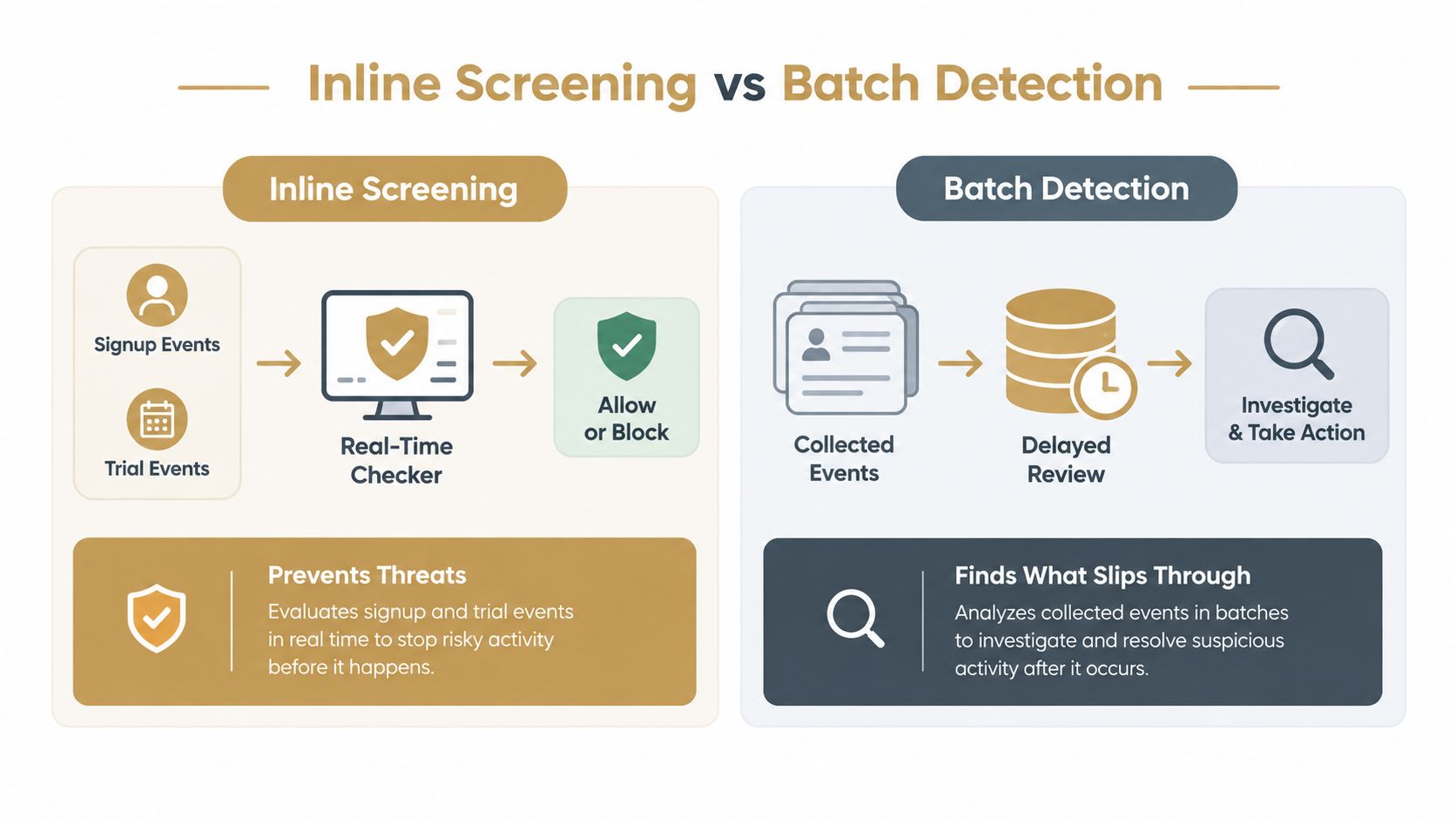
A good architecture makes the live decision before the user feels the workflow stall, not after the charge or signup already cleared.
Read more about how a screening layer fits into a broader stack at fraud detection software for online products.
Core Components of Fraud Detection Architecture
A fraud stack works best when each component has a narrow job. The gating layer should make the decision, the evidence layer should explain it, and the memory layer should preserve what happened across events. If those roles blur together, teams end up with opaque scores that no one trusts in production.
The decision path
At the center is the Verdict API, which receives an event and returns a deterministic result. In practice, that means a signup, trial start, checkout attempt, or login reaches the system, risk is evaluated, and the product either allows, reviews, or blocks the action before it commits. That's much easier to operationalize than a score that only makes sense to data science.
Identity is the next layer, and it's the point where many systems get too narrow. Email alone is fragile, and IP alone is even weaker. Stronger setups use hashed identity keys such as email, device token, card fingerprint, and payer wallet, then connect those keys across sessions so burner-email churn doesn't reset the system's memory.
The supporting pieces
- Decision workspace: gives analysts the evidence behind a verdict in one place.
- Review queue: handles ambiguous cases instead of forcing false certainty.
- Abuse graph: stores linked history across time so repeated behavior is visible.
- Cluster marking: spreads confirmed abuse signals to related identities and devices.
- SDKs and webhooks: let product teams insert screening into signup, checkout, and login flows.
That connected design is what makes real-time screening practical. The payment event isn't judged in isolation, it's compared against linked history, device continuity, and known abuse clusters. Without that memory, you're stuck rebuilding suspicion from scratch on every request.
I'd only mention one product example here because the architecture matters more than vendor branding. Portreeve is one inline screening layer that uses this kind of verdict-and-history model, but the broader design pattern is what teams should care about.
The best fraud stack is not the one with the most inputs. It's the one that turns the right inputs into a decision fast enough to matter.
Measuring Detection Effectiveness
Accuracy is usually the wrong headline metric for fraud. Fraud is highly imbalanced, so a model can look excellent on paper while missing meaningful abuse or annoying too many legitimate users. That's why deployment metrics have to reflect operations, not just machine learning curiosity.
Why high accuracy can still be bad
A benchmark study using 555,719 labeled transactions compared logistic regression, random forest, and multilayer perceptron models with ROC-AUC, Matthews correlation coefficient, and precision-recall analysis. Random Forest achieved a ROC-AUC of 0.9868 and MCC of 0.6638, but the experiment still produced 28,995 false positives (CNAPC study). That's the kind of result that looks strong in a paper and still needs real threshold work before production.
The right question is not “Which model has the highest score?” It's “Which threshold gives the best trade-off between prevented fraud, review capacity, and customer friction?” For inline gates, that usually means cost-sensitive calibration, not raw optimization of ROC-AUC.
What to watch in production
- Precision-recall curves, because they reflect class imbalance better than accuracy.
- MCC, because it handles skew more accurately than simple percent correct.
- Recall at a fixed false-positive rate, because customer friction has a cost.
- Expected monetary value, because fraud losses and review costs both matter.
- False positives by event type, because signup, checkout, login, and trial conversion do not behave the same.
Reason codes matter as much as the metric set. If the analyst can't see whether a block came from device linkage, velocity, payment history, or cluster evidence, they can't tell whether the issue is model drift or a threshold that's too aggressive. That slows down tuning and increases the odds that a good system gets turned off.
For teams that want a deeper analytics workflow around this, a practical starting point is to align decision logging and threshold review with your fraud operations stack, not just your model notebook. Portreeve's decision workspace and reporting model fit that pattern, but any equivalent setup needs the same discipline.
Real-World Fraud Scenarios for SaaS Products
SaaS fraud rarely falls into a neat bucket. One attack looks like card testing, another looks like a real user opening a trial, draining credits, and disappearing. If every event gets the same treatment, you miss abuse or create so much friction that good users feel it first.
Patterns subscription teams run into
Free-trial and AI-credit farming usually target usage, not direct payment theft. The attacker wants value before the bill ever lands, so signup and trial-start screening matter early. Card testing is the mirror image. The fraudster is checking whether a payment method works before scaling the attack.
Account cycling causes a different kind of pain in products with generous trials. The same device or payer wallet can keep reappearing under fresh email identities, and without cross-event linkage each account looks separate. Bot signups add noise on top of that, which makes growth metrics less reliable and review queues harder to manage.
Authorized social engineering needs a different response again. Recent UK open-banking data showed impersonation, phishing, smishing, and fake-refund journeys as major drivers of reported fraud, which is the kind of attack that can make a user look genuine while still being manipulated.
What that means for decisioning
The detection strategy changes by event type. A low-risk login should not be handled like a checkout from a brand-new device, and a trial activation should not get the same review policy as an enterprise subscription change. The useful question is whether the surrounding evidence supports the action as trustworthy.
For subscription businesses, the risk is often concentrated in the first few events, not the final failed payment.
A payment-fraud system that understands these scenarios can treat abuse as a product problem, not just a chargeback problem. See how these patterns play out in practice in this fraud detection case study for SaaS products (Portreeve fraud detection case study).
Implementation Guidance for Payments Teams
The cleanest fraud strategy can still fail if the integration comes in too late or the review policy is too blunt. Start with the events that move money or consume value, then wire screening in before those events commit. For most subscription products, that means signup, trial start, trial conversion, checkout attempt, and login.
What to wire first
Use the screening point as close to the user action as possible. If you wait until after authorization or after account creation, you've already accepted the cost of the attempt. Keep the gate fast enough that the product team can call it inline instead of building around it as a background job.
Identity keys deserve special care. Email is useful, but it's too easy to churn. Device token, card fingerprint, and payer wallet usually carry more operational value for cross-session linking, especially when abuse is trying to hop across burner identities.
A practical operating model
- Allow low-risk events with minimal friction.
- Review ambiguous cases when evidence is mixed.
- Block only when the evidence is strong enough to justify hard friction.
That triage model works because not every suspicious event deserves the same response. A review queue absorbs uncertainty better than a stack of brittle rules, and it gives your analysts room to confirm linked abuse before the behavior spreads.
For teams building out measurement and tuning, a structured workflow around decision logs, event history, and review outcomes helps more than a larger rulebook ever will. One place to look at that operational pattern is payment fraud analytics for subscription products.
Operational details that usually get missed
- Reason codes should be readable, not just machine-friendly.
- Latency budgets should be set early, because checkout can't wait.
- Fallback behavior should be defined, including what happens if the service degrades.
- Review outcomes should feed back into the abuse graph so the system gets smarter over time.
A team that measures fraud catch rate without tracking friction will ship a brittle system. A team that tracks friction without linking it to prevented loss won't know whether the controls are worth the revenue they save. You need both sides of that ledger.
Building a Fraud Detection Strategy That Works
A useful fraud strategy for SaaS starts with a blunt truth. You won't eliminate fraud, and trying to do that usually produces a checkout flow that frustrates legitimate users more than it stops attackers. The goal is to keep the system adaptive, explainable, and early enough in the journey to prevent the expensive events.
What actually holds up in production
The strongest pattern is a layered one. Inline screening handles prevention, identity linkage handles persistence, and the abuse graph keeps history from disappearing between sessions. That combination works better than a stack of isolated rules because it sees behavior over time instead of treating every request as a fresh start.
The other essential is measurement. If you don't evaluate by event type and business cost, you'll optimize the wrong thing. Fraud reduction, review load, completion rate, and customer friction all belong in the same conversation because they all affect revenue.
For subscription businesses, the implications are especially clear. Free-trial abuse, account cycling, card testing, and authorized social engineering don't deserve identical treatment, and they definitely don't deserve identical thresholds. A system that can allow, review, or block with reason codes gives your team room to be strict where the evidence is strong and patient where the evidence is mixed.
Build for prevention first, investigation second. If you invert that order, you'll keep writing postmortems for losses you already absorbed.
If you're evaluating your current stack, start with the earliest point where abuse becomes expensive, then ask whether your system can make a decision there without guessing. If it can't, you've found the gap. If you want to see how an inline verdict layer fits into that workflow, visit Portreeve and compare it against your current signup, trial, checkout, and login flow.