
The World Bank found that 64% of adults worldwide made or received a digital payment in 2021. Online banking innovation is now less about branchless access and more about controlling fraud, consent, and transactions in real time.
That shift changes the question for product leaders. The issue isn't just whether customers can open an account, check a balance, or pay from a phone. It's whether a digital product can recognize legitimate behavior, stop coordinated abuse, preserve access for people who need help, and make a decision before an irreversible action occurs.
For subscription businesses, fintechs, and payment teams, online banking provides a useful model. Every new digital workflow creates more events to evaluate, from identity creation and authentication to payment authorization and account recovery. The strongest innovations therefore combine convenience with inline controls, rather than treating fraud prevention as a back-office process.
Table of Contents
- The Current Shape of Online Banking Innovation Today
- How Digital Banking Behavior Evolved Beyond the Browser
- Why AI Fraud Detection Is Replacing Static Rules
- What Open Banking Reveals About Production-Grade Control
- The Hidden Risk of Ignoring Hybrid-Access and Inclusion
- Balancing Frictionless Access With Fraud-Resistant Trust
- What Product Teams Should Prioritize Next
The Current Shape of Online Banking Innovation Today
Digital payment activity now provides the clearest measure of online banking's transformation. The World Bank's Global Findex 2021 data reports that 64% of adults worldwide, equivalent to 84% of account owners, made or received at least one digital payment during the year. Adoption reached 95% in high-income economies, compared with 57% in developing economies.
Online banking has become infrastructure connecting identity, consent, account data, merchant payments, transfers, and remote financial services. That makes product quality depend on how these systems coordinate, not only on whether an app can display a balance or initiate a payment.
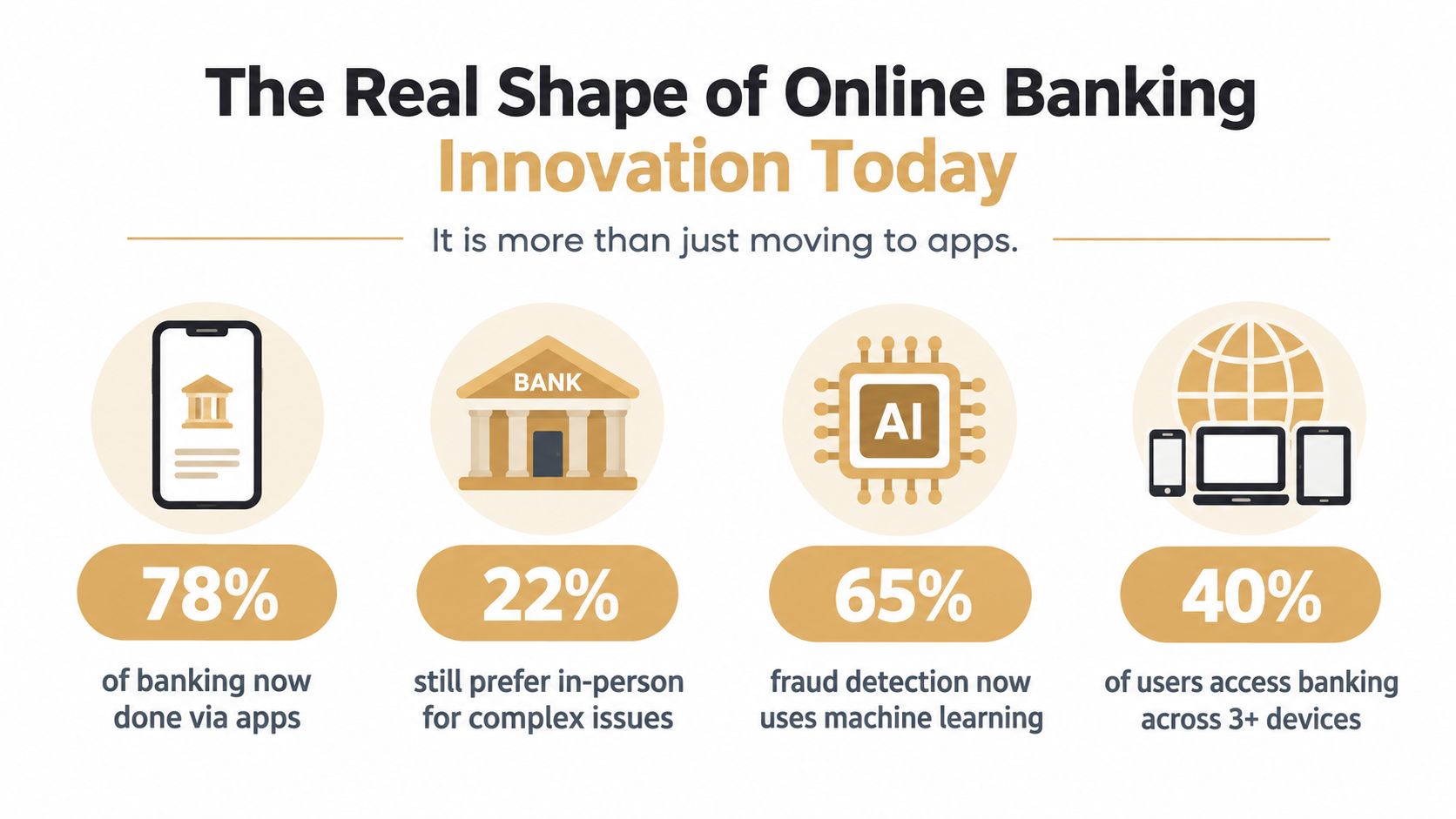
Adoption doesn't equal trusted usage
The same World Bank evidence identifies a gap between account ownership and active digital behavior. Approximately 1 billion adults with an account did not make a digital payment in 2021. An app can exist without earning the trust, clarity, accessibility, or reliability required for routine use.
China shows how quickly behavior can change as digital ecosystems mature. 82% of adults made a digital merchant payment in 2021, including more than 100 million adults, or 11% of the adult population, who made such a payment for the first time after the pandemic began, according to the same source.
For subscription businesses, fintechs, and payment teams, the practical priorities are clear:
- Treat every workflow as a risk event. A login, beneficiary change, trial conversion, or checkout attempt carries different signals and consequences.
- Move controls before commitment. Screening after account creation or payment capture leaves fewer safe intervention options.
- Measure active trust. Track successful completion, review rates, recovery outcomes, and support escalation alongside adoption.
Practical rule: A digital banking feature is complete when it supports legitimate users and distinguishes normal activity from repeated, coordinated, or anomalous behavior without forcing customers through unnecessary checks.
How Digital Banking Behavior Evolved Beyond the Browser
Online banking first expanded through the browser as a convenient account-access channel. A 2018 Deloitte survey of 17,100 consumers across 17 countries found that 73% banked online through a browser at least once a month, according to the Federal Reserve's account of digital banking developments.
Browser access largely turned a branch visit or phone call into a scheduled session. Mobile banking changed the timing and variety of customer actions. In the Federal Reserve's 2016 mobile-banking survey, 94% of mobile-banking users checked balances or recent transactions, 58% transferred money between their own accounts, 56% received bank alerts, 48% deposited checks using a phone camera, and 47% paid bills from a bank account through a mobile device, as reported in the Federal Reserve bulletin.
These actions represent more than a broader feature set. They create frequent decisions about identity, device trust, transaction context, and authorization, often while the customer is away from a desktop and expects immediate feedback.
Each workflow adds a different control problem
A balance check calls for account authentication and session monitoring. Remote deposit introduces document and image checks. A transfer adds beneficiary, velocity, and account-linkage signals. Bill payment requires the product to separate routine behavior from activity in a compromised session.
The shift to mobile should therefore be measured as an operating-model change, not just as movement between channels. Customers moved from occasional online viewing toward continuous, device-based financial management. Every added workflow increased the volume of real-time events that banks had to process consistently.
The same logic applies to subscription and digital-product teams:
| Workflow | Product question | Control requirement |
|---|---|---|
| Account creation | Is this a new customer or a repeat identity? | Identity linkage and abuse history |
| Login | Does this session match normal behavior? | Authentication and anomaly detection |
| Transfer or checkout | Is the action authorized and plausible? | Transaction and velocity screening |
| Recovery | Is the requester legitimate under stress? | Consistent, explainable escalation |
Mobile did not remove the browser or branch. It expanded the operating surface and multiplied the points where trust can fail. Product teams should assess each event before it becomes a support case, fraudulent payment, or irreversible account action. The practical design question is whether controls appear at the right moment, with enough context to protect the business without disrupting legitimate use.
Why AI Fraud Detection Is Replacing Static Rules
Static rules remain useful for clear conditions. A product can block a known compromised card, require additional verification for a high-risk action, or flag a velocity threshold. The weakness appears when attackers change emails, devices, payment artifacts, or timing faster than a team can maintain rules.
A systematic review covering 47 studies reported AI-driven fraud-detection rates of 87% to 94% and a 40% to 60% reduction in false positives compared with traditional rule-based approaches, according to the review of AI fraud-detection methods. The same review identified recurring barriers, including data quality, computational cost, and limited interpretability.
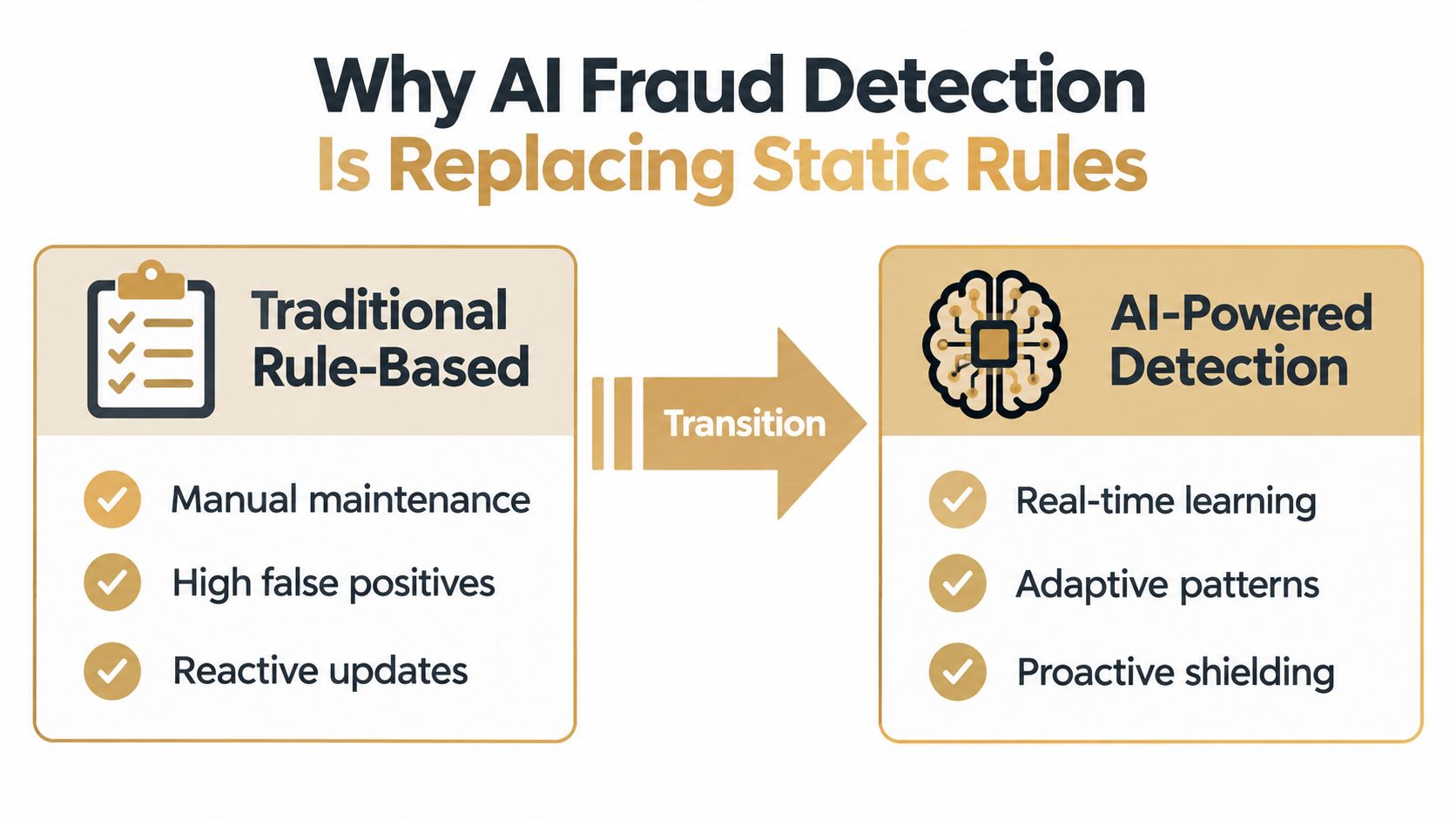
Adaptive detection needs persistent context
The advantage of machine learning isn't that it removes judgment. It allows a team to combine several types of judgment in one decision system:
- Supervised classification recognizes patterns associated with known abuse.
- Unsupervised anomaly detection surfaces behavior that doesn't match established norms.
- Graph analysis connects accounts, devices, payers, beneficiaries, and transactions that look separate when viewed one event at a time.
- Reason codes explain why the system allowed, reviewed, or blocked an action.
That last capability matters operationally. An investigator needs to know whether a decision came from device novelty, impossible travel, beneficiary risk, unusual velocity, or linked-account behavior. An opaque risk score slows review and makes customer support harder.
A model's accuracy is a starting point, not a deployment specification.
Teams should measure precision, recall, false-positive rate, calibration, review yield, and decision latency by transaction type and customer segment. They should also use time-split validation and monitor drift after deployment, because fraud patterns change and attackers adapt.
AI can improve detection without solving data governance or explainability. The product architecture still needs reliable feature retrieval, an escalation path for uncertain cases, and a way to preserve the relationships that reveal repeated abuse. Teams evaluating fraud-detection software should therefore assess the full decision loop, not just a model's headline performance.
What Open Banking Reveals About Production-Grade Control
Open banking shows what happens when digital banking innovation becomes API infrastructure. UK Open Banking reported 24.0 billion successful API calls in 2025, a 27% year-over-year increase, and 16.5 million user connections, up 36%. Payment-initiation-service calls grew 53%, while ecosystem availability stayed above 99.50% in every month, according to UK Open Banking's 2025 review.
The important point isn't only the scale. Payment initiation places consent, authentication, fraud screening, and reliability inside the transaction path. A later batch review can't protect an action that has already been authorized.
Design the verdict before the workflow
A production-grade control layer should answer five questions before committing an event:
- Who is acting? Validate client identity, account context, and the scope of consent.
- What is being requested? Classify the action, beneficiary, payer, amount context, and expected workflow.
- Has this happened before? Check velocity, replay resistance, linked identities, and recent history.
- What should happen now? Return a deterministic machine-readable outcome such as allow, step-up or review, or block.
- Can the decision be audited? Store reason codes and the relevant evidence across the customer journey.
This pattern applies to more than bank transfers. Subscription products can use it for account creation, trial starts, payment capture, and login completion. The event doesn't need to be a bank transaction to deserve a pre-commit decision.
Reliability requires explicit degradation
Average latency can hide unacceptable tail behavior. Teams should test p95 and p99 performance across network calls, feature retrieval, model execution, and fallback handling. Reliability planning also needs a degradation policy.
High-risk payment authorization may require a fail-closed posture when the control service is unavailable. A narrowly bounded low-risk event may use a fail-open path with disclosure and post-event monitoring. The correct choice depends on the harm of a false allow versus the harm of blocking a legitimate customer.
Open banking's reliability benchmark therefore becomes a design challenge for every API product. Teams should treat screening, consent, and recovery as part of the transaction architecture, not as optional middleware added after the checkout flow is complete.
The Hidden Risk of Ignoring Hybrid-Access and Inclusion
Digital adoption doesn't mean customers have abandoned physical or human channels. U.S. data shows that online banking through a laptop or PC reaches 81% and mobile-app use reaches 77%, while ATMs remain used by 67% and branches by 64%, according to Kantar's banking research.
The age pattern is just as important. Mobile-app use reaches 87% among Millennials, while branch visits are valued by 71% of Boomers and 83% of the Silent Generation, based on the same Kantar source. A bank that optimizes only for its most digitally active users may improve average completion while making complex cases harder for other customers.
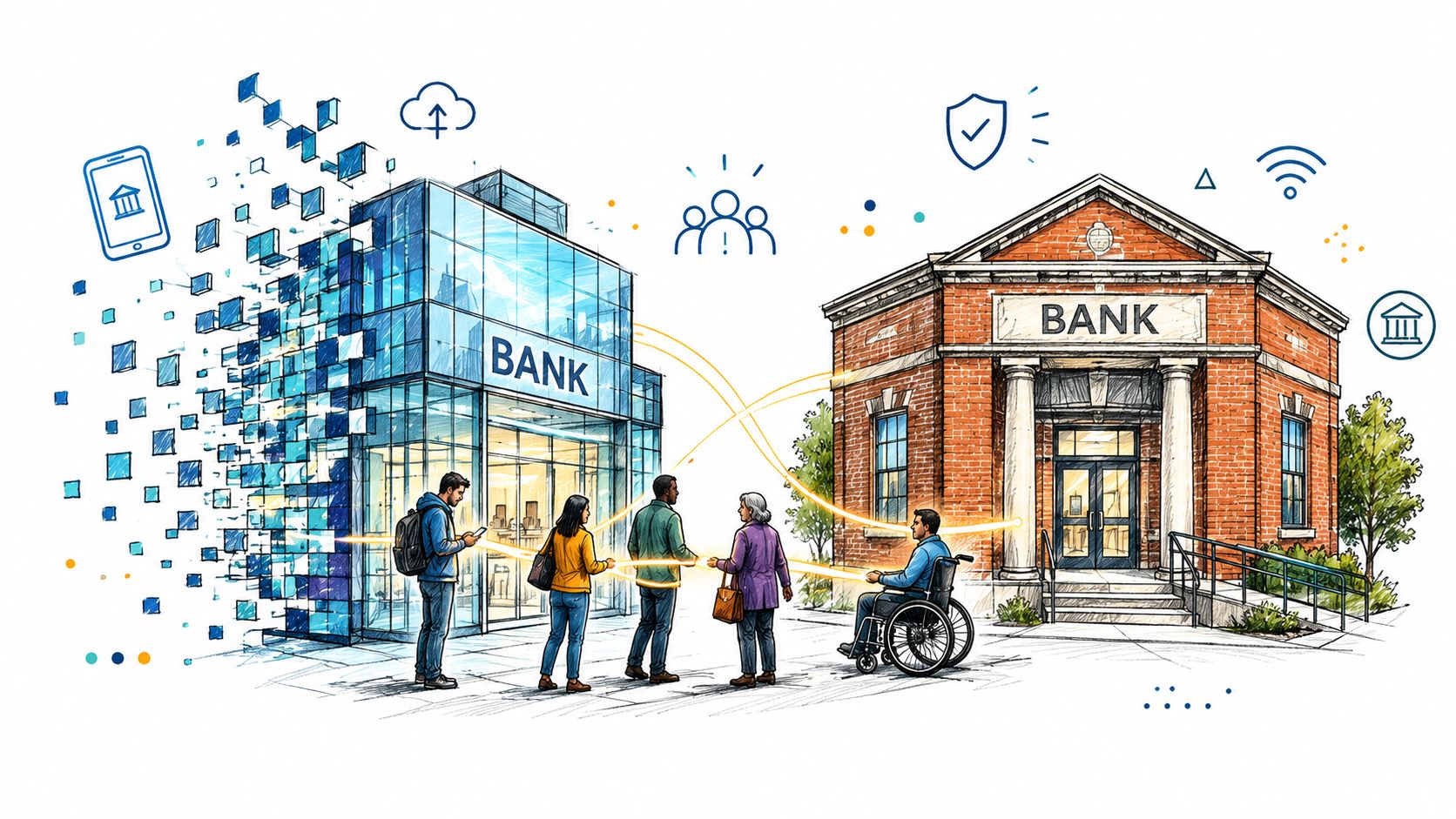
Inclusion is an architecture requirement
The Kenyan banking-sector survey adds a sharper warning. Although 96% of surveyed institutions had adopted digital financial services in 2025, only 13% reported products for people with disabilities, compared with 54% for youth and 46% for women, as summarized by Kantar.
That gap shows why adoption is an incomplete success metric. A digital service can exist at scale while still failing customers who need accessible design, assisted onboarding, a branch, an ATM, mail, or a human escalation path.
Product teams should preserve continuity across channels:
- Assisted onboarding: Let staff help customers complete digital processes without creating a separate, weaker identity standard.
- Accessibility support: Test key flows with users who rely on assistive technologies or alternative interaction patterns.
- Fallback access: Keep viable routes for outages, locked accounts, and complex financial decisions.
- Channel continuity: Ensure evidence and case history follow the customer between app, call center, branch, and support queue.
The most efficient channel isn't always the most resilient channel.
This matters for digital subscriptions too. A rigid automated recovery flow may reduce support volume while leaving legitimate customers unable to regain access. Hybrid access isn't a retreat from innovation. It's the layer that makes innovation durable when connectivity, confidence, or customer circumstances vary.
Balancing Frictionless Access With Fraud-Resistant Trust
Security friction has a non-obvious failure mode. If a legitimate customer can't complete a challenge, recover an account, or understand a block, they may seek help through a weaker channel or abandon the product entirely.
A 2025 survey of 6,000 consumers across six European markets found that customers of digital-only banks were more likely to have experienced fraud, yet only 47% of digital-bank customers were worried about it, compared with 57% of traditional-bank customers, according to the 2025 fraud and authentication report. The mismatch suggests that customers may not judge security by exposure alone. They also judge it through confidence, familiarity, and the quality of the response after an incident.
Legacy recovery can undermine modern authentication
The same report found that 47% of bankers still relied on knowledge-based authentication in call centers. Meanwhile, about 65% of large-bank respondents and 66% of regional-bank respondents planned investment in advanced analytics or AI fraud detection over the following 12 to 24 months, according to the report.
That creates an uneven control surface. An app may use device signals and behavioral analysis, while a customer-support recovery process still depends on information that attackers can obtain or socially engineer.
Teams should evaluate authentication as a connected system:
- Login: Can the product recognize a familiar device without automatically granting it trust?
- Step-up: Does the challenge match the risk and value of the action?
- Recovery: Can a genuine customer regain control without being pushed into an easier attack path?
- Support: Do agents see the same evidence and reason codes as the automated system?
Biometrics can reduce routine friction, but they don't eliminate the need for recovery design. Guidance on password and fingerprint authentication is useful only when teams also consider device loss, account takeover, consent changes, and human escalation.
The safest system isn't the one with the most challenges. It's the one that applies proportionate friction, explains decisions, and keeps security behavior consistent across every customer-facing channel.
What Product Teams Should Prioritize Next
Online banking innovation points to a practical operating model for subscription and digital-product teams. The priority isn't another isolated feature. It's a decision layer that understands the event, evaluates persistent context, responds quickly, and gives legitimate customers a safe path forward.
Build controls around the event
Start with the moments that create irreversible cost:
- Sign-up and trial start: Check whether a new identity connects to prior accounts, devices, payment artifacts, or repeated attempts.
- Checkout and trial conversion: Evaluate payment context, velocity, and linked activity before capture.
- Login and recovery: Combine authentication with device continuity and account history, then route uncertain cases to review.
- Consent and payment initiation: Validate scope, client identity, replay resistance, and beneficiary or payer signals before commitment.
A useful verdict should be deterministic and machine-readable. “Allow,” “review,” and “block” are more operationally useful than an unexplained score because product, risk, and support teams can map each result to a defined action.
Measure the cost of being wrong
A decision framework should include more than fraud caught. Track false positives, review yield, appeal outcomes, decision latency, recovery completion, and performance by customer segment. A control that blocks abuse but locks out high-value legitimate users can damage trust as surely as an undetected attack.
Persistent linkage also matters. Email rotation alone shouldn't reset a customer's history when the same device or payer relationship connects repeated activity. Graph-based memory gives investigators and models a way to see coordinated behavior without treating every event as unrelated.
Finally, define resilience before launch. Decide which events fail closed, which narrowly bounded events can fail open, what customers see during degradation, and how the team reviews decisions afterward. Teams exploring payment fraud analytics should ask whether the system supports this complete operating loop, from signal collection to verdict, investigation, recovery, and model refinement.
The result is a more mature definition of innovation. A fast interface is useful, but a trustworthy product also knows when to ask for proof, when to involve a human, and when to stop an action before it creates lasting harm.
Portreeve gives online products an inline screening layer for signups, trials, checkouts, and logins, returning an allow, review, or block decision with reason codes before the event commits. Visit Portreeve to evaluate how low-latency verdicts, persistent abuse graphs, and unified review workflows can support safer digital-product growth.