
The most popular advice on e-commerce fraud detection is also the least useful: “score the transaction and decline anything risky.” That checkout-only mindset misses the abuse that happens before a payment exists and after it succeeds. A fraudster can farm trials, cycle through accounts, test payment instruments, alter fulfillment details, or exploit a refund policy while each individual event looks ordinary.
A workable strategy treats fraud as a lifecycle profit-and-friction problem. Every decision should answer two questions: what loss does this event create if it passes, and what revenue or trust does the business sacrifice if it blocks a legitimate customer? That requires screening signups, trials, logins, checkout attempts, refunds, and disputes with shared context, not evaluating each event as an isolated transaction.
Table of Contents
- The Expanding Scope of Online Abuse
- Why Legacy Controls Fail in Digital Environments
- Architecting a Low-Latency Inline Gate
- Connecting Identities Across the User Lifecycle
- Balancing Fraud Prevention and Customer Friction
- Investigating and Remediating Flagged Events
- Building a Continuous Lifecycle Defense
The Expanding Scope of Online Abuse
Fraud isn't confined to the payment page. The FTC's 2024 consumer fraud data recorded more than 6.47 million consumer reports, including approximately 2.6 million fraud reports and 1.1 million identity-theft reports. Consumers reported losing more than $12.5 billion, a 25% increase from 2023, while reported online shopping losses reached about $432 million. These are consumer-reported figures, so they understate the full economic cost, but they still show why payment-stage controls alone aren't enough.
Online shopping issues were the second most commonly reported fraud category in that dataset. The important operational lesson isn't that checkout fraud is expensive. It's that abuse can begin with an account, a promotion, a free trial, or a login and only become visible when the merchant connects those events to later payment or refund activity.
Abuse starts before the order
Consider a subscription product with a free trial. A single signup using a new email may look harmless. The same device creating several accounts, starting repeated trials, and attempting low-value authorizations presents a different risk picture. Blocking only the eventual paid conversion leaves the business to absorb infrastructure costs, free resources, support work, and repeated acquisition waste.
The same pattern appears in retail. A new account can add a shipping address, place an order, change fulfillment details, and request a refund. If the risk system evaluates only the original checkout, investigators have to reconstruct the chain after the money or inventory has already moved.
Practical rule: Screen the action that creates exposure, not only the action that collects payment.
A useful event model includes signup, trial_start, login, checkout_attempt, order_change, refund_request, and dispute. Each event should receive an outcome before the next costly step commits. That doesn't mean every event deserves the same level of friction. A low-risk login may pass without intervention, while a repeated trial linked to prior abuse can be blocked before another entitlement is issued.
Linkage reveals coordinated behavior
Fraud detection improves when the system remembers relationships across recurring identities. Burner emails are easy to replace. Devices, payer wallets, payment fingerprints, and behavioral patterns are harder to rotate consistently. A merchant that stores only the email attached to an order loses the ability to recognize account cycling.
The Portreeve explanation of fraud reflects a broader principle: fraud is a pattern of connected actions, not just a suspicious payment. Privacy-conscious linkage can hash identity keys, isolate them per tenant, and retain only the history needed for the merchant's risk policy. That creates useful memory without treating a single signal, such as a shared device or privacy tool, as automatic proof of abuse.
The right question isn't “Does this checkout look fraudulent?” It's “What does this event mean in the context of everything this identity cluster has already done?”
Why Legacy Controls Fail in Digital Environments
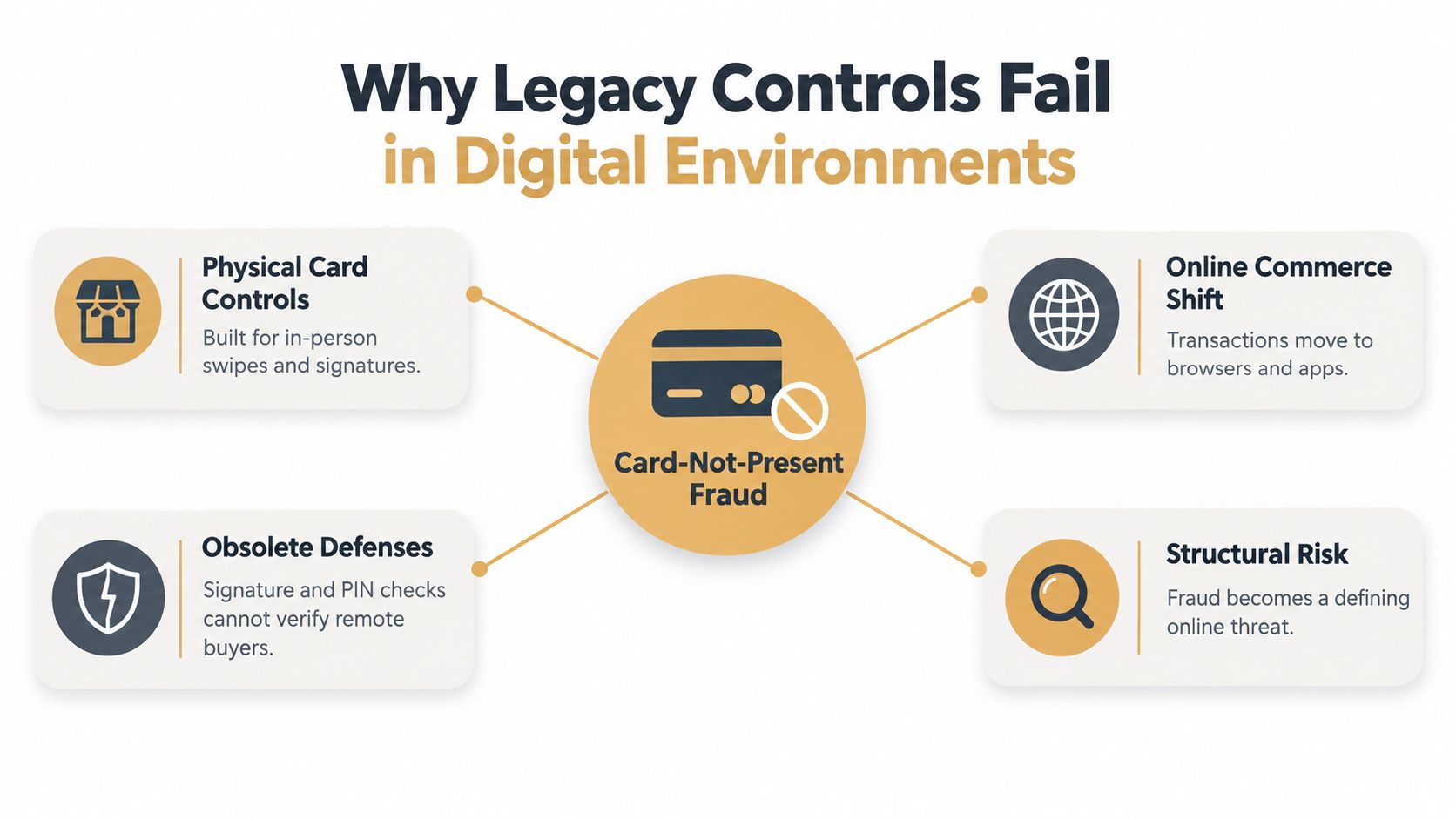
Physical-card controls were designed for a transaction where the card and cardholder could be presented together. Online checkout removes that verification context. The merchant receives credentials, device signals, identity information, and behavioral evidence, but the physical card isn't available for inspection.
Europol reported that, using 2013 data from 35 countries in the Single Euro Payments Area, card-not-present transactions represented 66% of the EUR 1.44 billion in fraudulent card transactions. The same source recorded approximately EUR 3.5 trillion in total card transaction value and about EUR 0.38 in fraud for every EUR 1,000 of card transactions. The figures are historical, but they explain the structural shift that made behavioral and identity-based controls necessary. See Europol's overview of fraud against payment systems for the original context.
What the old model cannot see
A signature check can't distinguish a legitimate first-time customer from an automated actor using stolen credentials. A PIN check doesn't reveal that the same device has attempted many accounts or that a payment artifact has appeared in previous abuse. Even address matching can mislead a team when fraudsters use legitimate billing details, reshipping arrangements, or compromised accounts.
Modern e-commerce fraud detection therefore needs several classes of evidence:
- Identity signals: Email, phone, account history, and payer wallet relationships.
- Device signals: Persistent device tokens, browser characteristics, and session continuity.
- Payment signals: Card fingerprints, authorization behavior, and repeated instrument use.
- Behavioral signals: Velocity, sequencing, login changes, and automated interaction patterns.
- Historical signals: Previous verdicts, disputes, refunds, and confirmed abuse linked to the same cluster.
None of these signals should operate as an isolated verdict. A shared device might belong to a household, a workplace, or a fraud ring. A new payment instrument might belong to a genuine returning customer. Context turns ambiguous attributes into useful evidence.
Distinguishing new customers from repeated abuse
A first purchase deserves a fair opportunity. A first purchase from an identity cluster with no adverse history should not be treated like a new account attached to a device and payment fingerprint previously connected to repeated failed attempts. That distinction requires a persistent relationship layer rather than a collection of one-time checkout rules.
Rapid transaction testing illustrates the problem. A fraudster may submit small authorization attempts to determine whether payment credentials work before attempting a larger purchase. A transaction-only system sees separate events. A linked system can recognize the sequence across device, payment artifact, and account activity, then intervene before the pattern develops into chargebacks and fulfillment loss.
Physical-card controls remain useful where they apply, but they can't answer the central online question: who is behind this event, and what has this connected identity done before?
Architecting a Low-Latency Inline Gate
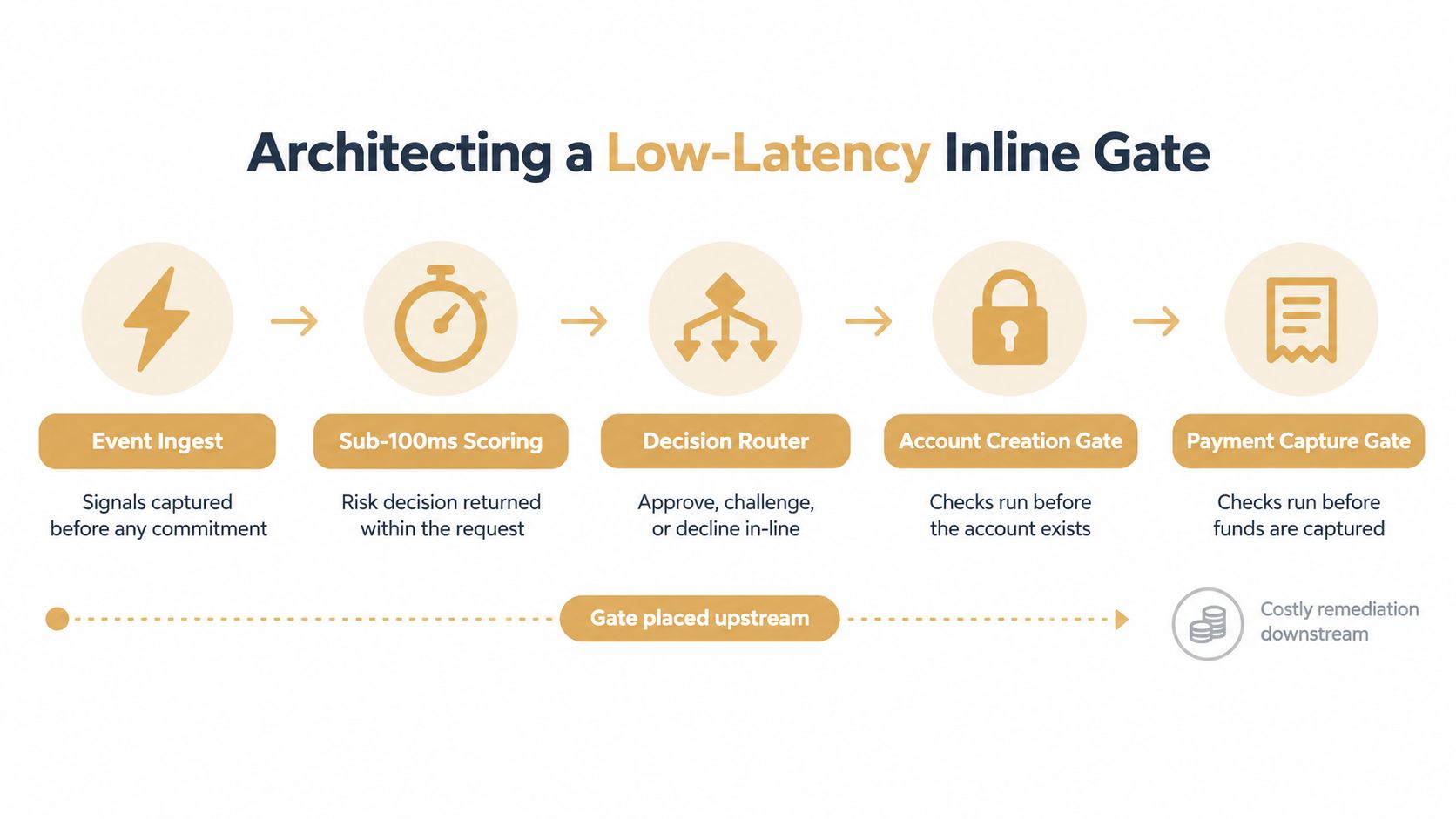
A fraud decision that arrives after account creation, trial issuance, or payment capture is often a post-event investigation disguised as prevention. Inline screening must sit upstream of the commitment it protects, while keeping the synchronous path small enough that risk controls don't become the product's bottleneck.
The target should be explicit. Portreeve's publisher data describes an inline gate returning a deterministic decision in under 100 milliseconds, with a stated p99 of approximately 90 milliseconds. Treat that as an engineering objective for this implementation, not a universal promise for every stack. Feature availability, network conditions, storage, event volume, and fallback behavior all affect real production latency.
Keep the decision path narrow
The synchronous path should do only the work needed to return a reliable decision:
- Normalize the incoming event and validate required fields.
- Retrieve bounded historical features from fast storage or cache.
- Evaluate the model and policy rules in memory.
- Return
allow,review, orblockwith reason codes. - Publish enrichment, graph updates, analyst tasks, and retraining data asynchronously.
A streaming design published in the engineering literature targeted end-to-end prediction and alert persistence below 200 milliseconds at 500 transactions per second, using Kafka ingestion and in-memory inference. Its benchmark Random Forest reached 96.3% accuracy with a 1.9% false-positive rate, but those figures are engineering reference points, not production guarantees. The published streaming fraud design itself should be read with dataset and deployment differences in mind.
Don't put an unbounded graph traversal, external enrichment call, or analyst workflow in the request path. Set strict timeouts, cache aggregates, limit relationship depth, and define what happens when a dependency is slow.
Replace binary classification with policy
A binary classifier forces uncertainty into the wrong action. A better gate has three outcomes:
| Decision | Appropriate use | Product behavior |
|---|---|---|
| Allow | Evidence indicates low risk | Commit the action with no additional friction |
| Review | Signals conflict or confidence is limited | Hold, challenge, or queue the event |
| Block | Evidence indicates high-confidence abuse | Prevent the action and record the reason |
A comparative study on the IEEE-CIS benchmark, which contains more than 590,000 anonymized online-payment transactions, found that a GRU model achieved the highest recall at 0.54 but only 0.28 precision. Tree-based models such as Random Forest and LightGBM offered a more operationally attractive balance for nonlinear transaction, device, identity, and behavioral features. The IEEE-CIS evaluation also supports time-based splits and precision-recall analysis because random splits can overstate performance through temporal or identity leakage.
Thresholds should follow business costs, not headline accuracy. Measure approval rate, chargeback rate, review precision, analyst capacity, customer friction, and the value of customers incorrectly declined. If the risk service fails, log the state and apply an explicit policy. Failing open protects conversion while increasing exposure. Failing closed limits abuse but can turn a dependency outage into a broad customer outage.
For teams comparing implementation options, fraud detection software should be assessed by decision latency, signal ownership, review workflow, tenant isolation, reason codes, and degradation behavior, not by model branding alone.
Connecting Identities Across the User Lifecycle
The strongest fraud signal is often not a single attribute. It's the relationship between events that appear harmless in isolation.
A new email address doesn't establish a new customer. A new account on a familiar device may represent account cycling. A fresh payment instrument attached to a payer wallet associated with prior abuse may deserve a different treatment from a new customer with no prior history. Persistent memory gives the system a way to express those distinctions.
Build an abuse graph with privacy boundaries
A practical identity layer can connect hashed, tenant-scoped keys such as:
- Email identifiers
- Device tokens
- Card fingerprints
- Payer wallets
- Event and account history
The graph shouldn't become a universal identity database. Scope keys per tenant, avoid retaining raw payment details when a fingerprint is sufficient, define memory windows according to the product's risk, and document which teams can access linked evidence. A short-lived graph may suit a high-frequency promotion. A subscription product dealing with repeated trials may need longer memory to recognize serial re-enrollment.
IP data can contribute context, but it shouldn't carry the identity model by itself. Shared networks, mobile connections, corporate gateways, travel, and privacy tools create legitimate overlap. The system should use relationships as weighted evidence rather than treating a common network as proof.
Connect low-value events to meaningful loss
Card testing is easier to detect when authorization attempts are linked to the events around them. A cluster of low-value attempts from one device, several emails, and a recurring payment artifact should influence the next checkout decision, even when no individual attempt looks conclusive.
The same logic applies to login and trial activity. A credential-stuffing pattern followed by a stored-payment checkout should not be evaluated as a clean customer session merely because the login succeeded. Likewise, a user who repeatedly creates accounts, consumes free resources, and abandons conversion should be evaluated at signup or trial start, not only when a charge eventually appears.
A burner email changes the label. It doesn't necessarily change the actor.
Cluster marking is useful after confirmation. Once an analyst establishes that an identity cluster represents abuse, the verdict can propagate to linked devices or payment artifacts, subject to review and tenant policy. That prevents the team from rediscovering the same actor through every new email while preserving an audit trail for reversals and legitimate exceptions.
Balancing Fraud Prevention and Customer Friction
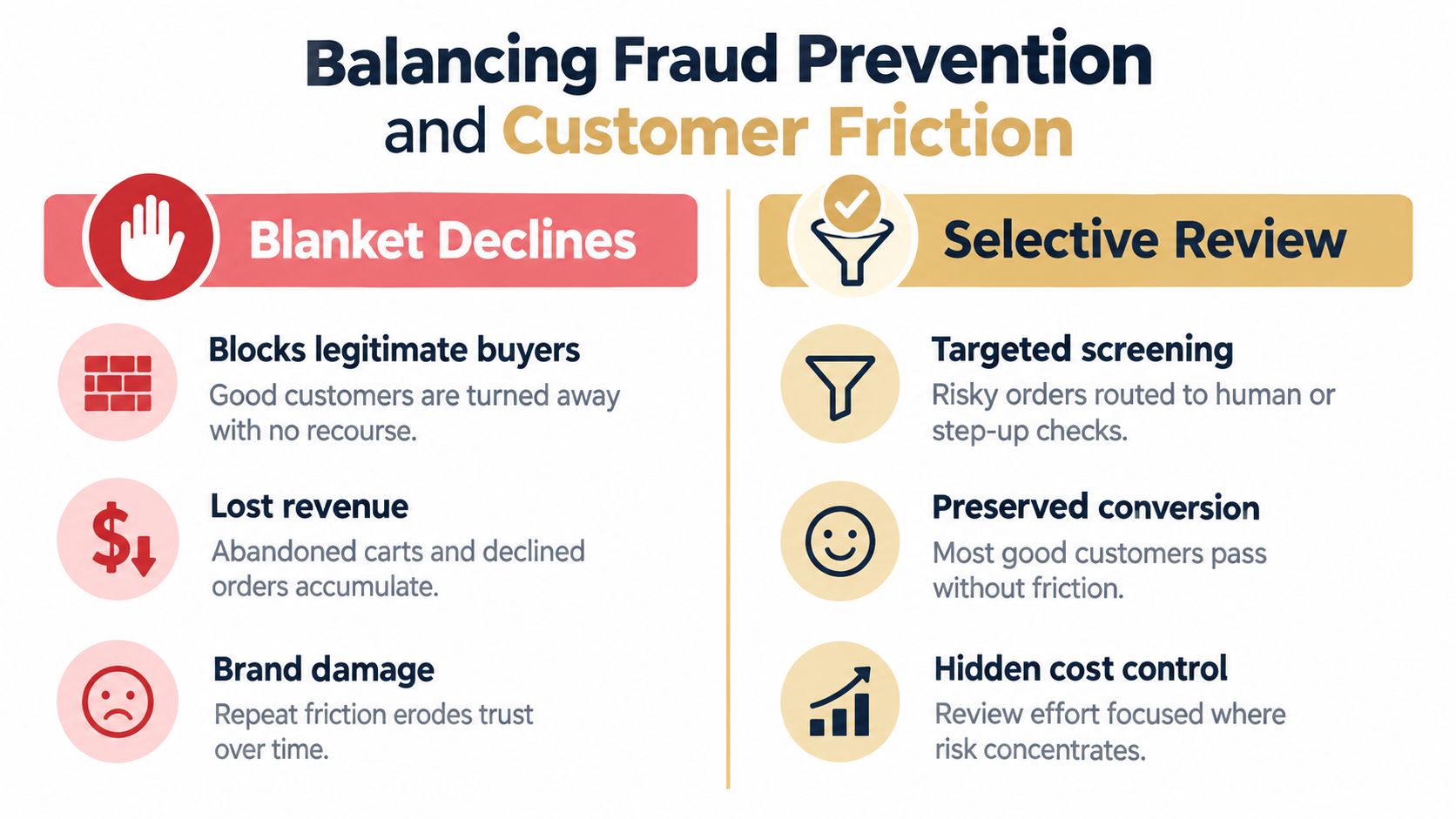
Aggressive blocking feels efficient because it reduces visible fraud quickly. It can also hide the revenue lost through false declines, abandoned purchases, support contacts, and customers who don't return. A policy that blocks every ambiguous event may improve a narrow fraud metric while damaging the commercial system it was meant to protect.
The friction problem is measurable. In a 2025 survey, 38% of global fraud and payments professionals identified friction and customer churn as the largest obstacle to effective fraud prevention, while 77% reported that fraud had increased year over year. The survey findings on fraud prevention and loyalty support a more careful conclusion: stronger controls aren't automatically better controls.
Compare the two operating policies
| Policy | Where it works | Where it fails |
|---|---|---|
| Blanket decline | High-confidence abuse with clear evidence | Ambiguous travel, shared devices, privacy tools, and new customers |
| Selective review | Conflicting signals and valuable edge cases | Requires analyst capacity and a clear service-level policy |
| Step-up challenge | Events where the customer can prove control | Adds friction and can frustrate legitimate buyers if overused |
A repeated trial linked to a device and payment artifact previously associated with abuse may justify a block. A checkout from a new device while the customer is traveling may warrant review or a proportionate challenge. Applying the same response to both events is a product decision disguised as a risk rule.
Give every decision a reason
Opaque scores make it difficult for support teams, analysts, and product managers to improve policy. Reason codes should identify the evidence that influenced the outcome, such as repeated trial linkage, unusual velocity, payment-artifact reuse, or a conflict between recent account changes and checkout behavior.
Review outcomes should feed back into policy evaluation. Track approval rate, chargeback rate, review precision, challenge completion, reversal rate, and the value of customers who were initially flagged. Run controlled comparisons between blanket declines and selective review where the operational risk allows it. The purpose isn't to maximize approvals or blocks in isolation. It's to find the point where prevented loss and preserved customer value justify the friction imposed.
Legitimate customers can resemble abuse patterns. Families share devices. Teams use common networks. Travelers log in from unfamiliar locations. Privacy-conscious customers may limit the signals a merchant expects. A mature policy treats those conditions as reasons to gather more context, not automatic grounds for rejection.
Investigating and Remediating Flagged Events
A review queue becomes valuable only when analysts can reach a decision without reconstructing evidence across unrelated systems. The workspace should show the triggering event, recent history, linked identities, prior verdicts, payment and device relationships, and the action that will follow the analyst's decision.
Use a repeatable investigation sequence
Start with the event itself. Confirm what action the customer attempted, what commitment was pending, and which reason codes caused the route to review. Then inspect the surrounding timeline rather than judging the event as a standalone record.
Next, examine the identity cluster. Look for repeated emails on one device, payment fingerprints appearing across accounts, rapid authorization attempts, unusual login changes, or prior refunds and disputes associated with linked entities. Don't treat every connection as malicious. The analyst should record whether the relationship is strong evidence, a contextual signal, or a legitimate shared attribute.
A practical workflow looks like this:
- Validate the trigger: Confirm that the rule, model feature, or linkage applies to the event.
- Review the timeline: Check signups, logins, trials, orders, changes, refunds, and disputes around the decision.
- Inspect linked entities: Compare devices, payment artifacts, emails, and payer wallets across the tenant.
- Choose the action: Allow, block, request a challenge, hold fulfillment, or escalate.
- Record the rationale: Store a reason code and notes that another analyst can understand.
- Propagate confirmed abuse: Mark the relevant cluster while preserving an appeal or reversal path.
The Portreeve fraud detection case study is a relevant reference point for teams evaluating a unified investigation workflow. The important design requirement is not a particular interface. It's that evidence and decision history remain connected.
Remediation must reach downstream systems
A block that exists only in the risk dashboard hasn't fully remediated the event. The decision should trigger the appropriate product action, such as preventing account creation, withholding trial access, pausing fulfillment, cancelling a refund, or requiring additional verification. Webhooks and durable decision logs help downstream systems apply the same verdict consistently.
Confirmed abuse should also improve future decisions. Cluster marking can raise risk for linked entities, while an analyst overturning a decision should remove or reduce the effect of a mistaken association. That feedback loop keeps the system from becoming permanently punitive because of one shared device or a recycled payment method.
Building a Continuous Lifecycle Defense
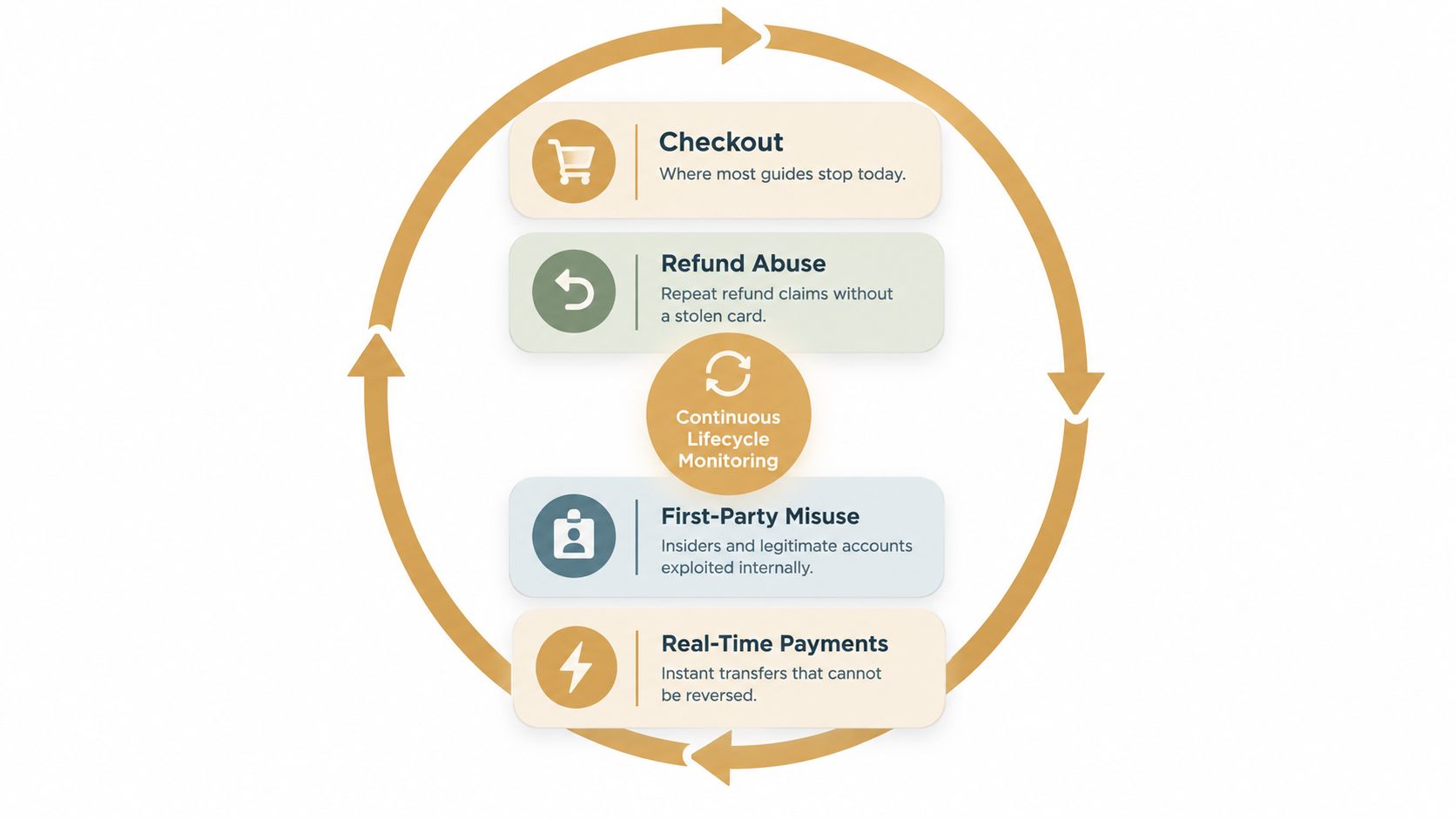
Checkout is a critical control point, but it isn't the boundary of e-commerce fraud. Merchant data from a 2025 global survey of 1,082 merchants across 38 countries identified refund abuse as the leading fraud attack, reported by 47% of respondents, followed by real-time-payment fraud at 45%. The same report found that 62% reported an increase in first-party misuse disputes and estimated that payment fraud consumes 3.2% of global e-commerce revenue. These findings make a card-centric program incomplete by design. See the 2025 Global Payments and Fraud Report for the survey context.
Cover every point where value changes hands
A lifecycle defense follows the customer's activity through the moments where the merchant creates entitlement, ships inventory, returns funds, or accepts a dispute.
- Pre-account activity: Screen signup, promotion claims, and trial starts before issuing resources.
- Authentication and login: Detect unusual access, credential abuse, and account changes before stored payment methods are used.
- Checkout and authorization: Evaluate device, identity, payment, and behavioral context before capture.
- Fulfillment: Monitor address changes, delivery interventions, and order modifications that alter exposure.
- Refunds and returns: Connect refund requests to order history, account relationships, and prior claims.
- Disputes: Preserve event evidence and distinguish criminal fraud from first-party misuse or a genuine customer issue.
Refund abuse and first-party misuse are especially important because the customer may use a valid card and a legitimate account. A checkout score alone won't identify repeated non-receipt claims, account cycling around return policies, or disputes that contradict the customer's prior behavior. The merchant needs persistent, privacy-conscious relationships across events.
Make the roadmap operational
Begin with the events that create the largest preventable exposure. Define the commitment each event protects, the signals available before it occurs, and the acceptable latency for the decision. Then establish three outcomes, reason codes, an analyst workflow, and a documented fallback if the service is unavailable.
Next, measure the whole system. Fraud recall matters, but so do approval rate, review volume, false-positive reversals, refund loss, chargeback outcomes, support contacts, and customer value. A team that improves fraud recall by blocking valuable customers may have optimized the wrong objective.
The strategic shift is straightforward: e-commerce fraud detection should manage connected risk across the customer lifecycle, not issue a single verdict at checkout. Inline screening prevents avoidable exposure, persistent identity linkage reveals coordinated abuse, and selective review preserves room for legitimate customers who happen to look unusual.
Portreeve provides inline screening for signups, trials, checkouts, and logins, returning allow, review, or block decisions with reason codes before the action commits. Visit Portreeve to evaluate a lifecycle risk workflow that connects hashed identity signals, event history, and review decisions in one abuse graph.