
UNODC estimates that money laundering may equal 2% to 5% of global GDP, or approximately US$800 billion to US$2 trillion in a single year, while a related estimate suggests that only around 0.2% of laundered criminal proceeds are seized or frozen (UNODC's overview of money laundering). Those figures don't describe a precise balance sheet. Laundering is designed to hide origin, ownership, movement, and beneficiaries, so the operational challenge is finding suspicious behavior before the money vanishes into legitimate-looking activity.
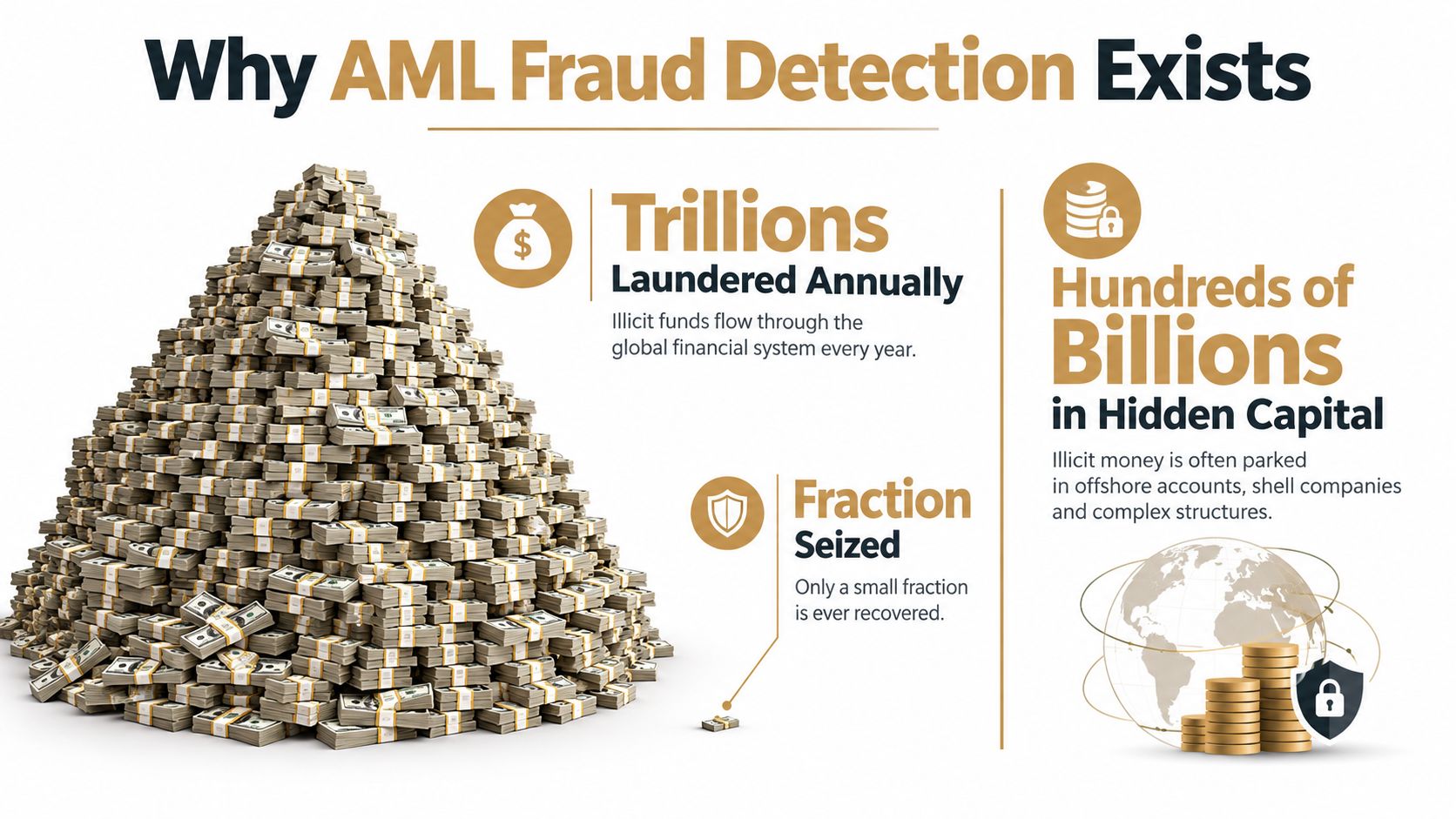
Table of Contents
- Why AML Fraud Detection Exists
- How Money Laundering Actually Works
- The Regulatory Framework Behind AML Detection
- Core Components of an AML Detection System
- Red Flags and Detection Methods Compared
- The Hidden Risk of Trusted Old Accounts
- From Alerts to Actionable Investigations
Why AML Fraud Detection Exists
AML detection exists because laundering rarely announces itself as one obviously bad transaction. What a risk team usually sees is a fragment: a new account, a login from a different device, a transfer to a fresh counterparty, a payout that arrives sooner than the customer's past behavior would suggest. Each event can look ordinary on its own. The risk appears when those events line up into a pattern.
That is why AML fraud detection works like tracing a faint trail across multiple systems rather than checking one ledger for a missing amount. By the time a team can prove where criminal proceeds ended up, the money has often already passed through enough hands to look legitimate. Detection has to start earlier, with signals that show how value is moving and who is connected to whom.
The measurement problem makes this harder. The broad laundering estimate from the UNODC figures cited above is intentionally uncertain, because criminals hide origin, ownership, and control. For a monitoring program, that means success cannot be defined only by recovered losses or by matching a list of already confirmed bad transactions. A useful program has to identify suspicious behavior before the case is fully visible.
In practice, teams look for signals such as:
- Behavioral change: An established customer suddenly uses unfamiliar devices, counterparties, or payment routes.
- Relationship structure: Multiple accounts connect through shared devices, cards, wallets, payers, or recipients.
- Movement patterns: Funds cycle quickly, split across intermediaries, or consolidate after passing through several identities.
- Contextual inconsistency: Activity does not fit the customer's known profile, geography, business purpose, or historical behavior.
Operational principle: The best alert usually explains a connected pattern, with reason codes an investigator can test, rather than a high score with no clear cause.
That last point matters more than many guides admit. Broad coverage can catch more suspicious activity, but broad rules also flood investigators with false positives. If an alert says only that risk is high, reviewers lose time reconstructing the story from scratch. If it says an older account changed devices, added new recipients, and began rapid pass-through transfers, the case is easier to triage and defend.
Old accounts deserve special attention. Risk teams often trust them because they have history, but mature accounts can be repurposed as mules precisely because they look safe at first glance.
For online businesses, the same logic applies beyond banking rails. A signup, checkout attempt, login, and payout request may seem harmless separately. Together, they can show account cycling, identity reuse, payment testing, or a compromised long-standing account being used to move value.
How Money Laundering Actually Works
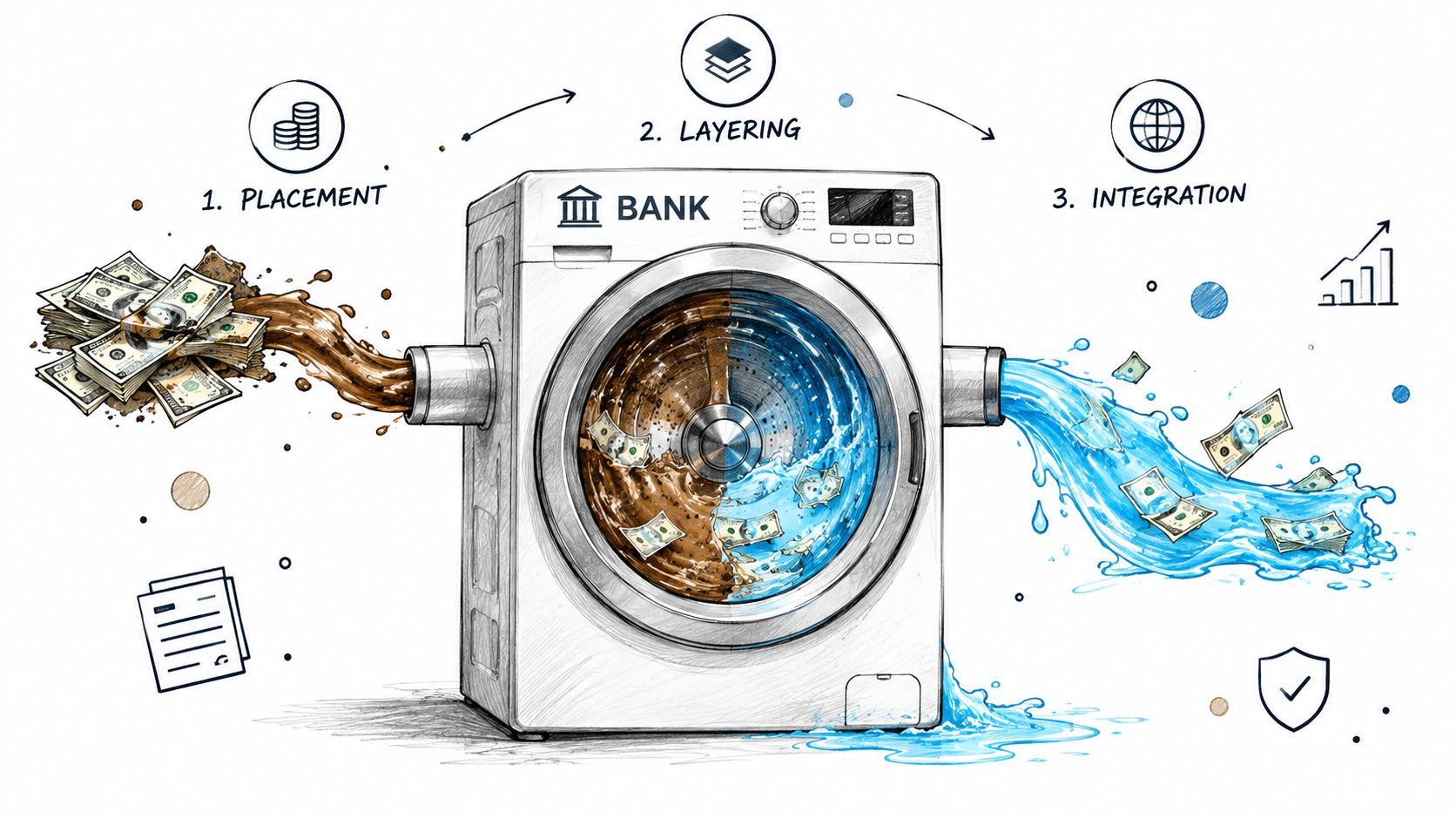
Money laundering is often described through three stages: placement, layering, and integration. The model isn't a rigid sequence in every case, but it gives risk teams a practical way to understand why different behaviors appear at different points.
Placement introduces illicit value
Placement is the attempt to put criminal proceeds into the financial or commercial system. A person may deposit cash, buy stored-value instruments, fund an account, or use a business that can absorb payments. At this point, the activity may create structuring signals, such as repeated deposits or transactions designed to avoid attention rather than reflect a genuine commercial need.
A single deposit rarely proves anything. Analysts look at frequency, timing, related accounts, shared instruments, and whether the activity makes sense for the customer.
Layering separates money from its origin
Layering adds distance between the proceeds and the original crime. Funds may move through accounts, counterparties, payment providers, wallets, or jurisdictions. The purpose is to make the trail harder to follow and the ownership harder to establish.
Consider a group of accounts that receive value, pass it to several intermediaries, and later send it toward a smaller set of recipients. Each transfer might satisfy a basic rule. The network structure is the stronger signal because it reveals shared counterparties, circular flows, rapid account cycling, and coordinated timing.
Watch the short explainer below for a visual introduction to these mechanics.
Integration makes funds look legitimate
Integration is the point at which value returns to the economy with an apparently legitimate explanation. It may appear as revenue, a loan, an investment, a purchase, or payment for services. The activity is designed to resemble normal commerce, so a transaction-only control may see little reason to intervene.
That's why detection must connect accounts, devices, counterparties, and events. A graph can show that an apparently legitimate payment follows a chain of linked identities or arrives after a sequence of unusual transfers. A behavioral system can show that a long-standing account changed its activity abruptly. No single signal is conclusive, but the combined context can justify review.
The Regulatory Framework Behind AML Detection
Modern AML detection developed from a regulatory shift toward shared international expectations. In April 1990, the Financial Action Task Force formulated its original 40 Recommendations, covering customer identification, suspicious-transaction reporting, domestic money-laundering legislation, law-enforcement cooperation, and related controls. In June 1996, FATF expanded the relevant predicate offenses beyond traditional drug crimes to include serious crime. In October 2004, it added a recommendation addressing physical cross-border cash transfers and created nine Special Recommendations related to terrorist financing and associated risks (the Ministry of Finance's summary of international AML and CFT efforts).
The operational lesson is important. AML compliance isn't a single identity check performed at onboarding. It combines customer identification, transaction monitoring, contextual risk assessment, suspicious-activity reporting, escalation, and documented decisions. Each layer answers a different question:
- Who is the customer?
- What activity is normal for that customer?
- Which transaction or relationship is unusual?
- What evidence supports escalation?
- Why did the institution allow, review, restrict, or report the activity?
Scale changes the operating model
FinCEN reported 4.3 million Suspicious Activity Reports in fiscal year 2022, 4.6 million in 2023, and 4.7 million in 2024 (FATF's technology handout). Its FY2024 total represented about 12,870 SAR filings per day, supported by approximately 324,000 registered financial institutions and other e-filers, according to the same cited data.
Those figures show why alert generation can't be the primary performance goal. A mature system must help teams rank cases, explain decisions, and preserve evidence. Otherwise, the reporting obligation produces a queue that grows faster than investigators can work it.
Regulatory frameworks also require judgment. A rule may identify an event for review, but a trained investigator must consider the wider customer relationship, available documentation, related parties, and the explanation for the activity. Automation should make that judgment faster and more consistent, not remove the reasoning that makes the decision defensible.
Core Components of an AML Detection System
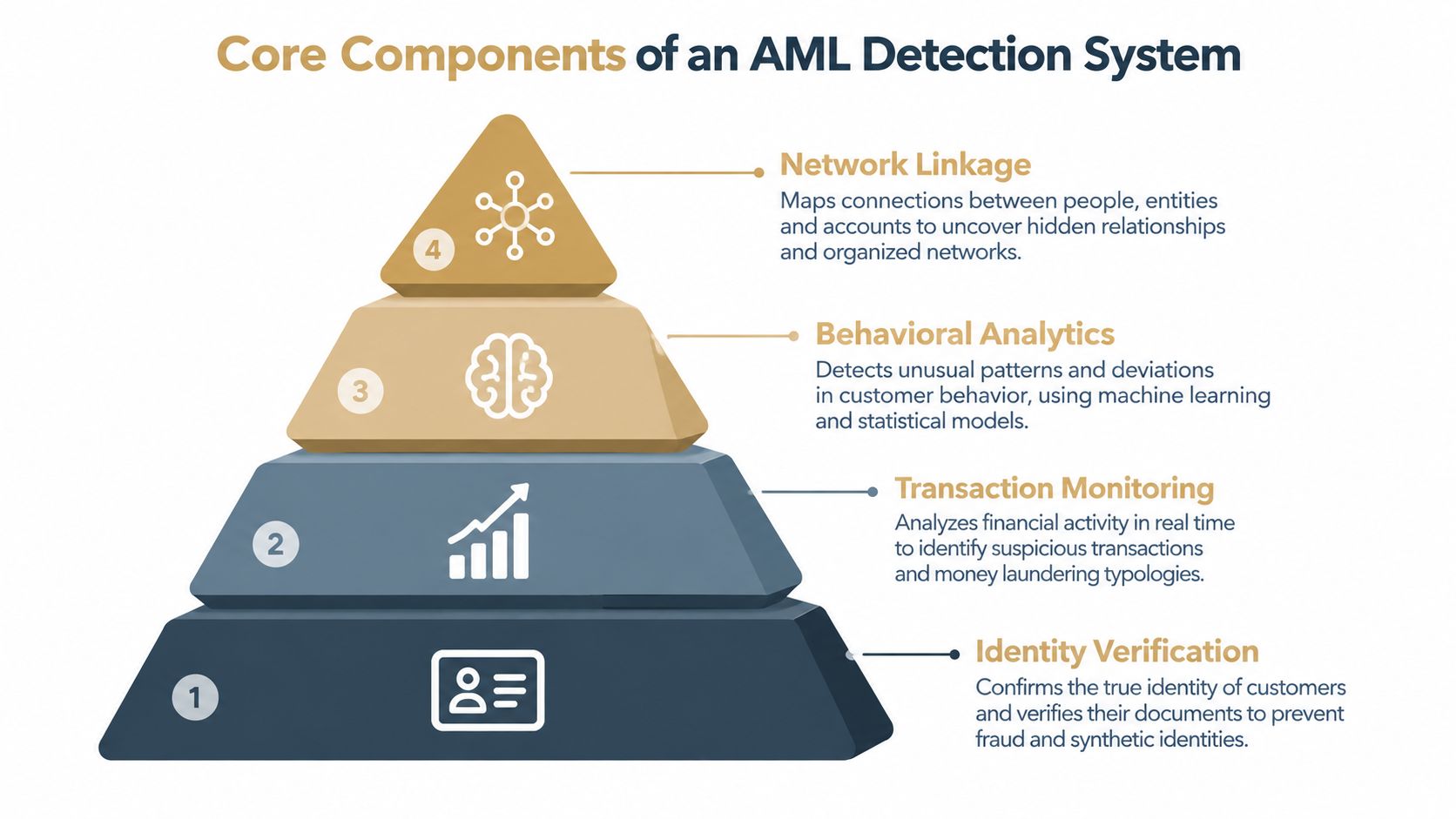
A credible detection stack combines several controls rather than asking one model to solve every problem. Each layer contributes context, and the system should preserve the evidence that connects one layer to the next.
Start with identity and event context
Identity verification and screening establish who is attempting an action and whether the identity presents known risk. That doesn't end the analysis. The system should also capture the event type, device token, payment instrument, payer wallet, login context, and relevant historical activity.
Suppose several new accounts appear within a short period and share a device token and payment instrument. Identity checks may find valid names and documents. Event monitoring adds timing and velocity. Linkage reveals that the identities aren't independent. The resulting signal is stronger than any one account's onboarding result.
A separate payment fraud detection approach can complement AML controls, but risk teams should avoid leaving payment, identity, and account-abuse evidence in disconnected workflows.
Behavioral analytics finds change
Behavioral analytics compares current activity with a customer's established pattern. It can examine account cycling, repeated trial activity, checkout velocity, login changes, recipient novelty, and unusual sequences of events. The key isn't only that behavior is unusual. The system should state what changed and why that change matters.
An established customer who logs in from a new device once may need no action. The same login followed by a new payment instrument, unfamiliar recipient, and rapid value movement deserves a different response.
Graph linkage connects the evidence
A tenant-scoped interaction graph stores relationships among identities, devices, cards, wallets, payers, recipients, and events. Configurable memory depth lets a team choose how far back the system should look, from recent activity to a persistent history. Identity keys such as email, device token, card fingerprint, and payer wallet help resist burner-email churn and repeated enrollment tactics.
The graph should support cluster marking, so confirmed abuse can propagate carefully across linked identities and devices. It should also preserve the path that caused escalation. A reviewer needs to see the connection, not merely receive a high-risk label.
Escalation turns signals into decisions
The final layer routes the event to an outcome such as allow, review, or block. A review queue handles ambiguity, while case management records the evidence, decision, reviewer, and later outcome. This creates a feedback loop for threshold calibration and model governance.
A checklist for implementation should include:
- Identity coverage: Verify and screen relevant customers, accounts, and counterparties.
- Event coverage: Monitor signups, trials, checkouts, payments, logins, and meaningful changes.
- Linkage coverage: Connect repeated identifiers without relying on one fragile attribute.
- Explainability: Store reason codes and reconstructable event paths.
- Operations: Give investigators a queue, evidence, escalation rules, and audit history.
Red Flags and Detection Methods Compared
Classic AML red flags are useful for detection, but they are weak as stand-alone proof. A pattern such as structuring, rapid account cycling, unusual velocity, shared counterparties, or circular flows only becomes meaningful when you place it against the customer's normal behavior, product type, and relationship history.
A practical list of money laundering red flags works like a field manual. It helps teams know what to look for. It does not tell them, by itself, why an event happened or whether it should become a case. The same payment pattern can be routine for one business and suspicious for another.
Why rule volume doesn't solve the problem
Rule-based monitoring remains popular because it is easy to explain. A rule can state that a threshold was crossed, a restricted relationship appeared, or a known scenario matched. That clarity matters in audits and investigations. Investigators need reason codes they can read, defend, and trace back to policy.
The problem starts when teams respond to missed cases by adding more rules without adding more context. One peer-reviewed review reports false-alert rates of roughly 95% to 98% for rule-based AML transaction monitoring (the review's discussion of AML false alerts). At that noise level, analysts spend time clearing obvious non-cases, genuine signals wait longer, and alert handling can become mechanical.
This is why explainability and precision must be designed together. An opaque risk score may rank alerts, but if the reviewer cannot see what triggered it, the score adds friction instead of clarity. Deterministic reason codes often perform better in operations because they tell an investigator what to verify next.
Machine learning helps in a narrower, more controlled role. It can find behavior clusters and pattern combinations that fixed scenarios miss. FATF also notes that these methods depend on accurate training data. In practice, that means labeled outcomes, drift checks, threshold controls, audit logs, and human review. A model is a tool for prioritization, not a substitute for governance.
Compare methods by operating purpose
| Detection Method | Strengths | Weaknesses | Best Fit |
|---|---|---|---|
| Rule-based monitoring | Clear logic, straightforward reason codes, easy policy mapping | Brittle thresholds, limited context, alert growth | Known typologies, mandatory controls, explicit restrictions |
| Graph-based analytics | Exposes shared counterparties, circular flows, and coordinated clusters | Requires reliable linkage, graph maintenance, and investigator-friendly visual evidence | Mule networks, linked identities, layered movement, relationship risk |
| Machine learning | Finds complex patterns and emerging behavior across historical data | Sensitive to label quality, drift, bias, and explainability gaps | Prioritization, behavioral segmentation, adaptive scoring with governance |
Graph methods are most helpful when the signal is relational rather than isolated. A single transfer may look ordinary. The surrounding network may show repeated links to the same devices, wallets, or beneficiaries, plus circular movement across connected accounts. In private-bank research, the same review reports that graph-learning methods reduced false positives by approximately 20% to 30% when reviewed by expert analysts. It also reports that FastGCN exceeded peer graph methods on a benchmark by as much as two orders of magnitude while retaining accuracy, which supports scalable feature generation under high screening volume.
The practical conclusion is straightforward. Use deterministic controls where policy requires clear triggers. Use graph features where relationships carry the signal. Use machine learning only where the team can explain outcomes, monitor drift, and keep alert volumes workable. That blend usually cuts noise more effectively than piling up more rules.
The Hidden Risk of Trusted Old Accounts
Account age can create false confidence. A long-standing account may have a clean history, familiar credentials, and no obvious onboarding anomaly, yet criminals can recruit, rent, compromise, or take over it for mule activity.
A 2025 analysis cited by RegTech Analyst found that about 60% of identified mule accounts were more than one year old, while 20% were more than five years old (RegTech Analyst's discussion of AI-driven financial crime and mule accounts). The figures challenge a common assumption: age may reduce detected risk even when it doesn't reduce the underlying threat.
Why onboarding-only controls miss the shift
Onboarding controls answer whether an identity appears acceptable at creation. They don't automatically detect that the account's operating pattern changed later. A compromised account may retain its original identity while a new operator introduces unfamiliar devices, counterparties, login locations, payment instruments, or transaction velocity.
Lifecycle detection treats the account as an evolving relationship rather than a completed verification task. It connects:
- Identity history: Original customer information and linked identifiers.
- Device history: Known devices, new device tokens, and unusual device relationships.
- Payment history: Established instruments, new cards, wallets, payers, and recipients.
- Login behavior: Access changes, session patterns, and unexpected authentication context.
- Transaction behavior: New velocity, counterparties, routes, and value movement.
A single new device shouldn't automatically block a legitimate customer. A new device followed by unfamiliar recipients and abrupt account activity is a different case because the signals reinforce one another.
Design for legitimate explanations
Older-account monitoring needs a review path, not just aggressive blocking. Shared devices, travel, family access, business administrators, and account recovery can all create unusual patterns without criminal intent. Investigators should see the relevant event path and have enough context to distinguish account takeover from a legitimate change.
Trust should be earned continuously through consistent behavior, not granted permanently by account age.
For online products, login and checkout events belong in the same abuse history as signup and trial activity. Screening only at creation leaves a blind spot precisely where criminals may prefer to operate, inside identities that already look established.
From Alerts to Actionable Investigations
The operating goal isn't to maximize alerts. It's to allocate limited review capacity to cases that contain enough evidence for a consistent decision. A 2025 to 2026 industry survey reported that more than 70% of financial institutions had AML false-positive rates above 25%, nearly one-third exceeded 75%, and 54% said fewer than 5% of alerts led to case escalation or suspicious-activity reporting (the compliance modernization survey).
That environment favors a calibrated decision system. Set thresholds by event type and customer context, measure false positives and false negatives separately, and review investigator overturn rates. A signup alert shouldn't use the same threshold logic as a payment or login anomaly.
Make every decision explainable
A deterministic outcome with concise reason codes can be more useful than an opaque risk score. “Review because this device links several identities and the account introduced a new payer after an abrupt velocity change” gives an investigator a starting point. A bare score doesn't.
The evidence trail should include the triggering event, linked entities, relevant history, rule or model contribution, reviewer decision, and later confirmation or dismissal. Teams can use fraud data analysis to examine these outcomes and identify thresholds that create noise without improving case quality.
A defensible operating loop looks like this:
- Detect: Combine identity, event, behavioral, and relationship signals.
- Decide: Return allow, review, or block with reason codes.
- Investigate: Present linked evidence and preserve the reviewer's reasoning.
- Measure: Track precision, false negatives, overturns, latency, and workload.
- Calibrate: Adjust thresholds and retrain only against confirmed outcomes.
- Govern: Monitor drift, labels, degraded-service behavior, access, and audit logs.
Human adjudication remains necessary for ambiguous cases. Automation should remove repetitive searching and expose the relevant relationships, while investigators retain the authority to interpret context and defend the final decision.
Portreeve screens signups, trials, checkouts, and logins inline, returning allow, review, or block decisions with reason codes and retaining linked history in a per-tenant abuse graph. Visit Portreeve to see how an explainable screening layer can connect lifecycle signals before suspicious activity becomes costly.