
A new user signs up for an ordinary SaaS trial. The email looks disposable, but that alone doesn't establish anything. Minutes later, the same device appears behind several new accounts, multiple payment methods are tested, activity moves at unusual speed, and the accounts show little genuine product use. Each signal could have a legitimate explanation. Viewed together, they justify a closer investigation.
Money laundering red flags are indicators that activity may involve concealed financial behavior, fraud, account compromise, or another form of abuse. They are investigation triggers, not proof of wrongdoing. The United Nations Office on Drugs and Crime estimates that between 2% and 5% of global gross domestic product is laundered annually, while noting that the clandestine nature of laundering makes precise measurement impossible. That scale reinforces the need to combine weak signals rather than treat one attribute as conclusive. (UNODC's overview of money laundering)
The eight red flags below follow the full event lifecycle, from onboarding and identity linkage through payment attempts, account behavior, and post-transaction disputes. The practical question throughout is simple: should the business allow, review, or block, and can an analyst explain why?
Table of Contents
- 1. Rapid Account Cycling with Burner Emails
- 2. Structuring and Micro-Transactions
- 3. Velocity Abuse and Extreme Action Concentration
- 4. Mismatched or Inconsistent Identity Signals
- 5. New or High-Risk Payment Credentials
- 6. Impossible Travel and Temporal Anomalies
- 7. Synthetic Identity or Fake Account Indicators
- 8. Refund Abuse and Chargeback Patterns
- 8-Point Money Laundering Red Flags Comparison
- Turn Red Flags Into Defensible Investigations
1. Rapid Account Cycling with Burner Emails
A disposable email address isn't automatically suspicious. Privacy-conscious users, testers, and customers managing separate workspaces may use aliases legitimately. The risk rises when temporary addresses appear alongside repeated enrollment, shared devices, reused payment artifacts, or accounts that claim incentives without showing meaningful use.
A typical pattern starts with a new signup and a promotional benefit. The same device token then appears behind several other addresses, often with similar formatting or alias conventions. A payment card or payer wallet may connect the accounts even when the email addresses don't. This is stronger than an email-domain rule because it identifies a relationship across the event history.
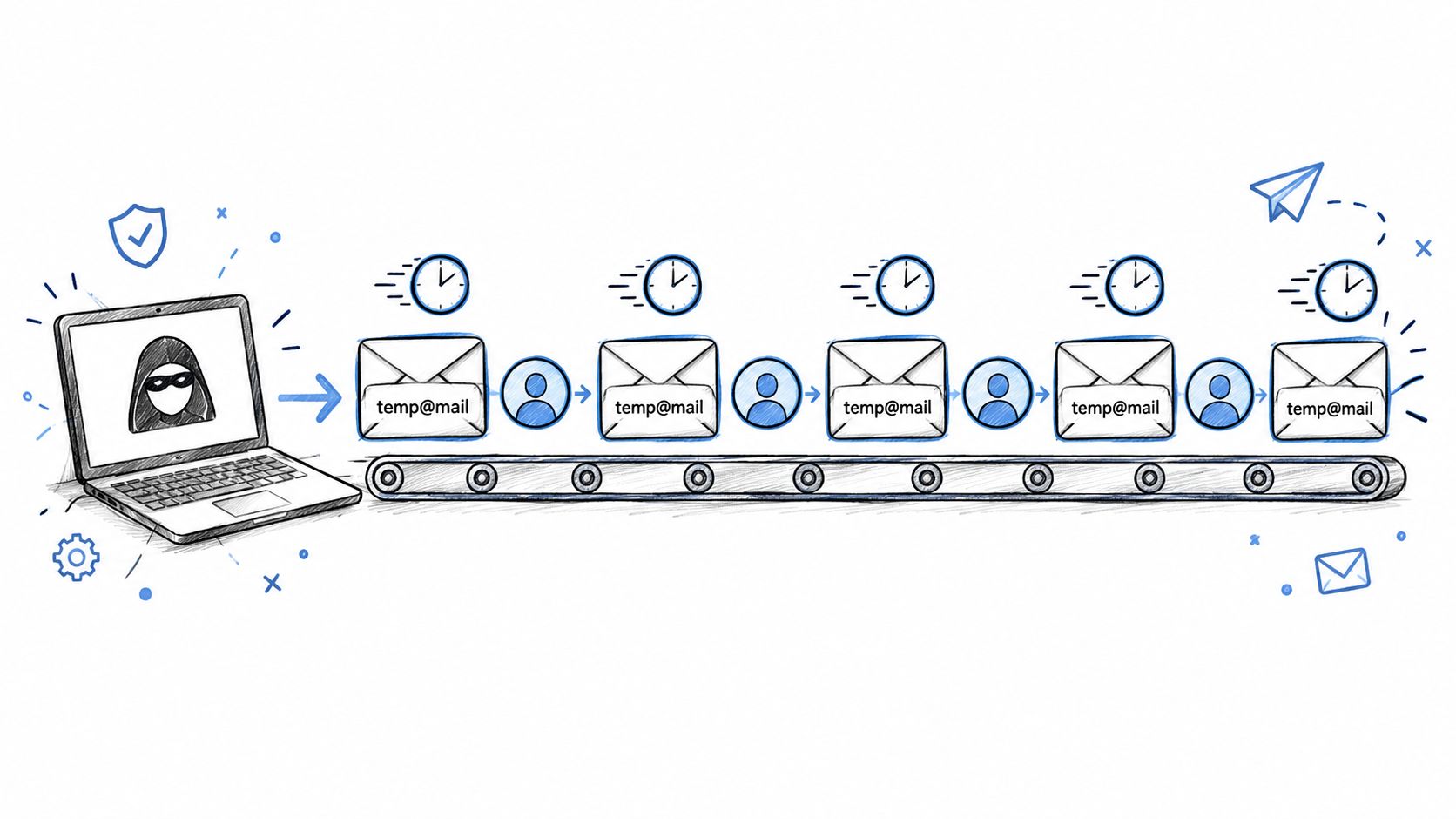
Practical rule: Treat burner-email use as context. Treat burner-email use combined with identity reuse and rapid re-enrollment as a review-worthy cluster.
Portreeve can link email addresses to device tokens, card fingerprints, and payer wallets within a tenant-scoped abuse graph. That lets a team recognize repeated enrollment without relying on IP address as the primary identity key. Teams investigating disposable addresses can also use this guide to disposable email domains as part of their domain-level controls.
Useful actions include:
- Preserve the relationship: Keep the original email, device token, payment artifact, timestamps, and decision reason together.
- Separate uncertainty from abuse: Send a suspicious cluster to review when the signals are incomplete instead of blocking every alias automatically.
- Mark confirmed clusters: Once an analyst confirms promotional abuse, propagate that signal to linked identities while keeping the evidence available for appeal.
- Measure product intent: Compare trial conversion with actual feature use. Early conversion without meaningful engagement deserves context, not an automatic accusation.
2. Structuring and Micro-Transactions
A low-value authorization may validate a payment method, cover a small add-on, or follow a checkout error. Review the pattern of repeated micro-transactions when attempts use different cards, arrive within a compressed period, or lead to a materially larger purchase.
Card testing often follows this sequence. An attacker submits low-value authorizations to identify stolen credentials that still work, then attempts a larger transaction. Several payment methods tied to one device can indicate credential testing rather than genuine purchasing, although shared devices and legitimate household or workplace activity can produce similar signals.
Small transfers can also support potential layering. Repeated movements through connected accounts or payment instruments may make the source and purpose of funds harder to interpret. The amount alone is weak evidence. Analysts should preserve the event sequence, linked instruments, account context, and stated profile. FinCEN's financial-trend analysis illustrates why suspicious activity reports are investigative leads, not confirmed laundering cases, and why activity becomes more informative when it conflicts with the customer's stated circumstances.
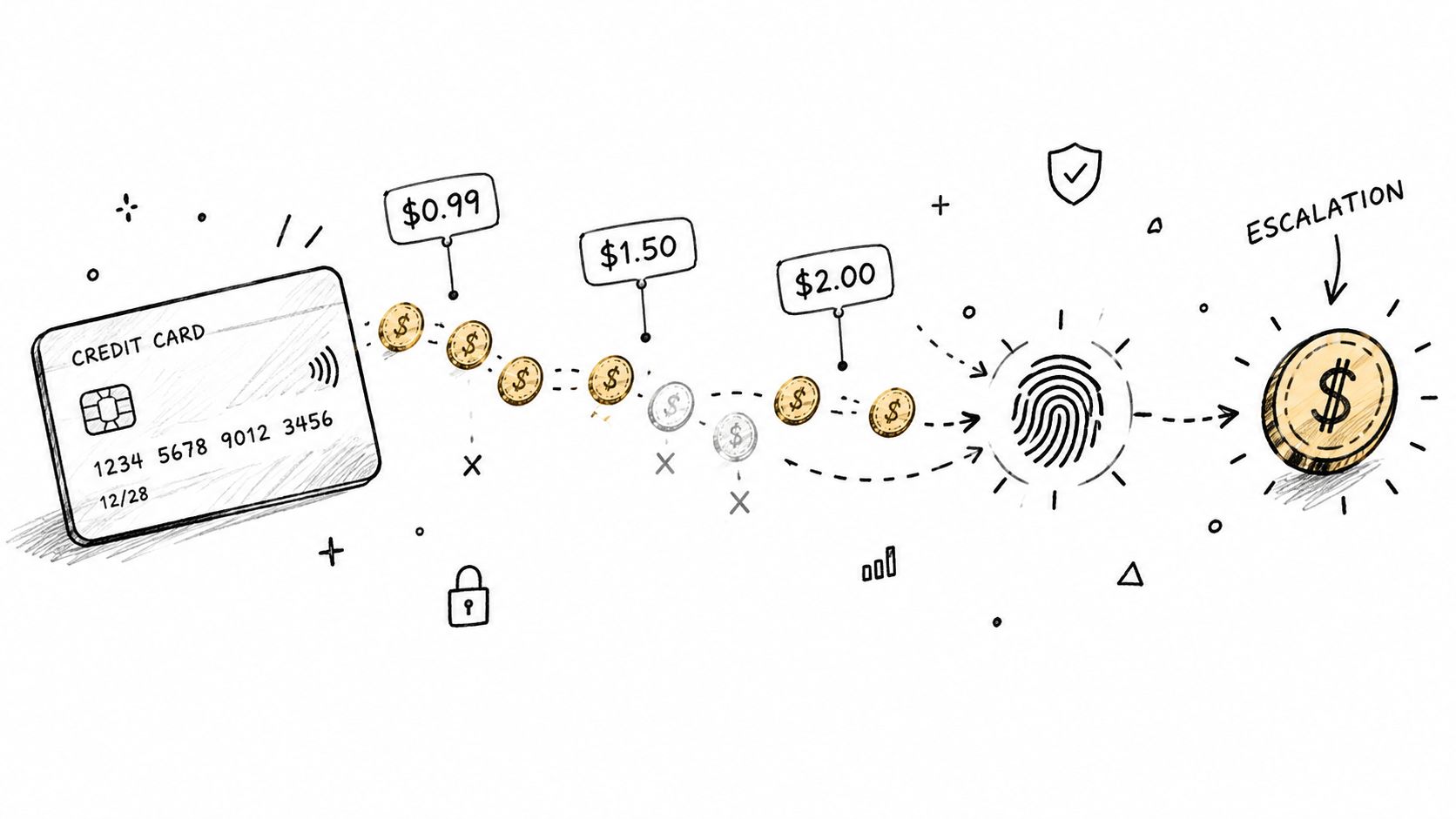
Operational controls should follow the sequence from checkout to account history:
- Gate before capture: Use Portreeve's Verdict API to assess a checkout attempt before the processor accepts a test authorization.
- Link cards carefully: Card fingerprints usually provide stronger linkage than IP addresses, which may represent offices, households, VPN users, or corporate proxies.
- Review ambiguous attempts: One low-value transaction from a new customer is a review signal, not proof of abuse. Escalate repeated attempts across linked identities.
- Watch decline patterns: Concentrated failed payments can support a card-testing hypothesis. Check processor incidents, outages, and other benign explanations before taking action.
Connect checkout events with account activity and later transaction outcomes. Teams building that monitoring process can consult payment fraud analytics practices for methods that join payment, identity, and behavioral signals.
3. Velocity Abuse and Extreme Action Concentration
Velocity is a behavioral signal, not a universal threshold. A product launch, public campaign, or partner promotion can produce a genuine surge in signups. The investigation question is whether the activity has the characteristics of normal growth, or whether it looks automated, coordinated, and disconnected from activation.
Look at the concentration of events across several dimensions. A sudden wave of account creation may involve many IP addresses but the same device characteristics, user agent, or email structure. Credential stuffing may produce repeated login attempts against many usernames from a connected device or infrastructure group. A promotional campaign may create many accounts, but legitimate users usually show a more credible progression into verification and product use.
Build a tenant-specific baseline
Static limits create avoidable false positives. A small professional tool and a public consumer platform won't have the same normal event volume, and a product's baseline can change during a launch. Establish expected behavior for signups, login attempts, trial starts, and checkout attempts, then evaluate deviations over sliding time windows.
Combine velocity with independent evidence:
- Check activation quality: A surge in accounts that never verify or use a feature is more concerning than a surge followed by normal engagement.
- Compare infrastructure: Many IPs don't disprove coordination when devices, email patterns, or payment artifacts connect the activity.
- Use staged responses: The first anomalous cluster can enter review, while repeated activity from a linked cluster can receive stricter treatment.
- Retain the event sequence: Analysts need to see what happened first, not only the final risk decision.
Portreeve's per-tenant abuse graph can connect event volume with linked identities over the configured memory period. That supports a review decision based on the whole cluster instead of a blunt rate limit that blocks legitimate growth.
4. Mismatched or Inconsistent Identity Signals
Identity inconsistencies matter when signals that should align do not. Billing country, device location, payment currency, account language, and login behavior can differ for legitimate reasons. A global SaaS customer may travel, use a corporate VPN, or pay through a centralized finance team. The concern increases when several mismatches appear during onboarding alongside a new account, payment risk, or unusual activity.
For example, a new account may use a card issued in one country, a billing address in another, and a device connection from a third. That pattern does not establish stolen payment credentials. It does justify checking whether the customer can explain the arrangement, whether identity details connect to earlier accounts, and whether the same card appears across unrelated customers.
FinCEN has highlighted occupation-to-activity mismatches in its analysis of suspected money-laundering-network activity. The practical principle is to compare declared customer information with observed account behavior. (FinCEN's warning on customer-profile mismatches)
A location mismatch should create a question, not a verdict. Location inconsistency combined with identity reuse, impossible timing, and payment conflicts can justify stronger action.
Use a graduated process:
- Define expected consistency by product: Financial services may require tighter reconciliation than a global collaboration tool.
- Anchor on durable identifiers: Compare card fingerprints, device tokens, email addresses, and payer wallets. Treat IP geography as supporting context, not identity.
- Allow legitimate exceptions: Record VPN or proxy use for review where appropriate instead of blocking privacy-conscious users by default.
- Check timing: Simultaneous or rapidly alternating activity from distant locations carries more weight than a single location change.
- Review the full lifecycle: Reassess the identity linkage if later payments, account activity, or post-transaction behavior conflict with the original profile.
Portreeve can return an explainable outcome with reason codes, helping the analyst record which identity relationships caused escalation. The result is a defensible review trigger, not an automatic finding of wrongdoing.
5. New or High-Risk Payment Credentials
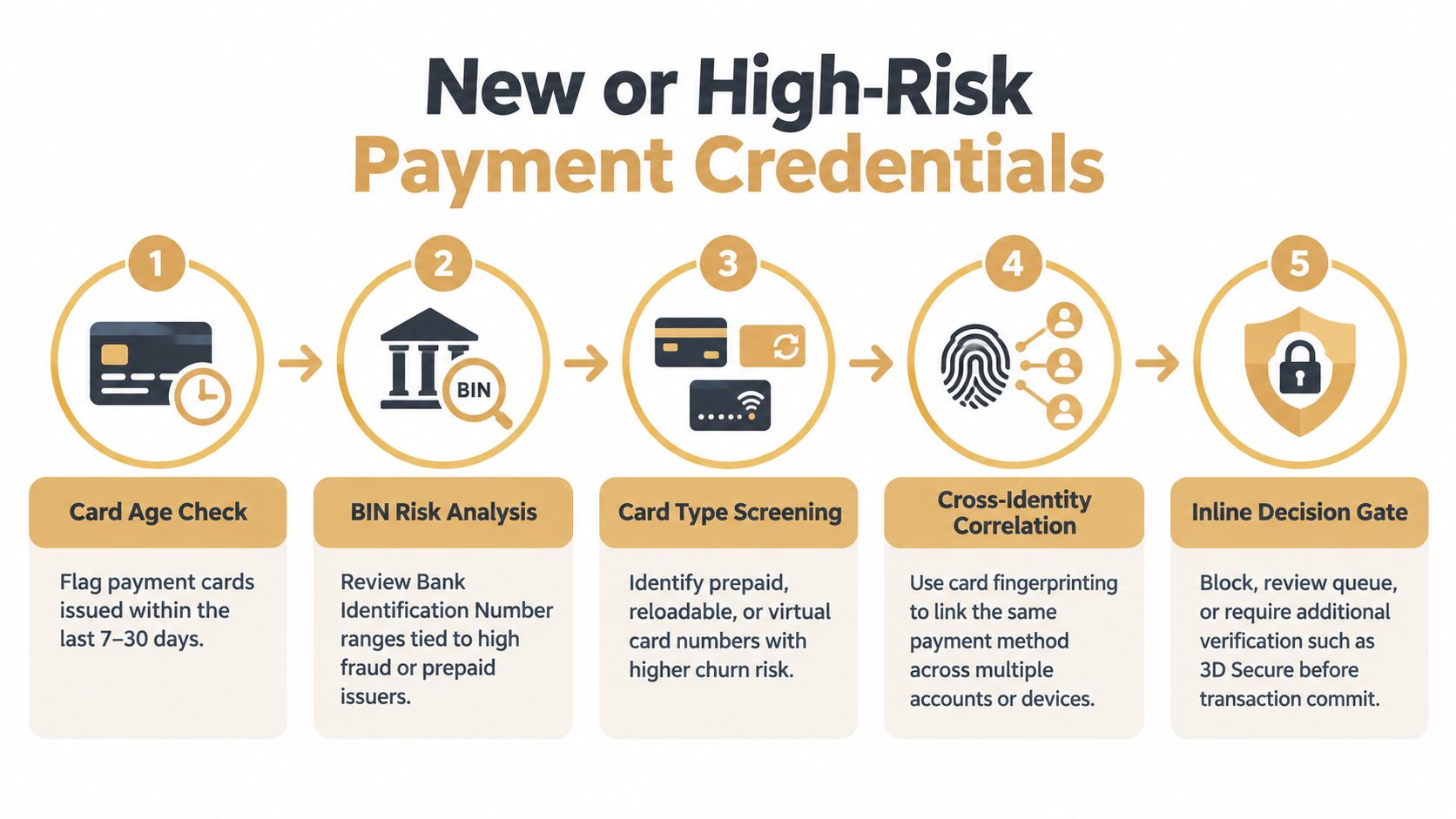
A new or prepaid payment method can carry higher risk, but payment type alone isn't a sufficient basis for rejection. Customers replace expired cards, use virtual cards for privacy, or pay through corporate instruments. The signal becomes stronger when the payment credential is new to the system and appears with a new device, a new email, unusual transaction behavior, or repeated attempts across accounts.
A practical investigation starts with the payment instrument's history in the product. Has the same card fingerprint funded other trials? Has it been declined across multiple accounts? Does the payer wallet connect to identities that previously generated disputes? These questions provide more context than a generic high-risk label.
Teams can also incorporate available payment-network or processor intelligence, provided the data is used consistently and within applicable privacy and compliance boundaries. A high-risk credential should usually change the verification path, not automatically determine the outcome.
Match control strength to the consequence
Use proportionate friction:
- Low-value, low-risk use: Allow the event when the customer profile and device history are consistent.
- New credential with linked anomalies: Request additional verification or send the event to manual review.
- Repeated cross-account attempts: Mark the payment artifact or connected cluster for heightened scrutiny.
- High-impact action: Require stronger payment authentication before granting valuable credits or capturing a larger payment.
This approach protects conversion while making credential history part of the decision. Portreeve's card fingerprint identity key can connect a payment method to prior account activity, and its decision workspace can show the linked evidence behind an allow, review, or block outcome.
6. Impossible Travel and Temporal Anomalies
An account that appears in geographically distant locations within an impossible timeframe may be compromised. The same pattern can also result from a VPN, a corporate network, inaccurate IP geolocation, or a shared account used by a distributed team. Treating every location jump as an account takeover creates friction for legitimate customers, so the timing must be evaluated with other evidence.
A login from one region followed immediately by a sensitive action from another region deserves more attention than an isolated change in login location. The concern increases when the new device is unfamiliar, the payment credential is new, or the activity includes password changes, invitations, exports, or checkout attempts.
Build the rule around event type. A login can tolerate more geographic ambiguity than a payment capture or account recovery action. For high-impact events, step-up verification can be more appropriate than an immediate block.
Useful safeguards include:
- Record trusted history: Store successful device and location patterns so future anomalies have a baseline.
- Estimate plausibility: Compare the distance and elapsed time against realistic travel, while recognizing that IP data isn't precise.
- Add identity context: A familiar device in a known corporate network may reduce concern. A new device paired with a new payment artifact raises it.
- Use progressive responses: Re-authentication, email confirmation, or review may be more defensible than a permanent block.
Portreeve can correlate timestamps, device tokens, payment artifacts, and account relationships in the abuse graph. That gives the reviewer a richer explanation than a location alert on its own.
7. Synthetic Identity or Fake Account Indicators
Synthetic identities often reveal themselves through accumulation of low-quality details. The name may look like a placeholder, the phone number may fail validation, the address may be incomplete, and the account may never use the product. None of these attributes proves criminal activity. Together, especially across a repeated cluster, they can show that accounts exist mainly to claim incentives or test controls.
Start with basic data quality. Client-side validation can reject malformed submissions, but validation shouldn't become a substitute for investigation. Real customers make typos, use transliterated names, or have unusual addresses. A rule that assumes every unconventional identity is fake will produce exclusion and may create regulatory concerns.
Behavior helps separate low intent from synthetic abuse. An account that completes verification and uses core features may just have incomplete profile data. An account that shares a device with many similar signups, claims a benefit, and remains inactive presents a different risk pattern.
Preserve an explainable identity trail
- Validate proportionately: Check phone, address, and required profile fields according to the product's risk.
- Detect obvious placeholders: Flag repeated filler terms, sequential variations, and malformed contact details for review.
- Link account creation: Compare device tokens, emails, payment artifacts, and payer wallets across the cluster.
- Use engagement as context: Lack of product use can support a promotional-abuse hypothesis, but it shouldn't be treated as proof by itself.
- Escalate valuable access: Enterprise trials, high-value credits, or sensitive features may justify stronger verification before approval.
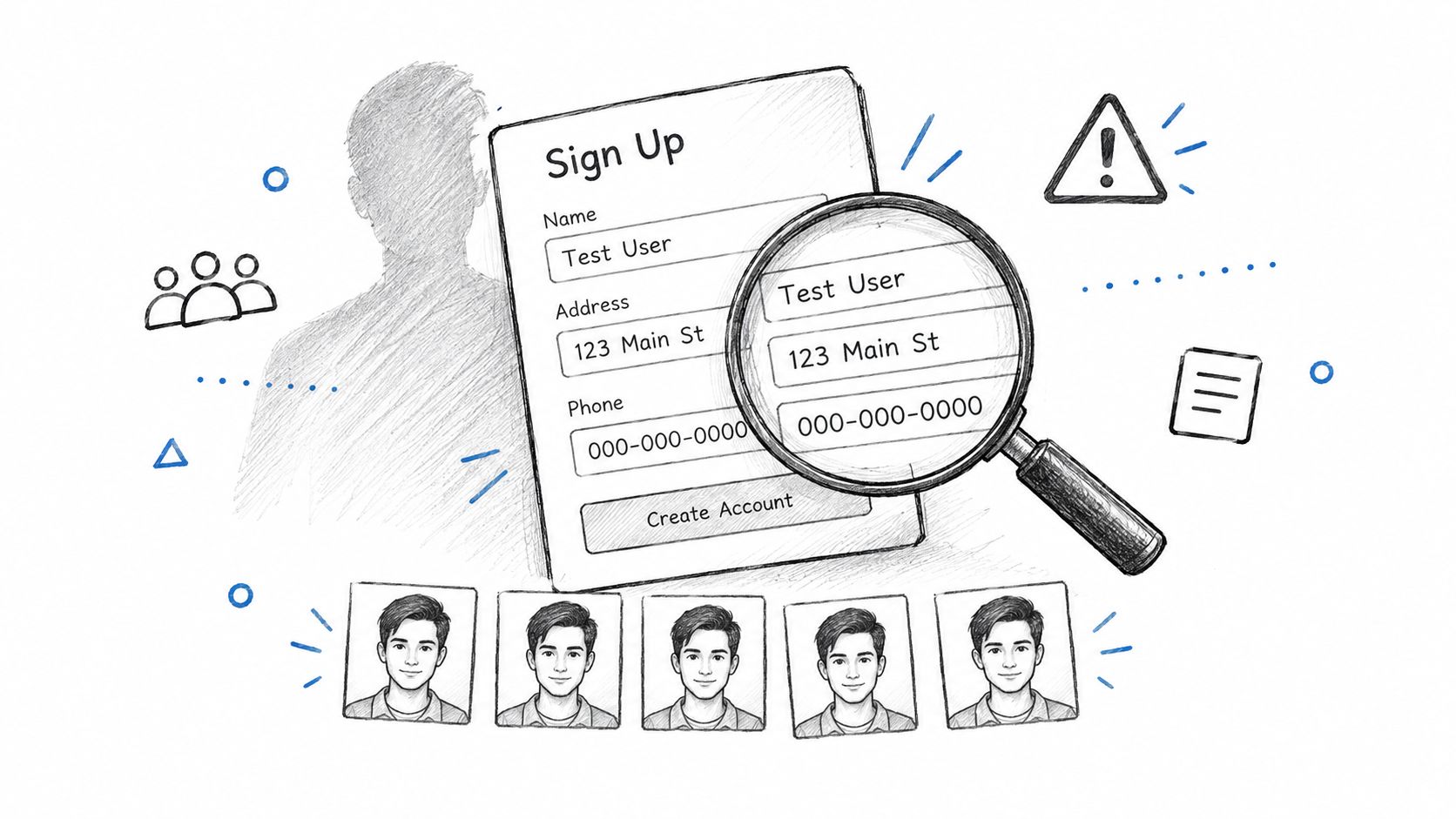
Portreeve's reason codes help analysts distinguish a malformed profile from a linked synthetic-account cluster. The decision workspace also keeps the supporting event history available when a customer challenges the result.
8. Refund Abuse and Chargeback Patterns
Post-transaction behavior can expose abuse that wasn't visible at checkout. Repeated refund requests, immediate cancellation after access, or chargebacks across linked accounts may indicate policy exploitation or friendly fraud. They may also reflect a genuine product defect, billing error, or service failure. The timing and surrounding usage matter.
Compare the refund request with product telemetry. A customer who used a feature, reported a documented failure, and requested a refund may have a valid complaint. A cluster that repeatedly signs up, receives access, makes little or no use of the product, requests a refund, and returns through another email presents a different pattern.
Chargebacks add another layer because the merchant often receives limited context about the cardholder's claim. The investigation should connect disputes to the payment method, device, account lifecycle, refund history, and prior decisions. Chargeback fraud investigation guidance can help teams frame that review around evidence rather than dispute volume alone.
Practical controls include:
- Track customer history: Record refunds and chargebacks against the user, device, card fingerprint, and payer wallet.
- Review timing: A refund immediately after access with no meaningful use deserves more scrutiny than a request following documented service consumption.
- Protect legitimate customers: Keep a path for billing corrections, technical failures, and clearly supported complaints.
- Use linked evidence: A payment artifact associated with disputes across several accounts should enter review even when the current request appears ordinary.
- Document the decision: Record the evidence, policy applied, customer explanation, and final outcome.
A refund is not proof of laundering, just as a chargeback is not proof of fraud. It becomes a meaningful red flag when it forms a repeatable pattern across the account lifecycle.
8-Point Money Laundering Red Flags Comparison
| Item | Implementation complexity | Resource requirements | Expected outcomes | Ideal use cases | Key advantages |
|---|---|---|---|---|---|
| Rapid Account Cycling with Burner Emails | Moderate, device/payment fingerprinting and abuse-graph correlation | Medium, device tokens, card fingerprints, email pattern analysis, review queue | Fewer trial farms, reduced promo exploitation, some false-positive risk | SaaS free trials, promo-heavy products, credit-limited offerings | Early detection, configurable memory depth, transparent reason codes |
| Structuring and Micro-Transactions (Layering Payments) | Moderate–High, real-time checkout gating and velocity rules | High, inline verdicts, card fingerprinting, BIN data, low-latency checks | Prevents card-testing, reduces chargebacks and test-charge losses | E‑commerce checkout, payment processors, digital goods | Stops card testing before commit, strong linkage across cards |
| Velocity Abuse and Extreme Action Concentration | Moderate, baseline modeling, sliding windows, fingerprinting | Medium, high-throughput event monitoring, behavior signals | Rapid mitigation of bot floods and credential stuffing | Platforms facing sudden signup/login spikes, API-heavy services | Real-time scale detection, prevents mass account creation |
| Mismatched or Inconsistent Identity Signals | Moderate, multi-signal correlation (geo, card, language) | Medium, IP geolocation DB, BIN/issuer data, device tokens | Detects stolen credentials and account takeover, some legitimate exceptions | Financial services, global SaaS, high-value transactions | Catches cross-identity fraud, leverages multiple corroborating signals |
| New or High-Risk Payment Credentials | Low–Moderate, BIN/age checks and fingerprint linking | Medium, BIN databases, card age checks, payment network alerts | Fewer frauds from new/prepaid cards, reduced chargebacks | Subscription signups, high-value checkouts, marketplaces | Flags risky cards early, inline gating and verification options |
| Impossible Travel and Temporal Anomalies | Moderate, distance/time calculations and timestamp correlation | Medium, accurate timestamps, IP geolocation, device fingerprints | Fast detection of account takeover, deterministic but borderline cases exist | Account security, fintech, teams with strict session control | Clear, physics-based signal, effective for high-risk actions |
| Synthetic Identity or Fake Account Indicators | Low–Moderate, form validation, regex rules, profile scoring | Low, client validation, engagement metrics, fingerprinting | Fewer fake accounts, reduced wasted trial credits | Promo-heavy services, onboarding funnels, trial programs | Rapid inline blocking, simple heuristics to catch low-quality signups |
| Refund Abuse and Chargeback Patterns | Moderate–High, longitudinal tracking and cross-account correlation | High, long-term abuse graph, payment processor data, dispute history | Reduced friendly fraud and chargebacks, slower feedback loop | Subscriptions, marketplaces, merchants with high refund volume | Links refund history across identities, supports dispute evidence |
Turn Red Flags Into Defensible Investigations
A useful monitoring program doesn't optimize for the highest alert count. The Wolfsberg Group identifies coverage of relevant red flags and typologies, alert and case volumes, alert productivity, and alert-to-SAR or STR ratios as measures for evaluating transaction-monitoring effectiveness. (Wolfsberg guidance on monitoring effectiveness) For online products, that means measuring whether the system covers the abuse patterns that matter and whether analysts can resolve cases efficiently.
Start with an event model that follows the customer. Capture onboarding data, identity relationships, payment attempts, login history, product use, refunds, and disputes. Link those events through tenant-scoped identity keys such as email, device token, card fingerprint, and payer wallet. IP address and geography can add context, but they shouldn't carry the entire decision.
Then assign clear outcomes:
- Allow: The event fits the customer profile and doesn't connect to meaningful adverse history.
- Review: The event contains unresolved inconsistencies or a combination of weak signals that requires human judgment.
- Block: The evidence meets a documented threshold for preventing the action, subject to appropriate appeal and remediation processes.
Reason codes make each outcome defensible. “High risk” isn't enough. An analyst should be able to see that a new account shares a device with prior confirmed abuse, that a payment artifact appeared across linked identities, or that the event sequence conflicts with the declared use case. Portreeve's inline Verdict API can gate signups, trials, checkouts, and logins before the action commits, while its decision workspace and review queue keep evidence and adjudication together.
Calibrate thresholds against tenant-specific behavior. A global rule may misclassify a product with legitimate international users, shared workspaces, or seasonal traffic. Review false positives regularly, record why analysts overturned decisions, and adjust the rule logic rather than passively accepting unnecessary friction. Also test failure behavior, privacy boundaries, retention periods, and tenant isolation. Portreeve hashes identity keys and scopes them per tenant, and its documented fail-open behavior makes the system state visible when screening service availability changes.
Automation should support investigation, not replace it. An ACAMS, KPMG, and SAS survey of more than 850 compliance professionals found that 21% of institutions had deployed AI or machine learning in AML processes, 15% were piloting those systems, and another 21% planned adoption within two years, 57% in total. (The ACAMS, KPMG, and SAS AML technology survey) The practical lesson is to pair automation with explainable decisions, preserved event history, analyst feedback, and outcome measures such as review productivity and confirmed-abuse yield.
Finally, document the escalation. State which signals fired, what alternative explanations were considered, what evidence was requested, who made the decision, and why the account was allowed, reviewed, or blocked. A red flag becomes useful when it leads to a consistent, proportionate, and reviewable action. It becomes dangerous when a single attribute alone determines the customer's fate.
Portreeve gives SaaS and subscription teams an inline screening layer for signups, trials, checkouts, and logins, with deterministic allow, review, or block decisions, reason codes, and linked event history. Use its Verdict API, review queue, decision workspace, and abuse graph to connect money laundering red flags with the identity and payment context needed for defensible action, then visit Portreeve to start testing your screening workflow.