
Account takeover fraud is the unauthorized control of a legitimate user's existing account, usually through stolen or guessed credentials, followed by fraud, data theft, or resale. In the U.S., reported account takeover losses exceeded $15.6 billion in 2024, which shows why the problem extends far beyond a few suspicious login attempts.
The important shift is to stop treating ATO as only a password problem. The login is often just the entry point. The financial and operational damage usually begins after the attacker has authenticated, when they change recovery settings, create persistence, export data, redirect money, or use the account's established reputation to abuse other parts of a product.
Table of Contents
- What Account Takeover Fraud Actually Means
- How Attackers Get In
- What Attackers Do Once They Are Inside
- Warning Signs Teams and Users Should Watch For
- Reactive Cleanup vs Inline Prevention
- Building a Layered Defense Against ATO
- First Steps to Reduce Your Account Takeover Risk
What Account Takeover Fraud Actually Means
Account takeover fraud, or ATO, happens when someone gains control of an existing account that belongs to another person or organization. The attacker may obtain a password through phishing, a breach, malware, social engineering, or credential reuse. They may also guess weak credentials or use an already authenticated session. Once inside, they act as the legitimate account holder.
That makes ATO different from new-account fraud. With new-account fraud, the criminal creates an identity or account for the purpose of abusing it. With ATO, the victim already exists. The account may already contain saved payment methods, customer records, credit, subscription access, administrator permissions, or a history of normal activity. Those existing trust signals can make malicious actions look more credible.
The scale is substantial. The Federal Reserve's summary of account takeover fraud reported more than $15.6 billion in reported U.S. losses in 2024, compared with $12.7 billion in 2023, while reports of ATO rose by more than 36% year over year. A separate 2025 account takeover report found that 29% of American adults had experienced ATO, up from 22% in 2021. These figures describe different research approaches, but they point to the same conclusion: ATO is a consumer-scale and business-scale problem.
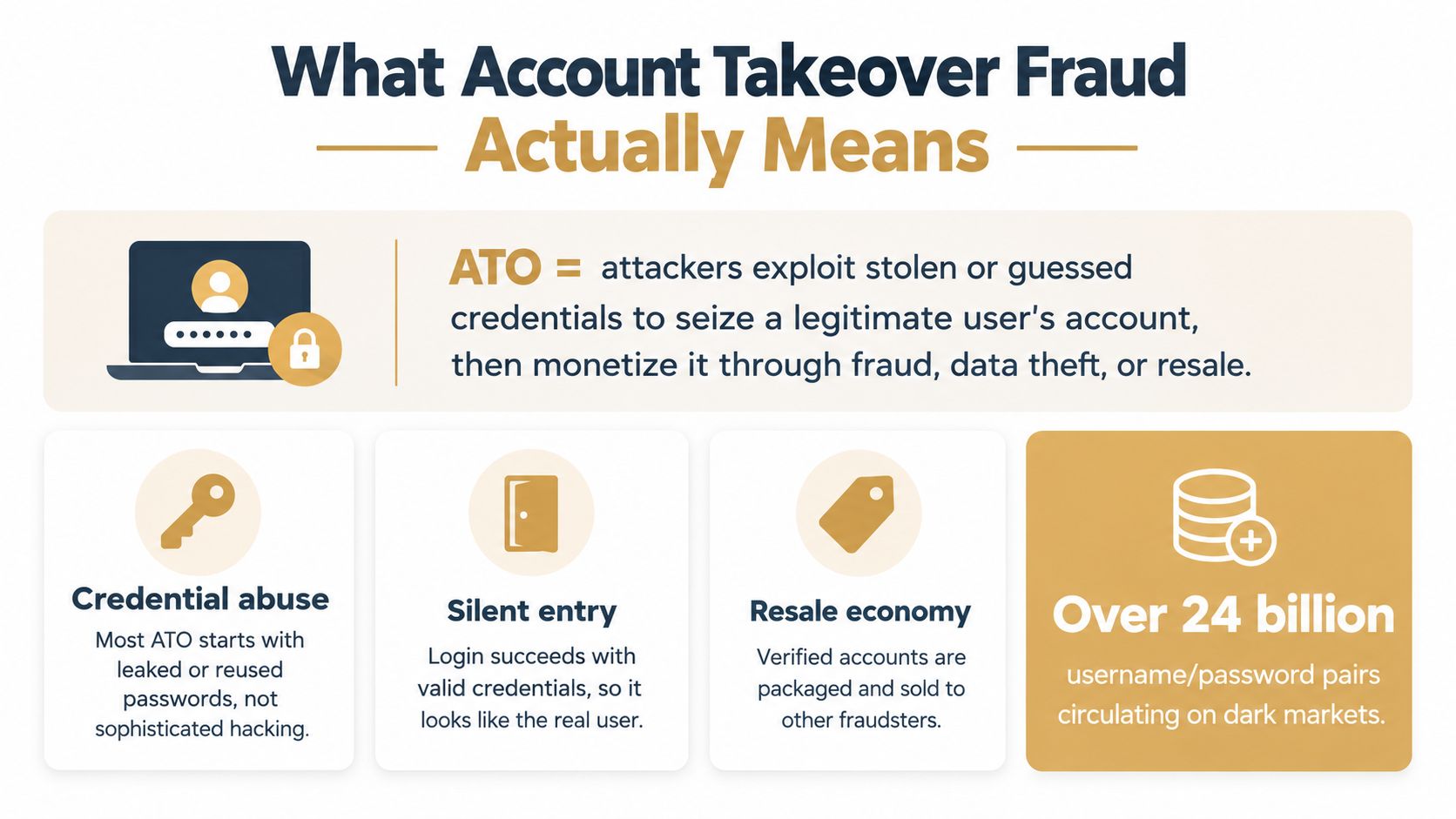
ATO affects banks, retailers, social networks, email services, marketplaces, and SaaS products. In a SaaS environment, the target may be a workspace rather than a personal wallet. The attacker can steal customer data, misuse API keys, consume paid resources, take over administrator functions, or abuse a trusted company account to create more fraudulent activity.
Practical rule: Treat every successful login as the start of a decision sequence, not the end of authentication.
The problem has two connected halves. First, the attacker needs a way in. Second, they need to turn authenticated access into value. A useful defense monitors both halves, because a clean password check can't tell you whether the person who passed it is about to change the payout account or export the customer database.
How Attackers Get In
Consider a mid-market CRM with a public login endpoint. An attacker buys a credential dump containing an employee's email and password. The employee reused that password on a gaming forum that suffered a breach. The attacker sends the credentials through automated login attempts from a residential proxy network, hoping to make the traffic look like ordinary consumer activity.
If the employee's company uses single sign-on, the attacker may target the identity provider instead of the CRM directly. A convincing phishing page can collect the employee's credentials, or a malicious OAuth consent screen can persuade the employee to authorize an application. An infostealer on the employee's computer may take a different route by copying browser session cookies, allowing the attacker to reuse an active session without submitting the password again.
The entry method changes the evidence you should expect. Credential stuffing often creates many failed attempts followed by a success, while stolen cookies can produce a successful session with no corresponding password event. A SIM swap can let an attacker receive SMS codes, but it may also coincide with a new device, a changed phone number, or an unusual recovery flow.
Entry vectors and their signals
Common Account Takeover Entry Vectors Compared
| Attack Vector | Mechanism | Typical Signal |
|---|---|---|
| Credential stuffing | Reused usernames and passwords are tested across many services | Repeated failures, unusual login velocity, unfamiliar network patterns |
| Password spraying | A small set of common passwords is tried against many accounts | Distributed failures across accounts, often followed by isolated success |
| Targeted phishing | A fake login or support interaction captures credentials or recovery information | New session context, suspicious referrer, unusual authentication sequence |
| SIM swapping | A phone number is moved to a device controlled by the attacker | Recovery or MFA activity combined with a new device or phone change |
| OAuth consent phishing | A user grants a malicious application access through a convincing authorization flow | New application authorization, token creation, or unusual scope |
| Infostealer malware | Malware collects passwords, browser data, or session cookies | Session from a new device, cookie reuse, or behavior inconsistent with the user |
The FBI IC3 account takeover guidance summarized by Veriff identifies brute-forcing, phishing, social engineering, breached credentials, and malware as common ways attackers obtain access. It also highlights weak passwords and missing MFA as factors that increase exposure.
Device and browser context can help separate a familiar employee from someone replaying that employee's credentials. A product team designing this layer can also review password and browser fingerprint considerations when deciding which signals belong at login and which belong in a broader session profile. The goal isn't to block every unfamiliar device. It's to ask whether the device, authentication path, location, and subsequent actions make sense together.
What Attackers Do Once They Are Inside
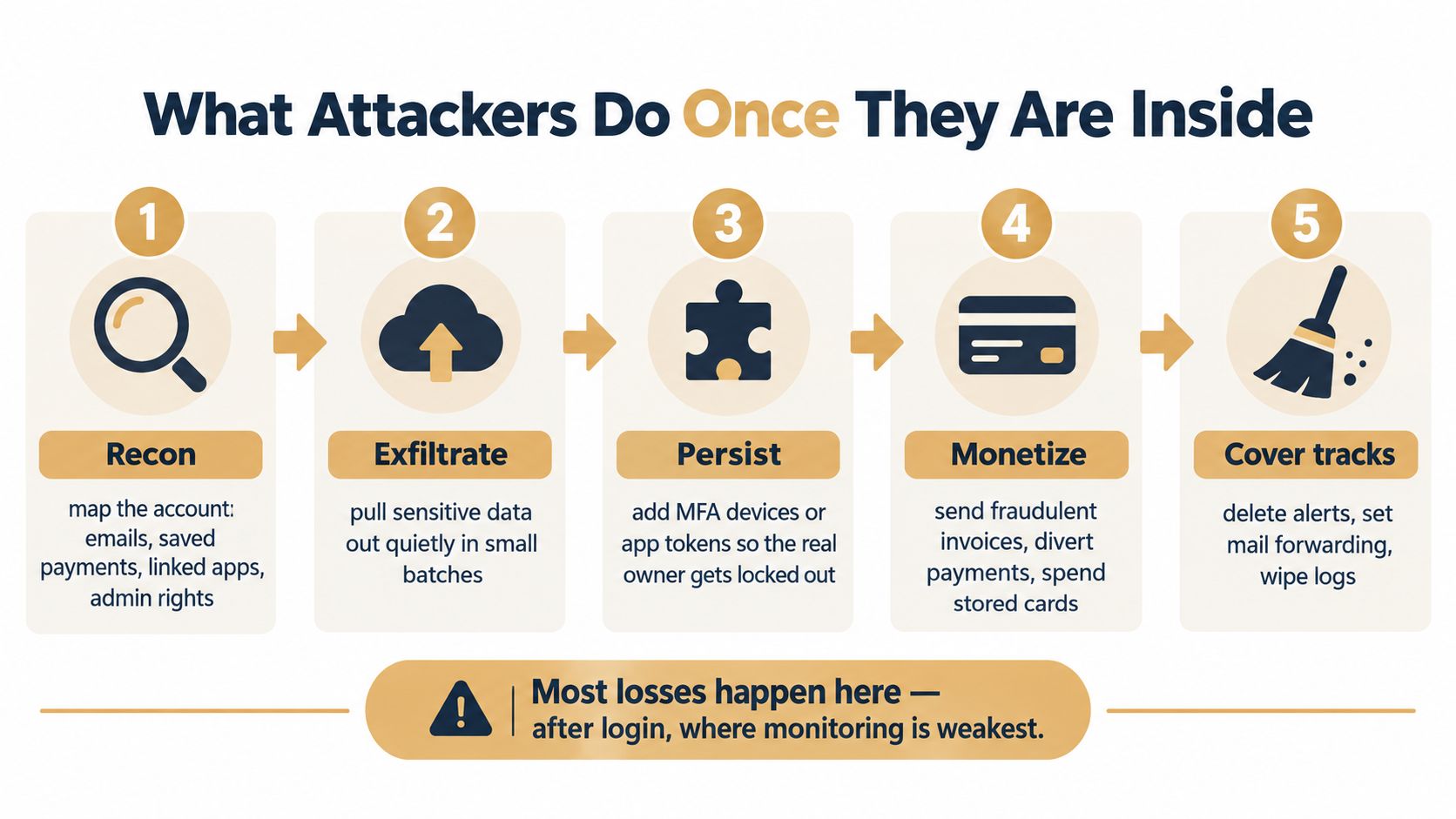
A successful login gives the attacker a foothold. The next actions often look administrative rather than obviously fraudulent, which is why a system that only watches authentication events can miss the most important part of the attack.
In a compromised SaaS workspace, the attacker may first inspect the account. They look for customer lists, saved payment methods, administrator roles, connected applications, invoices, support conversations, and API access. This reconnaissance tells them what the account can do and which actions are likely to produce value.
Next, they establish persistence. They might register a new MFA device, create an application token, change the recovery email, or replace the phone number. These changes matter because they can cut the legitimate owner off from recovery. An attacker doesn't need to make every change immediately. Quiet, low-volume modifications can be harder to distinguish from routine account maintenance.
The post-login playbook
The monetization step depends on the account's permissions. An attacker may redirect payouts, alter invoicing details, spend stored cards, issue fraudulent refunds, export sensitive records, or use a trusted company workspace to send convincing messages. They may also create additional fraudulent accounts under the compromised organization's reputation.
The Federal Reserve's explanation of ATO as a persistent threat emphasizes that unauthorized access is only the defining event. The practical risk continues into transaction and payout abuse. That distinction matters for product design because a session can be suspicious even when the login itself passed every password and MFA check.
The value of an account isn't determined by the password that opened it. It's determined by the actions the authenticated user can take.
Detection should therefore watch for a sequence, not just an isolated event. A new device followed by a recovery-email change is more meaningful than either signal alone. A new MFA factor followed by an API-key creation and a bulk export deserves a different response from an ordinary login from a hotel network. The attacker's objective is to convert access into control, persistence, and money or data.
Warning Signs Teams and Users Should Watch For
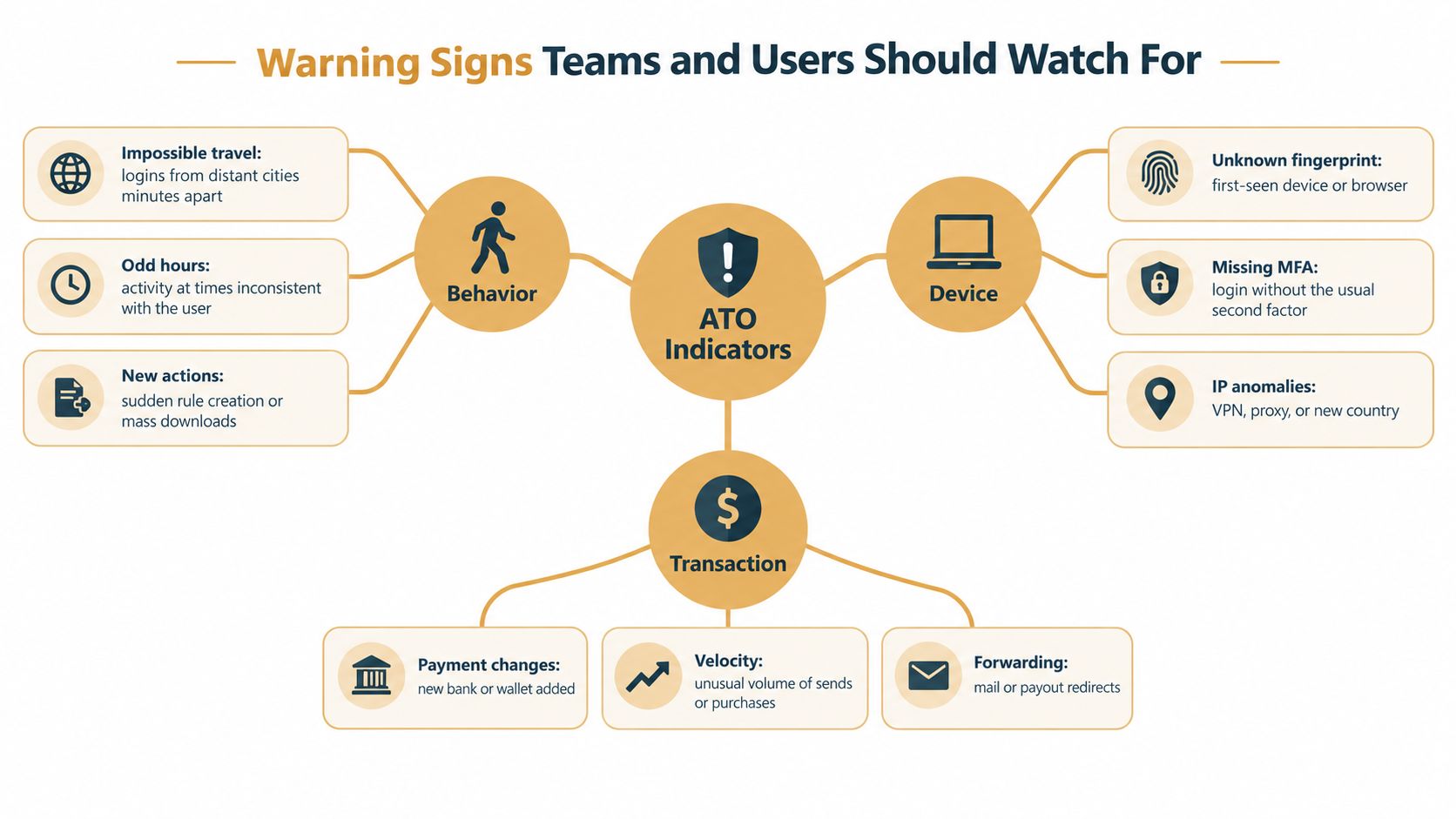
ATO indicators become more useful when teams group them by the stage of the user journey that produces them. A login service, product analytics system, and SIEM may all record related evidence, but they won't necessarily label it in the same way.
Behavior signals
Behavior signals describe how the session unfolds. Product analytics may show an employee who normally opens a few records now downloading large collections, creating rules, or moving rapidly through administrative screens. A fraud or SIEM system may connect impossible travel, unusual session duration, odd-hour activity, and a burst of failed logins followed by a successful one.
Velocity is especially useful when interpreted in context. A single failed login is ordinary. A concentrated series of failures across several accounts, followed by a successful session that immediately changes account settings, is a stronger signal. Teams should preserve the order and timing of events rather than reducing the session to a single login outcome.
Device signals
Device evidence helps answer whether the session came from a familiar environment. Relevant indicators include a first-seen browser or device fingerprint, an unexpected country, a residential proxy, a known automation network, or a login that lacks the usual second factor. A browser cookie stolen from an employee's machine may look different from a credential-stuffing attempt, so the system should retain the authentication method and device history.
Transaction signals
Transaction indicators appear after authentication. Watch for a new bank account or wallet, a changed payout destination, a recovery-email update, an MFA reset, a newly created API key, a large export job, or an escalation to an administrator role. These events should reach the same risk workflow as login anomalies because they often represent the attacker's real objective.
A product analytics view can display the action in the account timeline. A fraud or security system can enrich it with linked devices, identities, payment instruments, and previous activity. Combining behavior, device, and transaction evidence reduces the chance of blocking a legitimate user because of one unusual detail. It also makes a step-up challenge more precise, since the system can explain which combination caused concern.
Reactive Cleanup vs Inline Prevention
Reactive cleanup starts after the product has accepted the risky event. The team investigates the account, reverses transactions where possible, restores access, handles chargebacks, contacts affected users, and reconstructs the timeline. Those steps remain necessary, but they happen after the product has already created cost and uncertainty.
Inline prevention makes a decision before the action commits. The system can allow the event, ask for stronger verification, send it to review, quarantine the action, or block it. This applies not only to login, but also to signup, trial conversion, payout changes, checkout attempts, and high-risk API calls.
The trade-off by scenario
A credential-stuffing wave against a trial flow illustrates the difference. Reactive handling creates a queue of newly created accounts to inspect, disable, and possibly restore. An inline gate can evaluate the signup context before trial resources are provisioned, preserving capacity while allowing ordinary users to continue.
The same principle applies when someone tries to replace the recovery email on a high-value account. A reactive system may discover the change only after the actual owner loses access. An inline control can require re-authentication or a stronger factor before accepting the new recovery path. That adds friction for a legitimate user, but it places the friction on the sensitive action rather than on every session.
Card testing after login creates another contrast. Reactive teams investigate suspicious charges and process disputes after payment capture. Inline screening can pause a transaction that combines an unusual device, a new payment instrument, and abnormal purchase behavior.
Reactive Cleanup vs Inline Prevention
| Dimension | Reactive Cleanup | Inline Prevention |
|---|---|---|
| Decision point | After the account or transaction changes | Before the action commits |
| Main tools | Investigation, restoration, chargebacks, reimbursement | Allow, review, challenge, quarantine, or block |
| User experience | Legitimate users may face recovery delays | Some users encounter targeted verification |
| Evidence | Often reconstructed from scattered logs | Captured as part of the decision context |
| Best role | Safety net and incident response | First control for high-risk actions |
Teams evaluating fraud detection software should ask whether the system can act inline or only report after the event. SaaS products with instant onboarding, free trials, or thin margins generally have more to gain from decisions made before account creation, resource allocation, or payment capture. Reactive cleanup still matters because no control catches every attack and legitimate users still need a clear recovery path.
Building a Layered Defense Against ATO
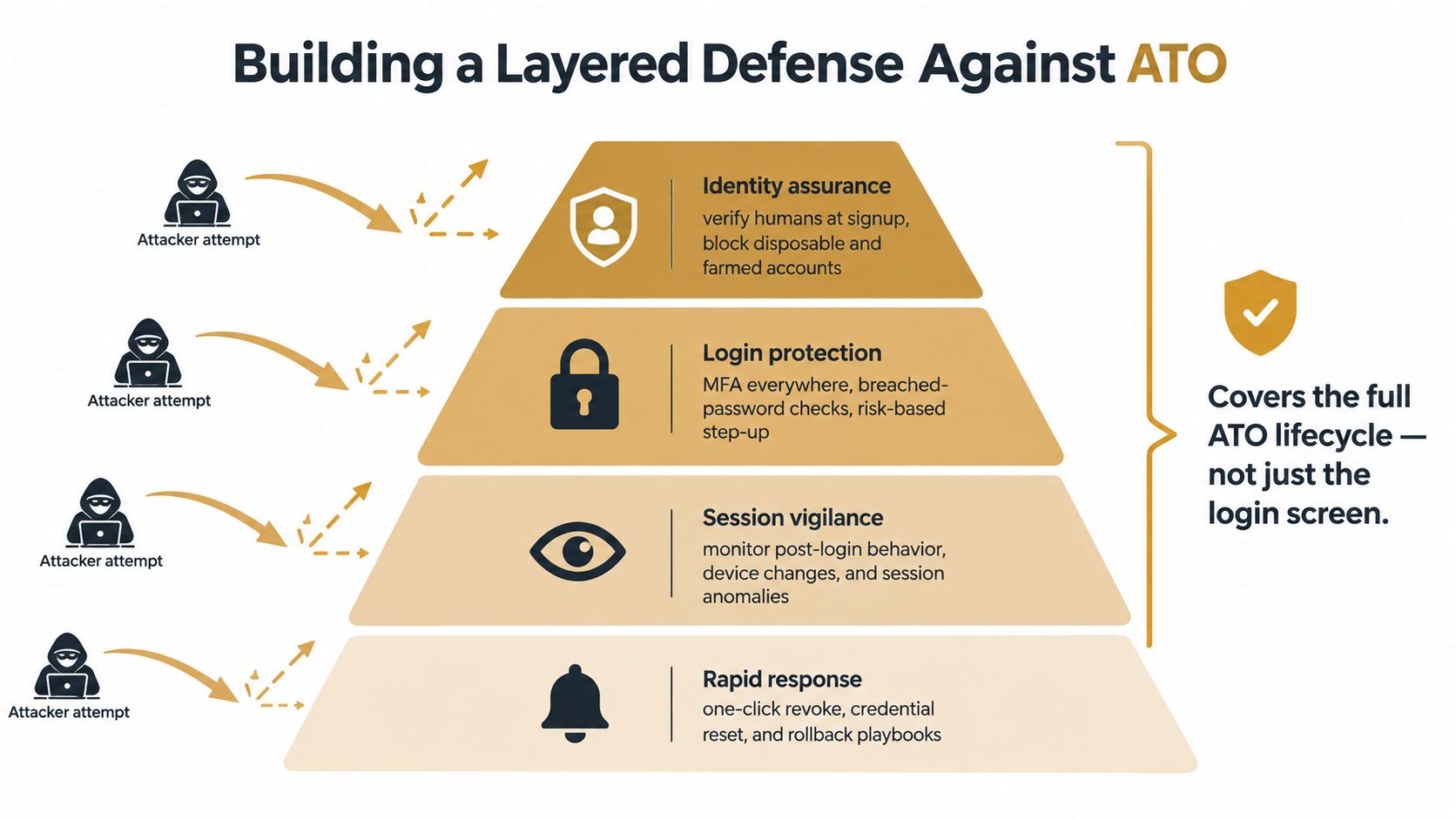
A strong ATO program follows the account through its lifecycle. It doesn't place every responsibility on the login screen. Four layers work together, with each one catching a different failure mode and handing useful context to the next.
Identity assurance starts early
At signup, the product can verify email and phone ownership, assess disposable inboxes, inspect device and network context, and identify patterns associated with farmed or scripted accounts. Growth and product teams usually own this layer, with support from trust and safety. Its purpose isn't to prove that every person is harmless. It is to prevent an attacker from creating a large base of accounts that later becomes useful for abuse.
Authentication raises the cost of entry
The authentication layer uses strong MFA, breached-password checks, rate limiting, and risk-based challenges. Security and engineering typically lead it, while product owns the user experience. Phishing-resistant methods such as passkeys or WebAuthn provide a stronger path than relying only on passwords or SMS codes. Adaptive challenges can reserve extra friction for sessions that combine suspicious credentials, devices, and behavior.
Session vigilance watches the authenticated user
After login, the product should monitor device changes, unusual navigation, data exports, privilege changes, recovery updates, API-key creation, and payment or payout actions. Fraud, risk, and security teams need a shared event stream so they can see that these actions belong to the same session. A user who passes MFA but immediately changes recovery settings should not receive the same treatment as a user who signs in and performs familiar work.
Linkage reveals coordinated abuse
An abuse graph connects identities, devices, payment instruments, wallets, and behavioral patterns across accounts. This layer helps teams recognize repeated trial enrollment, shared infrastructure, or a payment artifact that appears across apparently unrelated users. It is particularly useful when attackers rotate email addresses or devices but continue to reuse other parts of their operating pattern.
The Federal Reserve account takeover data summarized by Microblink describes credential reuse and social engineering as reasons ATO can scale across services. A layered design responds to that scale by linking evidence instead of evaluating every event in isolation.
Skipping a layer leaves a predictable gap. Signup controls won't stop a compromised existing user. MFA won't explain a dangerous post-login payout change. Session monitoring won't necessarily connect several burner identities to the same payment artifact. The layers should share events, decisions, and recovery actions so an account can be challenged, revoked, or restored without forcing every team to start from zero.
First Steps to Reduce Your Account Takeover Risk
ATO reduction is a continuing product responsibility, not a one-time authentication project. Start with controls that protect the most valuable account actions and assign an owner, a response path, and a measurable outcome to each one.
-
Protect staff and high-value users with phishing-resistant MFA. Begin with passkeys or WebAuthn for administrators, support agents, finance users, and other roles that can change recovery or payout settings. The security owner should track enrollment, failed challenges, recovery attempts, and exceptions. Give customer-facing teams a documented fallback for users who lose a factor.
-
Harden the login endpoint against automated abuse. Apply rate limits, preserve authentication-method telemetry, and compare device and session context with the user's established history. Backend engineering can own the controls, while fraud teams review clusters of failed attempts and successful logins. Avoid treating every new device as malicious. Use multiple signals to decide whether to allow, challenge, or review.
-
Add step-up verification to sensitive changes. Require stronger confirmation when a user changes the recovery email, phone number, MFA factors, payout destination, payment method, administrator role, or API credentials. Product should define which changes are reversible and which require a cooling or review path. Log the old and new values, the device, the session, and the factor used.
-
Give customers a clear session review screen. Show active devices, recent sign-ins, authentication changes, connected applications, and important account actions. Let the user revoke sessions, remove unfamiliar devices, reset credentials, and contact support from the same place. Support and product teams can measure how quickly users identify suspicious activity and whether recovery succeeds without manual escalation.
For a SaaS team, the next sprint should produce a simple ownership map. Security owns authentication strength, product owns sensitive-action friction, engineering owns event quality, and fraud or trust teams own investigation rules. Review the results regularly, tune challenges around real user behavior, and make post-login actions part of the same risk conversation as the initial sign-in.
Portreeve provides an inline screening layer for signups, trials, checkouts, and logins, returning allow, review, or block decisions with reason codes before an action commits. Visit Portreeve to assess whether its event screening and linked-identity history fit your account takeover prevention workflow.