
A signup can look perfectly ordinary when viewed alone. The email is new, the form is complete, and the browser behaves normally. Connect that event to a device token, a payment method, a payer wallet, and earlier activity, and the same signup may reveal a user cycling through trials or testing stolen cards. That difference between an isolated event and a connected pattern is the foundation of a useful fraud detection example.
The scenarios below follow the complete path: the attempted action, the signals that add context, the allow, review, or block decision, and the operational work that follows. The practical question isn't whether a model can label an event as risky. It's whether your product can make a fast, explainable decision before the account, trial, checkout, or login creates downstream cost.
Fraud prevention needs that timing. The U.S. Federal Trade Commission reported that consumers lost more than $12 billion to fraud in 2024, and 38% of 2.6 million reports indicated that money was lost, an increase of more than $2 billion from 2023. Those figures make inline detection an operational requirement, not a niche feature. Portreeve applies an inline allow, review, or block model to signup, trial, checkout, and login events, with reason codes and persistent per-tenant history.
Table of Contents
- 1. Free-Trial Farming and Credit Abuse Prevention
- 2. Card Testing and Payment Fraud Detection
- 3. Bot Signup Prevention and Low-Quality Traffic Filtering
- 4. Burner Email Account Cycling Prevention
- 5. Login Abuse and Account Takeover Prevention
- 6. Promo Code and Discount Abuse Detection
- 7. Centralized Fraud Review and Decision Workflow
- 8. Declining Conversion Rate and LTV Recovery via Risk-Based Decisions
- 8-Point Fraud Detection Comparison
- Turn These Scenarios Into a Screening Playbook
1. Free-Trial Farming and Credit Abuse Prevention
An AI or machine-learning SaaS product offers a free trial with access to expensive inference, storage, or project credits. A user creates an account with one email, consumes the allowance, then repeats the process with different addresses. Each signup looks plausible by itself. The abuse appears when the product connects the accounts to the same device token, payment method, or related identity.
The screening event should happen before the trial starts. The system receives the signup and trial context, searches the abuse graph, and checks whether linked identities have already received the same benefit. A new user with no meaningful connection to earlier activity can be allowed. A cluster of accounts sharing strong identifiers should be blocked, while a weaker connection can go to review.
Portreeve's persistent abuse graph is designed for this pattern. It can correlate signup events across email addresses, device tokens, and payment methods, then return a deterministic verdict rather than forcing an operator to interpret an opaque score. The fraud explanation guide is useful when teams need to distinguish suspicious activity from confirmed abuse.
Signals and operational trade-offs
The best signal isn't just “new email.” Burner addresses are easy to replace. Durable signals, such as a device token or payer identity, help establish whether several accounts belong to one repeated actor.
- Set memory to the benefit lifecycle: Retain relevant history through the trial period and the likely re-engagement window, not just the signup session.
- Mark confirmed clusters: Once reviewers confirm abuse, propagate that signal to linked identities and devices.
- Review uncertain patterns: A shared office device or household payment method can create legitimate overlap, so don't block every connection automatically.
- Tune by product: A generous consumer trial and a restricted enterprise evaluation need different sensitivity levels.
The implementation takeaway is simple: screen signup and trial_start as separate events. A user might pass signup but become ineligible when requesting credits, and that distinction protects both conversion and infrastructure costs.
2. Card Testing and Payment Fraud Detection
A low-value checkout attempt fails, then the same card appears on another account and shortly after on a third. The sequence may indicate stolen or generated card numbers being tested before the attacker attempts larger fraudulent charges. Evaluating only successful payments misses the strongest evidence, the connected trail of declines.
Card testing needs a decision before fulfillment or payment capture. An inline screening layer can correlate the card fingerprint with the device, account, and payment-provider context, then return a clear allow, review, or block decision without requiring an opaque risk score. Repeated failures tied to one card and device carry more weight than an isolated decline. A long-standing customer with one failed payment should generally remain eligible for allow or review.
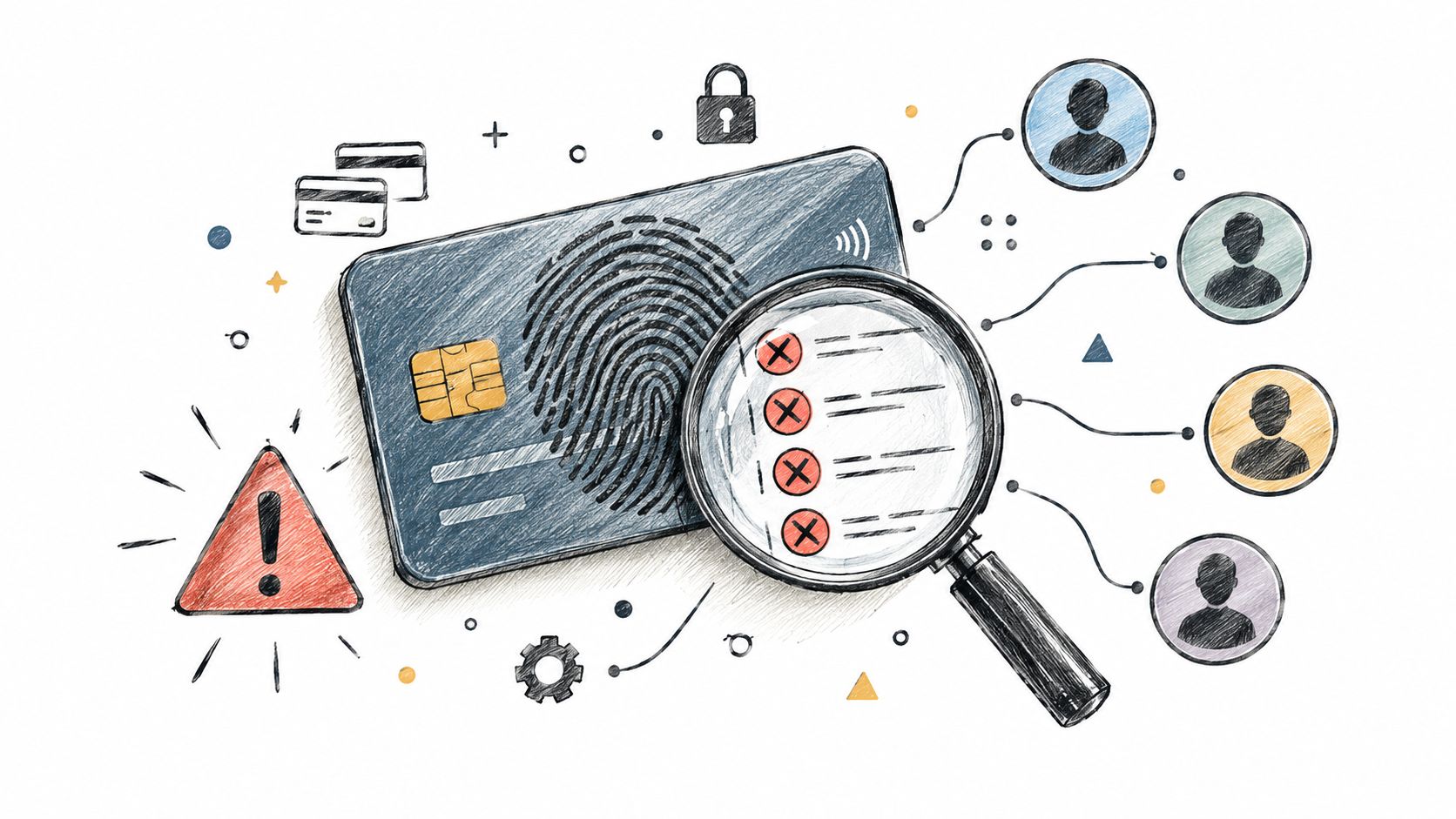
Portreeve uses card fingerprints as an identity key, connecting suspicious attempts across accounts instead of treating each visible account as a separate case. That correlation can stop test transactions before fulfillment while still leaving payment-provider controls in place. A broader payment fraud prevention workflow should send post-purchase outcomes, including confirmed chargebacks, back into the same decision process.
The operational question is what evidence should change the decision. Correlate card and device first. A fingerprint linked to several new accounts deserves more scrutiny than one used consistently by an established customer. Use provider context such as processor decline codes and available IP reputation data, while keeping IP from becoming the sole identity key.
Review ambiguous attempts when a corporate card or shared purchasing desk creates high volume without clear abuse. Feed back outcomes through chargeback and confirmed-abuse webhooks so later attempts inherit relevant history. Protect known business users with an allowlist for verified enterprise payment methods, reducing unnecessary challenges for legitimate buyers.
Velocity is evidence, not an automatic verdict.
Block clear card-testing sequences, review patterns with legitimate explanations, and allow consistent customer behavior. The operational follow-up matters: investigate confirmed clusters, record chargeback outcomes, and monitor whether review rules create avoidable payment friction. A fast decision protects the workflow because authorization followed by manual investigation may arrive after fulfillment has already started.
3. Bot Signup Prevention and Low-Quality Traffic Filtering
A community platform receives a burst of completed signups from devices creating accounts at unusual speed. The forms look valid, yet many accounts share device characteristics, disposable email domains, and inconsistent user context. Allowing them through shifts the cost to moderators, who must later remove spam, fake sellers, and coordinated accounts individually.
Screen the signup before creating the account. Correlate device velocity, email context, signup sequence, and known abuse clusters in one inline decision. A device token producing many accounts in a compressed period can support an automatic block. A single weak signal should lead to review or an extra verification step, preserving access for legitimate users while the evidence develops.
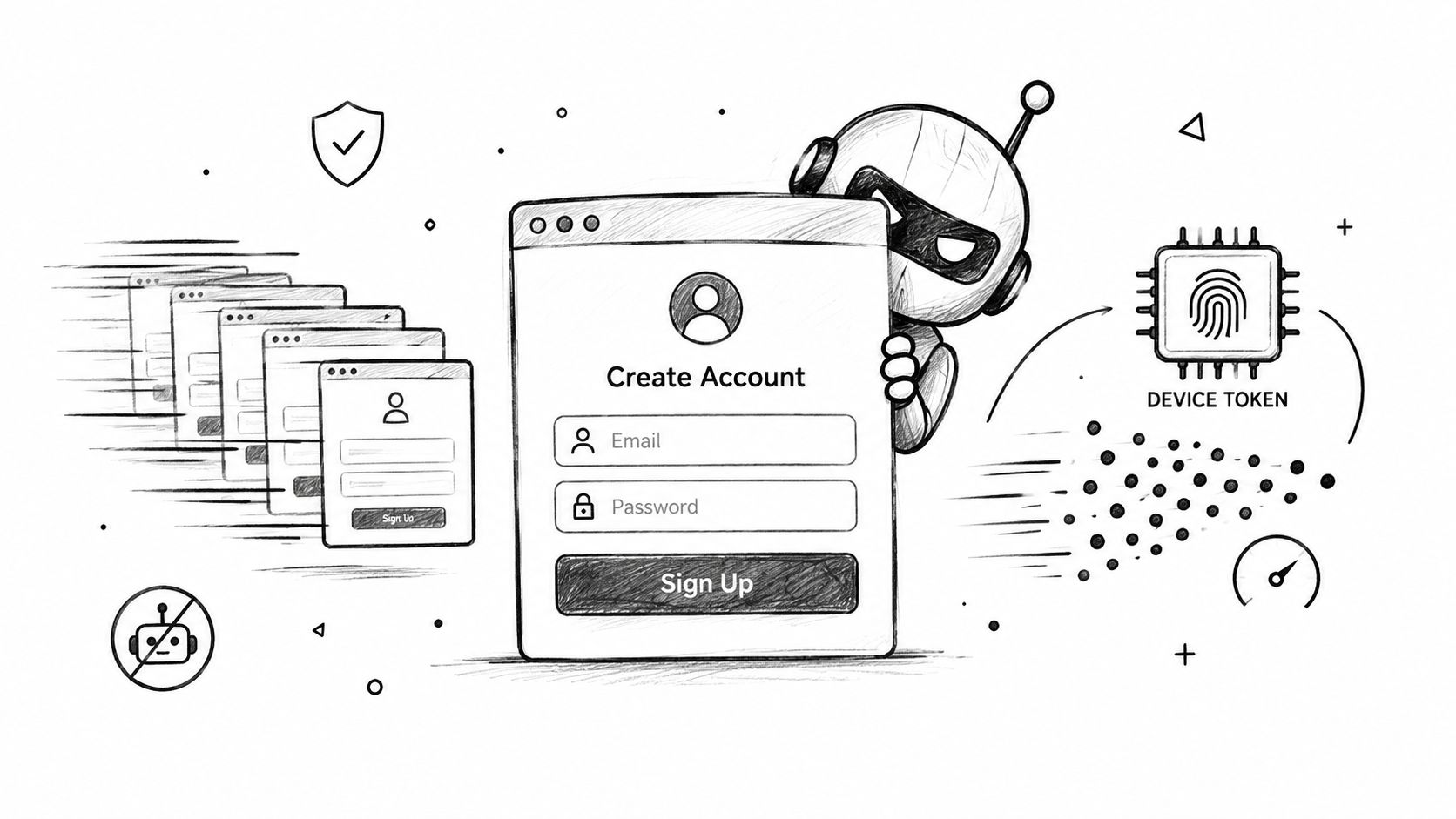
Device evidence gains value when connected to a broader identity record. Portreeve retains device tokens across events and each tenant's history, so teams can link a new signup to earlier abuse without treating an IP address as the primary identity. This device fingerprinting guide explains how device identity supports screening.
Set thresholds around real user behavior
Signup velocity varies by product, region, and shared environment. A marketplace serving a large seller network may see several legitimate accounts from one workplace. A community enforcing one account per person may reasonably apply tighter controls. The decision should follow the product's rules and the strength of the correlated signals.
- Establish a local baseline: Compare activity with normal behavior by market and user type.
- Separate block and review thresholds: Block combinations of strong signals, and route ambiguous cases to review.
- Check email context: Use disposable domains as supporting evidence, never as the sole reason to reject.
- Update cluster rules: Let confirmed bot farms inform decisions for linked accounts found later.
- Measure downstream quality: Track moderation workload and account quality alongside blocked signups.
The workflow should preserve the decision reason and linked evidence. Trust and safety teams can then review false positives, adjust rules when attackers change their signup pattern, and keep the screening layer from creating unnecessary user friction.
4. Burner Email Account Cycling Prevention
A user claims a productivity app's trial with a temporary email address, consumes the available access, then registers again with a different address. The second signup may still come from the same laptop, browser profile, device network, or payer wallet. An email-only check treats each attempt as new and leaves the eligibility rule easy to reset.
Screen the event sequence across signup, login, and trial conversion. Capture a device token when the account is created, then retain it for later activity. If a new email appears on a device linked to earlier trial use, correlate the events and inspect the strength of that relationship. A strong match can support a block, while a weaker connection can send the account to review.
Portreeve can use a payer wallet fingerprint as a secondary identity key. This connects accounts that use separate email addresses but eventually rely on the same payment identity. The signal needs context. A household may share one device legitimately, and an office, school, or managed workspace can create genuine overlap across accounts.
Apply graduated eligibility decisions
Set the response around the product's terms and customer model. The first eligible trial can proceed. A second linked attempt can require review, while a later attempt can be blocked when the device, wallet, and activity history point to the same abuse pattern. These thresholds should reflect the product's actual enrollment behavior rather than a universal rule.
Build the device profile at signup and login, not only after suspected abuse. Retain enough history to identify repeat enrollment through the relevant promotional cycle, including for seasonal businesses. Create allowlists or separate review paths for shared environments. Combine device and payer wallet evidence, since either signal alone can produce false positives.
Record the reason for each link and expose the supporting events to reviewers. Support staff should be able to distinguish confirmed duplicate use from an unresolved connection, explain the eligibility decision, and correct legitimate customer cases. Confirmed abuse can also inform later linked-account rules, while review outcomes provide the feedback needed to adjust controls without adding unnecessary friction.
5. Login Abuse and Account Takeover Prevention
A marketplace seller logs in from a familiar country but an unfamiliar device. The account has a history of trusted access, while the new session is preceded by repeated failed attempts against the same email. The login may look normal after the attacker obtains the correct password, but the deviation from the account's established device and access pattern changes the decision.
Screen the login before issuing a session. Compare the email's historical devices, the current device token, IP context, login velocity, and recent failure patterns. A known device with normal behavior can be allowed. A suspicious deviation can trigger step-up MFA or review. A clear credential-stuffing pattern should be blocked or rate-limited before the attacker reaches a valid account.

The main trade-off is security versus access continuity. Immediate blocking protects the account but can lock out a legitimate traveler. Review may be too slow for a live login flow. Step-up verification often provides a better middle path when the account owner can prove control.
Practical rule: Treat an unfamiliar login as a request for more evidence, not automatic proof of compromise.
A strong implementation records device tokens at every login, supports trusted-device enrollment, and watches failure patterns over time. Teams can also check whether credentials appear in a relevant breach-monitoring service, then require a password reset or stronger authentication when exposure is suspected. The follow-up should include session revocation, notification to the account owner, and a review of recent account changes.
Portreeve's login event can return allow, review, or block with reason codes. That makes the response explicit for the application and gives support and security teams a shared explanation when a user asks why access was challenged.
6. Promo Code and Discount Abuse Detection
A retailer launches a referral offer. Several new accounts redeem the same code, originate from one device, and refer one another in a closed loop. A SaaS company can see the same pattern when users create new accounts to claim an early-bird discount that was intended for one customer. The abuse isn't necessarily payment fraud, but it still transfers revenue or inventory to an ineligible actor.
The checkout or redemption event should include the promotion identifier and eligibility context. The system links redemptions across emails, devices, payer wallets, and referral relationships. A normal customer using one valid code can be allowed. A cluster of accounts sharing strong identity signals can be blocked from redeeming future offers, while a borderline case can wait for manual approval.
Design the rule before launch
Promotion abuse often starts with unclear eligibility. If the business hasn't defined whether an offer applies per email, person, household, company, or payment identity, support teams will struggle to resolve disputes. Document the rule before distributing the code, then make the screening decision match the published terms.
- Protect high-value promotions: Require stronger verification when the discount or credit has meaningful economic value.
- Mark confirmed clusters: A confirmed abuser should not be able to redeem the same offer through a newly discovered account.
- Watch redemption patterns: Compare current behavior with the promotion's normal redemption flow and investigate sudden clusters.
- Keep a review path: Shared family devices and legitimate referral groups can resemble abuse.
- Use contextual verification: Email-domain or phone verification may help when the promotion targets a defined customer group.
The result should include a reason code such as repeated linked redemption, referral-loop behavior, or ineligible identity connection. That detail lets marketing understand why a campaign underperformed and lets support resolve a legitimate exception without weakening the entire promotion.
7. Centralized Fraud Review and Decision Workflow
A fraud analyst receives a chargeback alert in one system, a suspicious signup in another, and a support ticket describing a locked account somewhere else. Each tool contains part of the story. The analyst spends time assembling evidence instead of deciding whether the activity belongs to one coordinated cluster.
A centralized workflow starts with the event and preserves the evidence around it. The reviewer should see the attempted action, linked email addresses, device history, payment artifacts, previous verdicts, and any cluster markings in one workspace. The decision then moves back to the product through an API or webhook, so a confirmed abuse finding can affect future signups, trials, checkouts, or logins.
An inline engine is only useful when operations can inspect and correct its decisions. Portreeve's decision workspace connects verdicts to event history, linked identities, and the per-tenant abuse graph. Its built-in review queue provides a path for cases that don't justify an automatic block.
Make review a designed system
Manual review becomes a bottleneck when every queue has the same priority and no service expectation. Create tiers based on customer impact and financial exposure, then give each tier an owner and a response target.
- Separate access by role: Fraud analysts need evidence, finance needs revenue impact, and support needs customer context.
- Record reasons consistently: Structured decision reasons make overrides easier to audit and compare.
- Feed confirmed outcomes back: Webhooks can carry confirmed abuse signals into future screening logic.
- Tag clusters: Categories such as trial abuse, card testing, and account takeover reveal recurring gaps.
- Audit overrides: Review decisions should show where automation is too aggressive or too permissive.
The review queue isn't a fallback for poor automation. It's the control that lets a team safely handle uncertainty. Over time, decisions from that queue should improve thresholds, exception handling, and the evidence shown to reviewers.
The process below illustrates how a case moves from an attempted event to an operational resolution.
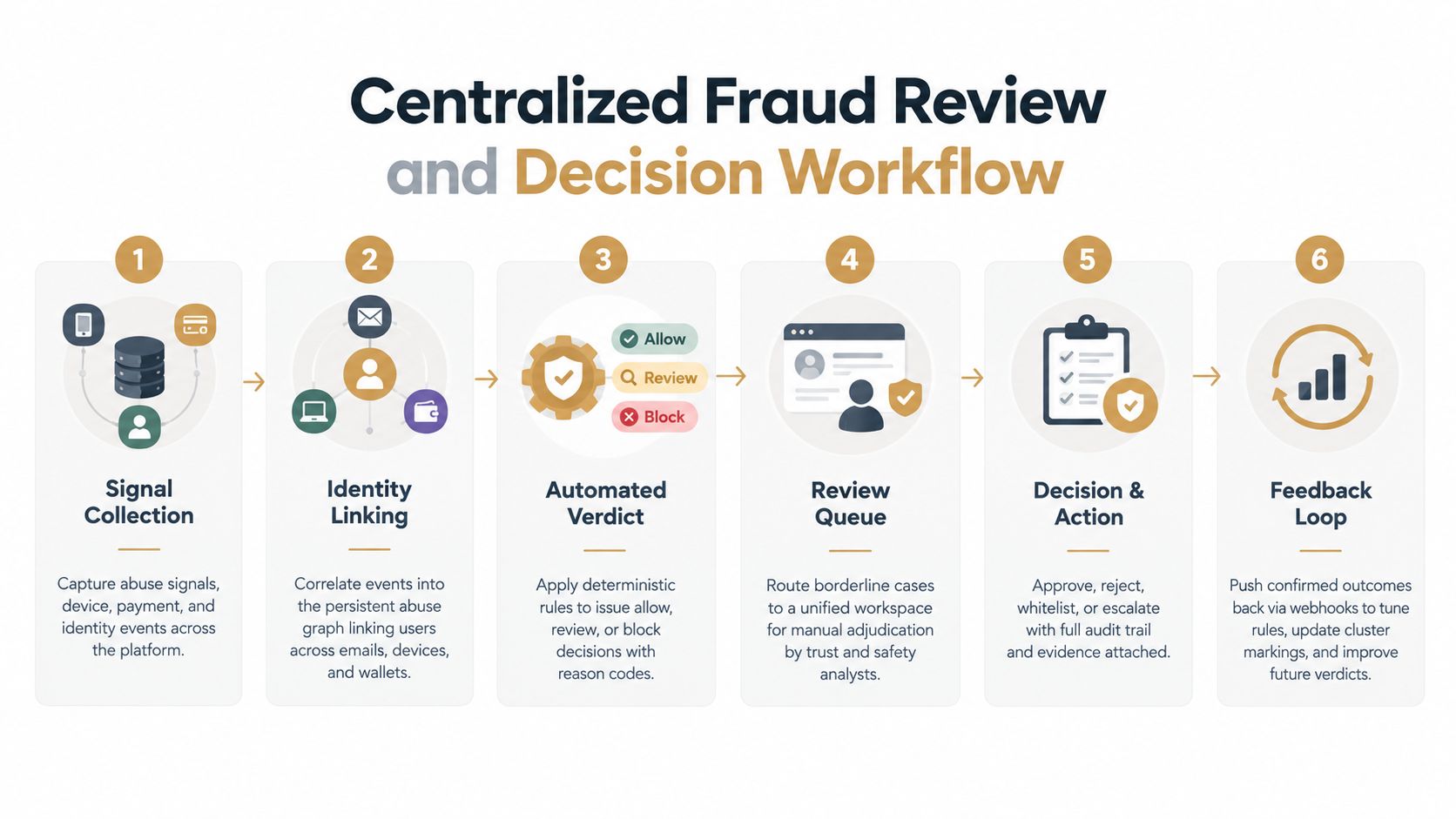
A short implementation walkthrough can also help engineering and fraud teams align on the handoff between event ingestion, verdicts, review, and feedback.
8. Declining Conversion Rate and LTV Recovery via Risk-Based Decisions
A product team notices that legitimate customers are being blocked during checkout. Fraud losses may be under control, but conversion is falling among returning users and high-value segments. The cause isn't always a bad signal. It may be a good signal applied with an overly harsh action.
Risk-based decisioning separates confidence from consequence. A strong card-testing pattern can be blocked. A returning customer using a new device can be reviewed or challenged. A new account with a weak connection to a prior trial can be allowed while the product collects more evidence. Each outcome should carry a reason code that product, growth, and support teams can understand.
One financial-services deployment reported a reduction in false positives from 50.7% to 11.8% and a reduction in detection time from 27.4 hours to 3.2 seconds, with intervention before funds left the bank in 94.3% of cases. The same report described fraud detection improving from 64.7% to 97.8% across fraud types and annual fraud losses falling by $19.7 million. These figures come from a specific deployment, so they shouldn't be treated as a universal benchmark, but they illustrate why speed and false-positive control must be evaluated together. The deployment report provides the full context.
Measure friction as a cost
Start by routing borderline cases to review or step-up verification rather than blocking them. Then compare the outcomes by customer segment, event type, and reason code.
- Measure recovered intent: Track users who complete a challenge or pending review.
- Compare lifetime value: A false positive on a high-retention customer can cost more than the prevented abuse.
- Test action thresholds: Compare block, review, and challenge paths for marginal cases.
- Calculate both costs: Include fraud loss, review labor, support contacts, and lost conversion.
- Keep verdicts explainable: Teams can't tune a policy they can't interpret.
The objective isn't the highest block rate. It's the best balance between prevented abuse and legitimate access, with enough evidence to change the policy when the balance shifts.
8-Point Fraud Detection Comparison
| Title | Implementation complexity | Resource requirements | Expected outcomes | Ideal use cases | Key advantages |
|---|---|---|---|---|---|
| Free-Trial Farming and Credit Abuse Prevention | Moderate, persistent abuse graph and identity linking | Storage for abuse graph, low-latency infra, tuning and review workflows | Reduced trial/credit abuse, protected revenue, lower CAC | SaaS and credit-based trial offerings | Multi-identity correlation, deterministic verdicts, inline blocking |
| Card Testing and Payment Fraud Detection | High, card fingerprinting, PCI-aware checkout gating | Payment integration, webhooks, review team, fraud model tuning | Fewer chargebacks, blocked test transactions before capture | E‑commerce, payment processors, high-volume promos | Blocks before capture, device-card linkage, explicit reason codes |
| Bot Signup Prevention and Low-Quality Traffic Filtering | Moderate, device velocity and trust-scoring rules | Device token collection, reputation feeds, review queue | Fewer spam accounts, lower moderation and cleanup costs | Communities, marketplaces, high-signup flows | Persistent device reputation, deterministic trust decisions |
| Burner Email Account Cycling Prevention | Moderate, device/payer fingerprinting and cluster marking | SDKs/cookies for device tokens, payment fingerprinting, storage | Prevents repeated trials via disposable emails, preserves acquisition economics | Streaming, productivity, design tools with trial limits | Device-centric detection, scales without heavy UX friction |
| Login Abuse and Account Takeover Prevention | Moderate, per-email history, step-up integration | Device token at login, MFA tooling, breach-db integrations | Reduced unauthorized access, fewer support recoveries | Banking, SaaS, marketplaces with sensitive accounts | Low-latency step-up, per-email/device history, deterministic actions |
| Promo Code and Discount Abuse Detection | Moderate, event clustering and promo-specific rules | Promo-event linking, review queue, coordination with marketing | Reduced promo exploitation, protected ROI and fair distribution | E‑commerce campaigns, referral programs, limited promos | Multi-account redemption detection, audit trail and reason codes |
| Centralized Fraud Review and Decision Workflow | Medium–high, unify signals and evidence into one workspace | Platform adoption, analyst seats, audit logging, integrations | Faster investigations, consistent decisions, auditability | Risk teams, chargeback investigations, cross-product fraud analysis | Single source of truth, built-in review queue, strong audit trail |
| Declining Conversion Rate and LTV Recovery via Risk-Based Decisions | Moderate, configurable thresholds and routing policies | Manual reviewers, analytics, alignment with product/growth teams | Improved conversion and LTV, fewer false-positive blocks | Growth-focused platforms balancing UX and fraud risk | Risk-based routing (review vs block), transparent reason codes |
Turn These Scenarios Into a Screening Playbook
These examples work best as one connected operating model rather than eight isolated rules. Start with the events where a bad decision creates the most immediate cost. For many subscription and digital products, that means protecting checkout and high-value trials first. Screen before payment capture, fulfillment, or credit allocation, then add signup and login coverage so the same identity signals remain useful throughout the customer lifecycle.
Next, connect the identity keys your product can legitimately collect. Email is useful but easy to replace. Device tokens provide continuity across account changes. Card fingerprints and payer wallets add payment context. Historical event data reveals whether a new action is genuinely new or part of a repeated pattern. Portreeve's abuse graph is one way to retain those relationships across signup, trial, checkout, and login events, with configurable memory depth and cluster marking for confirmed abuse.
Every rule should have a written operating specification. Document:
- The event: Define exactly what is being screened, such as
trial_start,checkout_attempt, orlogin. - The identity keys: Record which identifiers are available and which combinations create meaningful evidence.
- The required evidence: State what must be true before the system blocks, reviews, or allows.
- The verdict thresholds: Keep outcomes deterministic enough for engineering and operations to apply consistently.
- The exception path: Explain how legitimate shared devices, corporate cards, travelers, and managed environments are handled.
- The feedback loop: Send reviewer decisions, chargebacks, account recovery results, and confirmed abuse back into policy tuning.
Don't treat manual review as a sign that the system failed. Some cases are genuinely ambiguous, and a review queue protects legitimate users when the cost of a false positive is high. The important point is to give reviewers the evidence they need, set ownership and response expectations, and turn their decisions into better future screening.
Latency also belongs in the design. A verdict that arrives after account creation or payment capture may only support cleanup. An inline API allows the product to gate the action itself. Portreeve evaluates supported events and returns an allow, review, or block decision with reason codes in under 100 milliseconds, according to its product description. Its fail-open behavior and disclosed service state should also be considered during integration, because teams need to know what happens when a screening dependency degrades.
Finally, measure more than blocked events. Monitor confirmed fraud prevented, review volume, false-positive decisions, support contacts, recovered conversions, chargebacks, trial resource consumption, and time to resolution. A high block count can represent aggressive friction rather than effective prevention. A strong screening program shows that it stopped coordinated abuse while allowing trustworthy customers to complete the actions they came to perform.
Portreeve provides an inline screening API for signups, trials, checkouts, and logins, returning allow, review, or block verdicts with reason codes and linked event history. Use it to connect emails, device tokens, card fingerprints, and payer wallets across the fraud detection scenarios in this guide, then visit Portreeve to review the API, decision workspace, and integration tools.