
The loudest advice about buy now pay later companies is usually the least useful: pick the brand everyone knows. That sounds safe, but it misses the actual decision. A merchant selling sneakers online, a dental clinic funding urgent treatment, and a travel brand financing a vacation all need different repayment design, different integration paths, and different controls over eligibility, fees, and checkout behavior.
The market itself shows why one-size-fits-all advice fails. BNPL has moved from a niche fintech offer into a major consumer-credit channel, with one estimate putting the global market at USD 9.50 billion in 2024 and projecting USD 80.15 billion by 2033 (Grand View Research). In the United States, providers originated about USD 156.7 billion in BNPL products in 2025, and pay in 4 accounted for USD 78.3 billion, or 50% of originations (Federal Reserve). That scale means the checkout design matters as much as the brand name.
The comparison below looks at ten distinct provider models, from broad ecommerce checkout options to travel, healthcare, and card-based installment setups. The question is not which company is most popular. It's which repayment structure, merchant fit, and operational burden matches the sale you're trying to close.
Table of Contents
- 1. Affirm
- 2. Klarna
- 3. Afterpay
- 4. PayPal Pay Later
- 5. Zip
- 6. Sezzle
- 7. Splitit
- 8. Bread Pay
- 9. Sunbit
- 10. Flex Pay by Upgrade
- Top 10 Buy Now, Pay Later Providers Comparison
- How to Choose and Implement a BNPL Partner
1. Affirm
Affirm is a strong fit when a merchant wants both a familiar Pay in 4 style option and a longer-term monthly installment path. Its core appeal is the range of consumer choices, since some buyers want short, interest-free payments while others need a bigger ticket broken into fixed monthly pieces. The trade-off is simple, longer financing can carry interest, so the customer experience depends on the exact offer surfaced at checkout.
Where Affirm fits best
Affirm works best in online and app-based checkout flows where the basket is large enough to justify a financing decision, not just a quick split payment. It also fits merchants that want a clear consumer-facing explanation of terms and a financing product that can sit behind a platform integration such as Shopify's Shop Pay Installments. That makes it useful for brands that care about trust at the point of conversion, but don't want to build their own credit product.
Practical rule: If the basket needs more than a four-payment split, Affirm is often more relevant than a simple interest-free BNPL button.
Operationally, Affirm is not the lightest option for a merchant that wants total control over every loan term. The provider determines underwriting and offer structure, and the consumer may see different financing paths depending on the purchase and eligibility. For buyers, that keeps the checkout tidy. For merchants, it means less flexibility than an in-house installment program but less credit risk than carrying the financing themselves.
The cleanest way to think about Affirm is as a broad ecommerce financing layer. It supports conversion where shoppers need payment relief, but it's less about niche verticals and more about embedding financing into standard digital commerce.
Image reference, Affirm interface
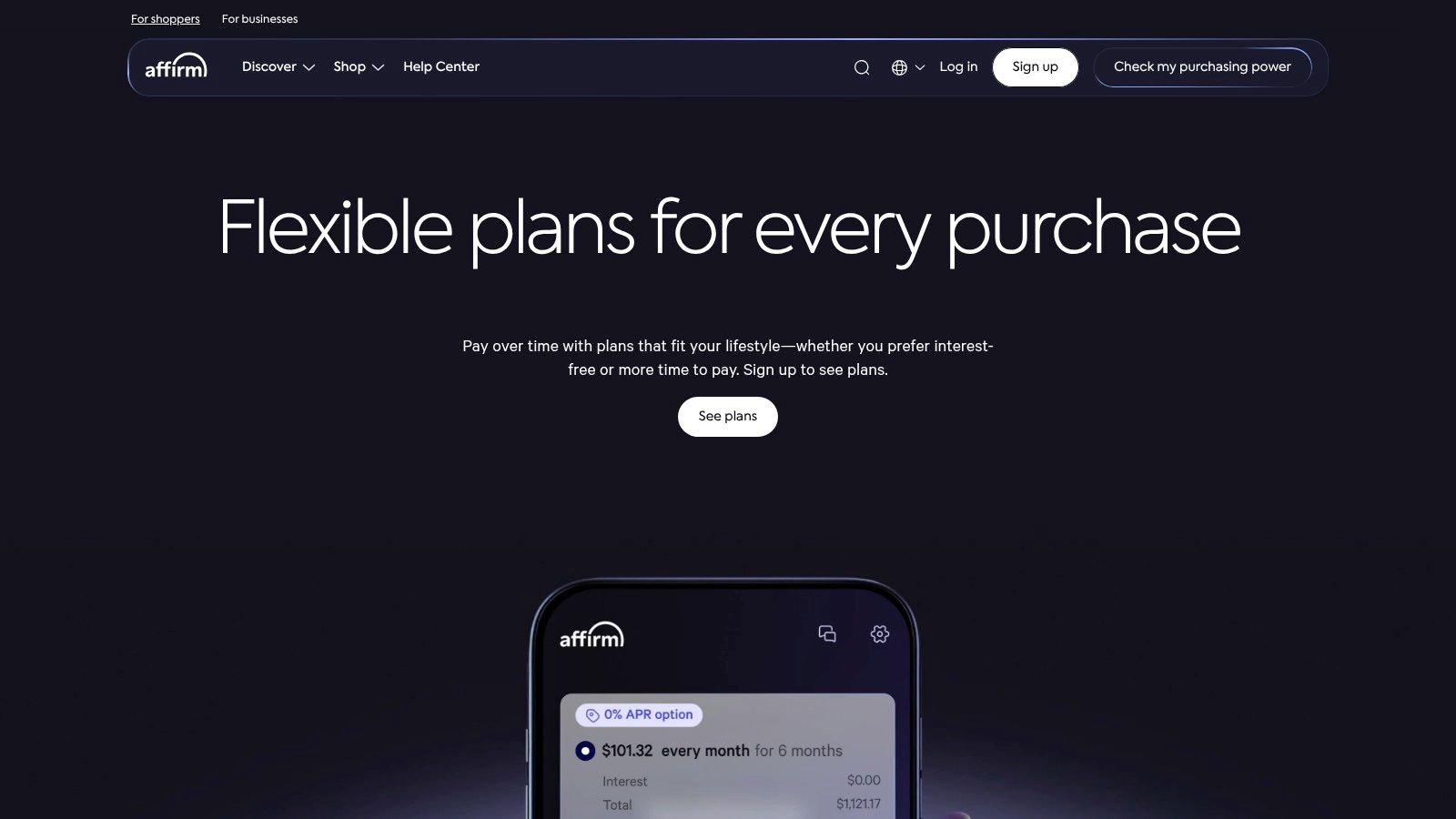
Website: Affirm
2. Klarna
Klarna is less a single payment plan than a shopping ecosystem with financing attached. Its appeal comes from flexibility, with options that include Pay in 4, deferred payment, and longer-term financing, plus a consumer app built around discovery and engagement. That makes it a better fit for merchants who want BNPL to influence the browsing journey, not just the final click.
The merchant reality is more complicated than the consumer experience suggests. Klarna's risk rules can determine which plans appear for which users, so a merchant doesn't always control exactly which repayment option is offered. That can be useful for risk management, but it also means product consistency can vary by shopper, merchant, and transaction profile. Merchants that need predictable checkout terms should treat that as an implementation constraint, not a minor detail.
Klarna also extends beyond the merchant page into wallets and app-based shopping surfaces, which broadens reach but can blur the line between checkout tool and retail media channel. That can help brands that want repeat visits and cross-sell exposure. It's less ideal for a business that only wants a simple payment rail with minimal consumer interaction.
What merchants need to watch
A merchant evaluating Klarna should pay close attention to how the provider's eligibility logic interacts with fraud screening and checkout abandonment. Because the repayment choice can shift based on risk and purchase details, the seller loses some control over the exact customer experience. That's manageable if the merchant values reach, but it's a poor fit if the business needs tight terms for regulated or highly sensitive transactions.
For teams building around customer acquisition, Klarna's app layer can be an advantage. For teams optimizing pure payment acceptance, it can feel like a lot of surface area around a simple goal: get paid.
If fraud controls matter in the flow around checkout and account creation, it's worth pairing the payment layer with a separate screening layer such as fraud detection software.
Website: Klarna
3. Afterpay
Afterpay is straightforward for shoppers, and that clarity is part of its value. Its core offer is Pay in 4 with biweekly repayments, plus monthly financing for larger baskets. That fits retail categories where the purchase is easy to understand at checkout, especially fashion and beauty.
The merchant trade-off is less straightforward. Afterpay still uses late fees, even if capped, and approval or spending limits can change without much notice. Merchants often want a fixed checkout promise, while consumers want a simple repayment path. Those priorities do not always align.
Why this model works in retail
Afterpay fits categories built around repeat purchases, impulse buying, and brand-led demand. The checkout flow is simple, the app supports automated payments and spend tracking, and the product matches shoppers who want to split a discretionary purchase without opening a new credit account. That is why it appears more often in fashion and beauty than in service categories that need more explanation.
For dispute and fraud handling specifics, see the guide to payment fraud prevention.
Use it when the purchase is easy to understand, not when the buyer needs a detailed financing consultation.
The main limitation is also the reason some merchants avoid it. If a customer base is highly fee-sensitive, even capped late fees can create support issues, disputes, and weaker repeat usage. For brands that want broad consumer familiarity, Afterpay is a practical choice. For brands that need tighter control over terms or more complex financing, it is less flexible than lenders built for larger purchases.
Image reference, Afterpay marketing view
Website: Afterpay
4. PayPal Pay Later
PayPal Pay Later is strongest where distribution matters more than novelty. It plugs into a checkout environment many buyers already recognize, and it offers two distinct paths, Pay in 4 for eligible purchases and Pay Monthly for longer repayment windows. That combination gives merchants a familiar button with enough flexibility to handle both smaller and larger carts.
The consumer proposition is relatively clean. Pay in 4 is fee-light for eligible purchases, while Pay Monthly uses fixed APR financing. That means the merchant doesn't have to choose between a purely short-term option and a longer-duration loan product. The customer sees both inside a system they already trust.
Merchant fit and limitations
PayPal's reach is its biggest advantage, but reach alone doesn't solve every checkout problem. Not all cart sizes or product categories qualify for every option, so a merchant can't assume universal availability. That matters if the seller wants a consistent promotional offer across the entire catalog.
Pay Monthly also changes the economics, because interest applies unless the merchant funds a 0% promotion. That shifts the decision from pure conversion tool to marketing investment. Some merchants will gladly absorb that cost to raise close rates on higher-value items. Others will prefer to keep financing strictly on the consumer side.
The integration path is straightforward if PayPal is already part of the stack, and that lowers implementation friction. The main question is whether the merchant wants a broad payment brand that can add BNPL, or a BNPL-first provider with more targeted checkout behavior. For a lot of merchants, PayPal sits in the middle, broad enough to be operationally easy, but not always precise enough for every pricing strategy.
For merchants thinking about disputes and post-purchase handling, the next step is to review how payment tooling affects chargeback workflows, including PayPal chargebacks.
Website: PayPal Pay Later
5. Zip
Zip is built around flexible access rather than a single merchant checkout lane. Its app-led model includes a virtual card that can be used more broadly, which makes it useful for consumers who want BNPL outside a narrow set of embedded partners. That “anywhere” design is a meaningful distinction, because it expands where the product can work without forcing every seller into a bespoke integration.
The downside is cost transparency. Zip discloses finance charges and example APRs, which is better than hidden pricing, but it also means the product is not always interest-free. For the consumer, that can be fine if the terms are clear. For the merchant, it means the checkout proposition may feel less clean than a straightforward zero-fee split payment.
What the virtual card changes
The virtual card matters because it reduces dependence on direct merchant integrations. Instead of waiting for a specific on-site button, the consumer can use the Zip app in more places where card acceptance already exists. That improves reach, but it also weakens the merchant's control over the exact payment flow.
Zip is a better fit for merchants that want broader compatibility and can live with a more consumer-led acquisition model. It's less ideal for sellers that need tightly scripted financing terms at the point of checkout. The product can support conversion, but it does so through flexibility that comes with periodic changes in terms and fees.
For buyers, Zip feels like an adaptable installment tool. For merchants, it's a reminder that broader reach often comes with more variable economics.
Website: Zip
6. Sezzle
Sezzle stands out because it offers more than one repayment rhythm. Buyers can use Pay in 4, Pay in 5, or monthly financing, and the company also offers an “Anywhere” virtual card. That creates a more flexible consumer experience than a single fixed installment button, especially for shoppers who don't want to be locked into one structure.
The merchant fit is broad, but not frictionless. Sezzle's public merchant guidance and optional subscription features make it accessible to different business models, while credit-reporting tools can appeal to consumers who want some positive account history tied to usage. At the same time, some transactions carry prepaid finance charges and service fees, which means the product can feel less like a pure no-cost split and more like a hybrid credit utility.
Where Sezzle makes sense
Sezzle makes sense for merchants that want wide compatibility and consumers that want visible flexibility. The virtual card broadens use beyond a narrow partner list, and the optional credit-building element gives the product a different value proposition from BNPL brands that focus only on checkout convenience. That can help when the buyer is comparing alternatives and wants more than just short-term payment relief.
The operational caution is that fee structures and rescheduling terms can change, and that can affect support volume. Merchants should make sure their customer service teams know how the plan works before they promote it heavily. Otherwise, the checkout promise and the support experience can drift apart.
Practical rule: If the buyer may need to use the plan outside one merchant's site, Sezzle's broader card-based model is more relevant than a closed-loop checkout button.
Website: Sezzle
7. Splitit
Splitit takes a different route from most buy now pay later companies. Instead of issuing a new loan, it uses the shopper's existing credit card open-to-buy to split the purchase into installments. That means no separate BNPL account, no added interest from Splitit itself, and no new consumer credit product to manage.
That structure lowers one set of risks and introduces another. For merchants, the appeal is reduced lending complexity and a simpler fraud profile than a loan-based BNPL product. For shoppers, the limitation is obvious, it only works if there's enough available credit on the card. If the card is near its limit, the model won't work.
Why merchants pick it
Splitit is attractive when a merchant wants installment behavior without moving the transaction into a new lending relationship. It can fit better with higher-trust categories or with merchants that want to reduce the feel of “taking out financing” while still letting the shopper pay over time. Because the customer is using an existing credit card, the experience can feel lighter than a standalone financing application.
The flip side is visibility. Splitit is less ubiquitous than the big BNPL buttons shoppers already recognize. That can reduce conversion if the merchant's audience expects a branded BNPL choice at checkout. It's also a different kind of promise, one based on card line allocation rather than a dedicated installment account.
For teams prioritizing minimal consumer friction and lower lending overhead, Splitit is worth a close look. For teams chasing broad consumer recognition, it may be less immediately obvious than the larger app-led brands.
Website: Splitit
8. Bread Pay
Bread Pay, under Bread Financial, is a good example of a BNPL suite that leans into partner distribution. Its SplitPay option offers four equal interest-free payments, and it also supports longer-term installment loans for larger baskets. That combination makes it useful for merchants that need both a short-split option and a more traditional financing path.
The practical strength is infrastructure. Bread Financial brings lending and servicing capabilities that matter when the product is embedded into partner checkouts. The merchant gets a program built for retail distribution, rather than a standalone consumer app trying to force its way into every cart.
Best fit and trade-offs
Bread Pay fits merchants that value partner-specific programs and enterprise distribution. It's a better match for a retailer that wants to embed financing into a known checkout journey than for a brand looking for a flashy consumer discovery app. The SplitPay option gives shoppers a clear interest-free path, which is often enough for mid-sized purchases.
The downside is that consumer experience can vary by partner program. Some agreements may include late fees or other charges, and that means the buyer's perception of Bread Pay can depend heavily on the specific merchant relationship. For merchants, that's manageable. For consumers, it can make the brand feel less uniform than a single standardized product.
Bread Pay is strongest when the merchant wants a financing partner with the operational depth to support different baskets and partner structures. It's less about universal consumer recognition and more about embedding a lending layer into retail distribution.
Website: Bread Pay
9. Sunbit
Sunbit is built for necessity spending, especially in-person services like auto repair, dental care, and vision care. That focus matters because the buyer often isn't browsing for a discretionary purchase, they're dealing with an urgent bill and needs financing at the point of need. In that setting, speed and clarity matter more than a polished consumer shopping app.
The product supports short- and longer-term plans, including dental terms that can extend much longer than a standard split payment. It also emphasizes transparent disclosures and sample cost information, which is important when the purchase is tied to a service appointment rather than a retail cart. The merchant fit is therefore very different from fashion or general ecommerce.
Why service merchants use it
Sunbit works because it matches the moment. A customer at a repair shop or dental office doesn't want a delayed financing conversation. They want a fast answer, clear payment expectations, and the ability to move forward without leaving the service unfinanced.
That said, some offers can carry higher APRs than simple interest-free Pay in 4 models. Merchants in sensitive categories should take that seriously, because the affordability story can change quickly once financing terms are visible. In practice, Sunbit is less about low-cost consumer credit and more about making urgent services accessible.
It's a better fit for point-of-need financing than for general ecommerce checkout.
The platform is not a universal online button, and that's fine. Its strength comes from specialization. Merchants that sell repairs, procedures, or other urgent services should treat Sunbit as a category-specific financing tool, not as a general substitute for broader BNPL checkout providers.
Image reference, Sunbit homepage
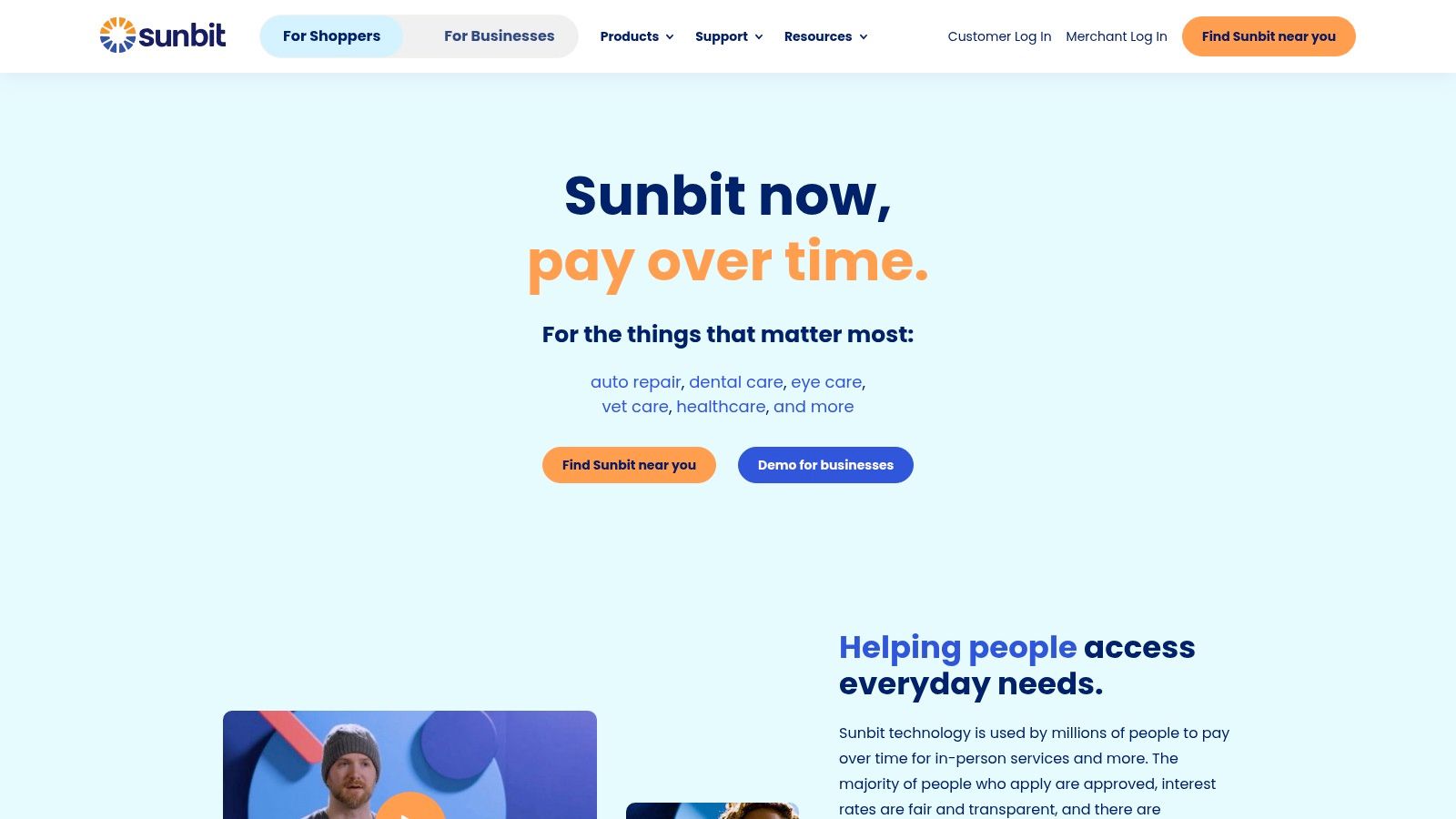
Website: Sunbit
10. Flex Pay by Upgrade
Flex Pay by Upgrade is more focused on travel financing than on broad retail checkout. It was formerly known as Uplift, and its partner network includes airlines, cruises, online travel agencies, and travel agents. That focus matters because travel purchases are usually high-ticket, time-bound, and tied to a fixed departure date, which changes how installment financing is used.
The product uses fixed installments, often over multi-month periods, and the merchant experience is shaped by partner-specific terms and promotions. For travel brands, that can reduce friction on large bookings without presenting the offer like a generic consumer loan.
Why the vertical matters
Travel financing follows different buying behavior from standard ecommerce. The customer is securing a future experience, not financing an immediate physical product. Flex Pay is built for that context, and its deeper integration into the travel ecosystem supports it. For merchants, that can help conversion on high-value bookings that might otherwise stop at the payment screen.
The trade-off is limited reach. Outside participating travel and retail partners, Flex Pay is less relevant than broader checkout BNPL providers. That is a specialization, not a weakness. Merchants should only choose it if their business model fits the partner network and booking patterns it was designed for.
For travel brands, clear payment summaries and partner tooling make the offer practical. For general retail, it is too specialized to serve as the default BNPL option.
Image reference, Flex Pay by Upgrade
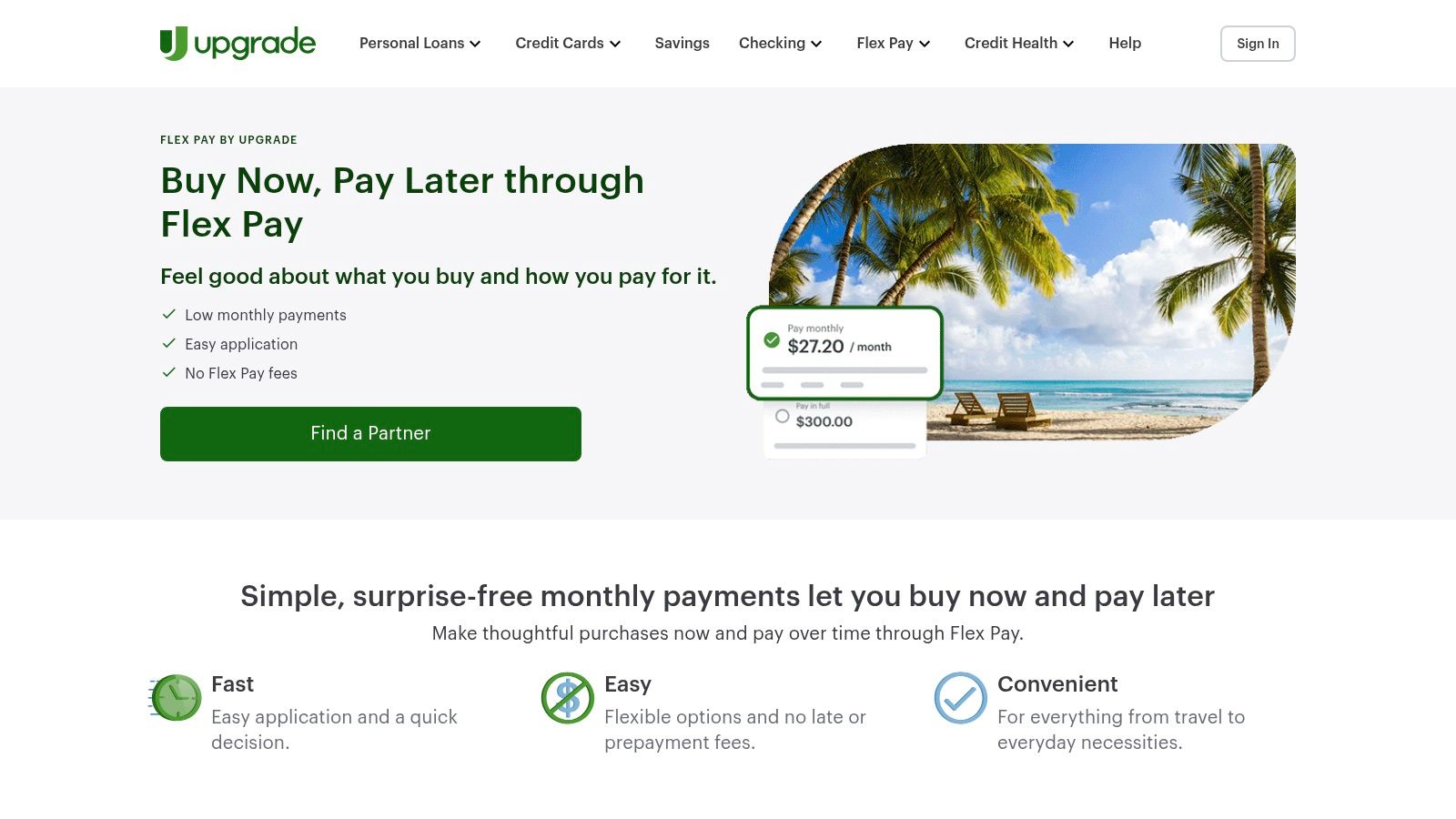
Website: Flex Pay by Upgrade
Top 10 Buy Now, Pay Later Providers Comparison
| Provider | Product type | Merchant integration & distribution | Consumer cost / fees | Fraud & risk notes | Target merchants / use cases | Unique selling point |
|---|---|---|---|---|---|---|
| Affirm | Pay-in-4 + longer simple-interest loans (0–36% APR) | Platform/merchant integrations (Shopify, Amazon, in‑app) | 0–36% APR on loans; merchants pay per-transaction fees | Lending risk; merchant-funded promos possible; some card blocks reported | Online retailers, marketplaces | Strong brand trust; transparent disclosures |
| Klarna | Pay-in-4, Pay-in-30, longer financing; app-led | Apple/Google Pay, wide platform integrations; consumer app | Varies by plan/market; interest on longer plans | Availability varies by user/merchant; merchant control limited | Global retail, fashion, mobile-first shoppers | Large consumer reach + shopping/engagement app |
| Afterpay (Block) | Biweekly Pay-in-4 + monthly financing | App for payments; strong fashion/beauty merchant presence | Late fees (capped); some monthly plans carry interest | Late-fee model; approval/limits can change | Fashion, beauty, retail chains | Simple UX and strong vertical presence |
| PayPal Pay Later | Pay-in-4 and Pay Monthly (3–24 mo fixed APR) | Broad via PayPal checkout button | Pay-in-4 often fee-light; Pay Monthly carries APR unless merchant funds 0% | Soft credit checks; high-volume exposure | Broad e-commerce and marketplaces | Massive reach and consumer trust via PayPal |
| Zip | Pay-in-4 + virtual card for anywhere use | Virtual card via Zip app; U.S. & AU/NZ availability | Upfront origination/installment fees; example APRs shown | Consumer fees present; virtual card expands merchant reach (and fraud surface) | Online merchants and any virtual-card-accepting merchant | Virtual card flexibility and clear example costs |
| Sezzle | Pay-in-4/5, monthly financing, virtual card, optional credit reporting | Virtual card; merchant compatibility; optional subscription perks | Some prepaid finance/service fees; subscription optional | Fee/reschedule policy changes affect UX; reporting option affects underwriting | Wide online retailers | Flexible plans + optional credit-building features |
| Splitit | Installments using shopper's existing credit card (no new loan) | Checkout integration; uses card open-to-buy | No added interest/fees from Splitit; card issuer terms apply | Requires available card credit; lowers merchant lending risk | Merchants seeking low lending/fraud exposure | No new loan; minimal consumer friction |
| Bread Pay (Bread Financial) | SplitPay (4 interest-free) + longer installment loans | Brand-partner embed and enterprise integrations | SplitPay interest-free; other products may include fees/late | Partner-specific product variability | Enterprise retailers and brand partners | Enterprise lending/servicing infrastructure |
| Sunbit | In-person service BNPL (short & long terms; dental up to 72 mo) | Point-of-need approvals; large in-person merchant network | State-specific APR disclosures; can be higher than Pay-in-4 | In‑person focus reduces online card-testing risk; service-specific underwriting | Auto repair, dental, vision, other essential services | Purpose-built for urgent, in-person service financing |
| Flex Pay (Upgrade) | Fixed-installment financing (commonly 3–24 months) | Deep travel ecosystem integrations (airlines, OTAs, cruises) | Fixed installments; partner-dependent terms | Terms and availability vary by travel partner; high-ticket risk factors | Travel merchants (airlines, cruises, OTAs) | Specialization in travel financing and partner tools |
How to Choose and Implement a BNPL Partner
Start with the sale, not the brand. A merchant selling discretionary ecommerce goods usually needs a broad checkout option with simple consumer messaging, while a healthcare, auto, or travel business often needs a provider that fits a specific service moment, partner ecosystem, or booking flow. Basket size, channel, repayment length, and the amount of control you want over eligibility rules all matter more than the headline name.
Then compare the pieces that create real operating cost. Look at total merchant fees, consumer APR and fee disclosure, approval variability, settlement timing, refund handling, dispute support, reporting, geographic availability, and the effort required to connect the checkout or point-of-sale flow. If the provider hides important details inside partner-specific terms, that's a signal to slow down and read the operational playbook carefully.
Test the full journey before launch. Run declined applications, partial refunds, failed payments, plan changes, and support handoffs through the exact flow your customer will use. The merchant sees the problem fastest when a real customer can't complete a checkout, but the long-term cost usually shows up later in support volume, dispute friction, and inconsistent refund handling. BNPL should reduce checkout resistance, not create a new service burden.
The bigger strategic question is where BNPL fits in the risk stack. Many merchants use it to improve conversion, but if BNPL is protecting trials, credits, signups, or checkout capacity, the payment layer shouldn't do all the screening work. Portreeve can sit inline before the action commits, returning allow, review, or block decisions with reason codes and linking repeat abuse across events. If that matters to your stack, review the product details at Portreeve.
If you're evaluating BNPL alongside signup, trial, or checkout risk controls, Portreeve can help you screen the event before it commits and return a deterministic allow, review, or block decision. Visit Portreeve to see how inline screening can sit beside your payment flow and support cleaner approvals, fewer abuse loops, and clearer operational decisions.