
You launch a ticket marketplace, the first events perform well, and the dashboard looks clean until a state attorney general asks why a resale listing for a sold-out concert is sitting at several times face value with vague fees and a seller identity that doesn't match the buyer's trail. That's the moment ticket scalping laws stop being a policy topic and become a product problem. If your checkout, listing, and identity flows aren't enforcing the rules, your platform is already making legal decisions for you.
Table of Contents
- Why Ticket Scalping Laws Matter to Your Platform
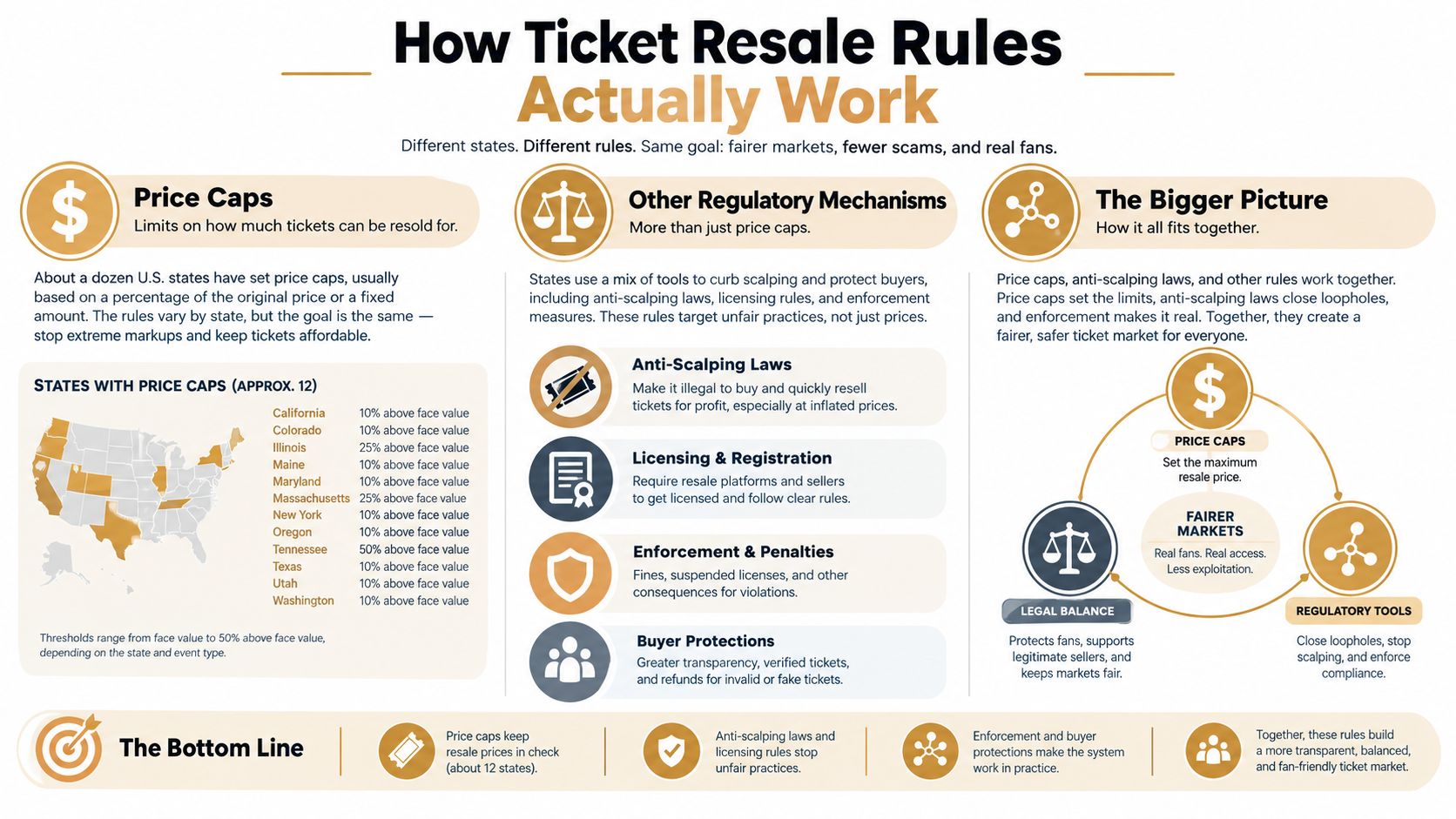
- How Ticket Resale Rules Actually Work
- What a Real Resale Cap Looks Like in Practice
- Where Regulators Focus in 2026
- The Deregulation Story Most Founders Miss
- Building a Compliance Program That Actually Holds
- Treating Compliance as a Product Feature
Why Ticket Scalping Laws Matter to Your Platform
A founder usually thinks this starts with consumer anger. It doesn't. It starts when a complaint turns into an inquiry, and the inquiry asks for your listing rules, fee logic, seller verification, and records of how you handled purchase limits.
Secondary ticketing sits in a nasty overlap. State consumer protection rules can govern the resale price, federal law can target automated bypassing of ticket limits, and venue contracts can still control where and how tickets are resold. That means one listing can create exposure on three fronts at once, even if the seller claims the ticket was “legit.”
The risk is in the workflow, not just the price
If your listing page lets a seller publish inventory they don't hold, that's not a UX flaw. It's a compliance failure. If the checkout hides fees until the last screen, that's not a conversion optimization. It's the exact kind of transparency issue regulators keep treating as deception.
Practical rule: Treat every field that touches resale, identity, and fees as a control surface, not a cosmetic choice.
The old instinct was to let legal review the policy page after launch. That's too late now. By the time a regulator asks for logs, you need to show what the platform blocked, what it allowed, and why. Retrofitting that after a probe costs far more than building it into the product from the start.
How Ticket Resale Rules Actually Work
A platform can get ticket compliance wrong in three different places on the same sale: the price, the acquisition method, and the venue rules tied to transfer. Founders who treat this as one generic “resale policy” usually build the wrong controls.
State resale caps set the first boundary
Some states still cap resale above face value, and the details vary widely, with many jurisdictions carving out nonprofit or charitable events. Your pricing engine cannot assume a national rule set. It has to resolve the seller's location, the event's location, and the local standard before the listing goes live.
Federal law targets the automation, not just the listing
The federal Better Online Ticket Sales framework focuses on circumvention, not ordinary resale. It targets software-driven bypasses of purchase limits and security controls, and legal analysis notes that sale of bot-acquired tickets can also be unlawful, with enforcement exposure that can exceed $50,000 for a single violation, per the FTC's BOTS Act penalty guidance (FTC BOTS Act penalty guidance).
Your platform can watch resale listings all day and still miss the violation, because the federal hook sits in the acquisition path. If your controls ignore bot activity upstream, you are defending the wrong part of the product.
Venue rules still matter even when state law is silent
Promoters and venues often add their own restrictions through terms of use, mobile-only entry rules, or bans on resale inside event grounds. Those rules do not replace statute, but they shape what a buyer can do after purchase. A platform that ignores venue-level restrictions may be processing a sale while violating the operating agreement that gave it access in the first place.
| Layer | What it controls | What your system must enforce |
|---|---|---|
| State resale rule | Maximum permitted markup | Jurisdiction-aware pricing logic |
| Federal anti-bot rule | Circumvention of purchase limits | Bot detection and limit integrity |
| Venue contract | Where and how resale can happen | Listing and transfer constraints |
The clean mental model is simple. Price caps regulate what can be charged, federal law regulates how inventory is acquired, and venue rules regulate how tickets move. If your controls only cover one layer, you do not have compliance. You have partial negligence.
What a Real Resale Cap Looks Like in Practice
A real resale cap only works if the platform treats compliance as a product rule, not a legal footnote. Washington, DC is the cleanest example because the rule set combines pricing, fees, registration, and bonding into one system. A platform selling into DC has to treat the jurisdiction as a high-friction market, not a case it can clean up later.
The cap is only the beginning
The RESALE Act sets a 10% markup cap, a 10% fee cap, and requires sellers moving 50+ tickets per year to register and maintain a $25,000 surety bond. The point is simple. Once a seller reaches that volume, scale itself becomes a compliance trigger, not just a pricing issue. DC is saying high-volume resale creates operational risk, and the platform has to reflect that in code. See the District of Columbia RESALE Act for the underlying rule text.
Here's the engineering translation. Your fee calculator has to separate allowed fees from hidden add-ons. Your onboarding flow has to know when a seller crosses the registration threshold. Your records system has to preserve the transaction history that shows the platform applied the right rule to the right seller at the right time.
Build the policy into the product, not the legal memo
If you only enforce caps at the UI layer, sellers will route around them. If you only store bond status in a spreadsheet, your support team will miss it during onboarding. The right setup is boring, and that is the point. Pricing logic, registration state, and seller history need to sit inside the transaction system itself.
| Requirement | What it mandates | Platform work triggered |
|---|---|---|
| Resale markup cap | Limit price above face value | Jurisdiction-aware pricing engine |
| Fee cap | Limit total platform fees | Fee calculation and validation |
| Registration threshold | Register high-volume sellers | Onboarding and seller status checks |
| Surety bond | Maintain bond for qualifying sellers | Bond tracking and renewal alerts |
| Recordkeeping | Retain seller and transaction records | Audit logs and exportable history |
If you want a useful technical pattern for this kind of control, study how velocity checks are designed in transaction systems, including the approach described in this internal guidance on velocity checks. The principle is the same. A system should refuse risky activity before it commits.
The lesson is bigger than DC. Any city or state that adopts this stack becomes the template everyone else copies. Build for the hardest jurisdiction first. That is where your product either becomes defensible or breaks.
Where Regulators Focus in 2026
The lazy founder take is, “Just ban resale.” Regulators are not aiming at resale as such. They are targeting bots, deceptive checkout flows, and purchase-limit circumvention, because that is where the harm concentrates.
The fight is against extraction, not resale as a concept
The federal BOTS framework and related enforcement trends treat automated inventory hoarding as the main offense. Reselling itself is not the offense. The offense is software that strips inventory before ordinary buyers can reach it, then pushes that inventory back out through a secondary channel.
A blanket resale ban can still be the wrong fix. It can create a policy violation without stopping the abuse pattern. If your platform does not stop the upstream acquisition step, you are still exposed.
Fees and disclosure are now enforcement magnets
Hidden fees are a separate problem from price caps. State attorneys general increasingly care about whether the buyer saw the full price early enough to make an informed choice. If your checkout hides the full amount until the final step, regulators see a deception risk, not a harmless conversion tactic.
The same logic applies to purchase limits. If a platform's controls are easy to evade, regulators will not care that the policy exists on paper. They care whether the system prevented mass buying in practice.
| Regulatory target | Example action | Penalty range | Why it triggered |
|---|---|---|---|
| Bot circumvention | FTC action under BOTS-related theories | Qualitative exposure through enforcement | Software bypassed purchase controls |
| Hidden fees | Deceptive checkout scrutiny | Qualitative exposure through enforcement and restitution | Final price was obscured |
| Purchase-limit evasion | Platform tolerance of broker behavior | Case-specific enforcement | Limits existed but were not enforced |
The cheapest compliance move is usually to make the buyer see the full price, the seller prove they hold the ticket, and the system reject anything that looks automated.
That is the 2026 reality. Regulators care less about moral panic around resale and more about whether your product actively enables market manipulation.
The Deregulation Story Most Founders Miss
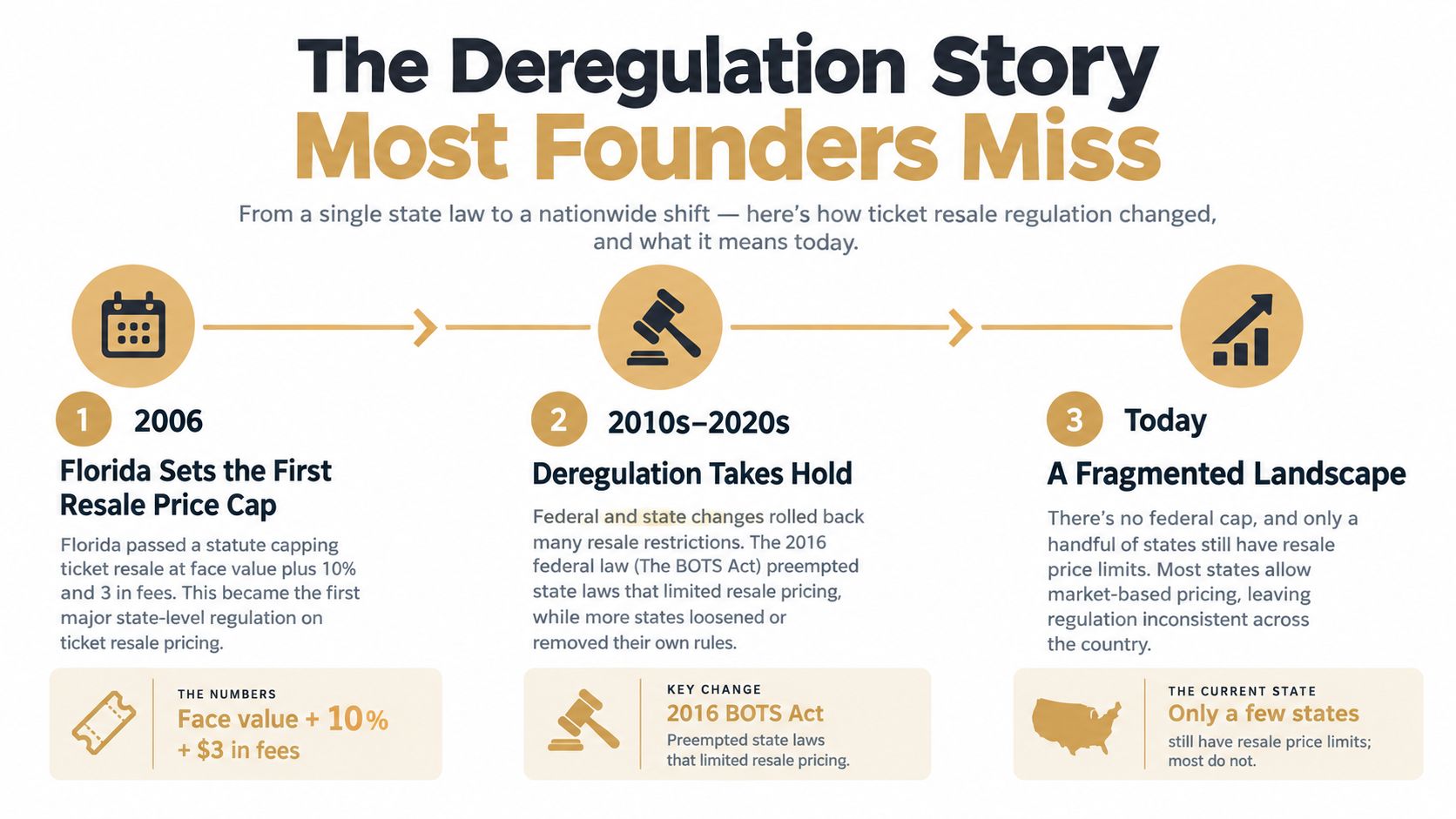
The history matters because it explains why your platform can't rely on one national rulebook. The legal center of gravity has moved. The states that once leaned hardest into price caps have loosened or repealed parts of those laws, while federal and venue-level controls picked up the slack.
Florida showed how strict caps can disappear
Florida's 2006 move matters because it replaced a very tight resale ceiling with a market-based approach. For years, that kind of law forced national ticketing stacks to build around a strict price cap, then suddenly they had to absorb a much looser model. That's the founder lesson, compliance can't be hardcoded to one regime and assumed stable.
Alabama and Michigan signaled the shift
The later repeals in Alabama and Michigan reinforce the same point. A growing number of states stopped treating resale price caps as the primary answer. Instead, the surviving pressure moved toward bot control, deception claims, and venue rules.
What that means in practice is blunt. A cross-state platform no longer wins by asking only, “Is this resale price legal?” It has to ask, “Is this listing process honest, and can I prove it when someone challenges me?”
That's the jurisdictional inversion founders miss. The rulebook moved from price control toward process control. If your compliance design still centers on one static cap table, your system is already behind the market.
Building a Compliance Program That Actually Holds
A real compliance program doesn't start with legal review. It starts in the transaction pipeline, where abuse either gets blocked or gets a foothold.
The five layers your engineers need
-
Bot detection at purchase. Use device fingerprinting, CAPTCHA escalation, and velocity rules tied to identity artifacts that recur across attempts. If you want a pattern for how identity-linked screening works in production, see this internal device-fingerprinting guide.
-
Purchase limits at the inventory layer. Don't rely on the UI to stop abuse. Enforce limits where the inventory is allocated, or brokers will find a thinner front end.
-
Identity verification for high-risk transactions. Jurisdictions that require seller registration or enhanced controls need the platform to identify who is really moving the tickets, not just which email address clicked “list.”
-
Fee disclosure before checkout completes. Put the full price on the screen before the buyer commits. Hiding fees in a confirmation email is the wrong place, and regulators know it.
-
Speculative listing controls. Block sellers from listing tickets they do not yet possess. If you allow that behavior, you're helping create the very market distortions lawmakers are targeting.
Documentation is part of the product
Your policy versions need timestamps. Your enforcement decisions need audit logs. Your takedown process needs an actual response SLA, not an inbox that gets checked when support is slow. If a regulator asks why a listing stayed live, you need a machine-readable answer, not a Slack apology.
Operational rule: If you can't reconstruct the decision, you can't defend the decision.
The engineering lift isn't trivial, but it's finite. A retrofit like this is the kind of work that belongs on a real roadmap, not in a legal panic sprint. If you wait until after the first complaint, you'll spend more time cleaning up than building.
Treating Compliance as a Product Feature
A ticket platform that treats compliance as a sidebar problem will end up enforcing it badly. The better pattern is to surface the rule set where people make decisions, in the listing card, the checkout flow, and the seller experience. Buyers see what they are buying. Sellers see what they can publish. Regulators see whether the platform can control the flow, not just explain it after the fact.
Make the rules visible to users
A listing should show whether it is resale, whether caps or restrictions apply, and whether the displayed price is the actual price. Sellers should know before they publish whether the listing sits inside the allowed range. If your product uses confidence signals, verified seller markers, or resale disclosures, put them in the interface instead of burying them in a policy PDF nobody reads.
The team split should be clear too. Listing ingestion controls what enters the catalog. Checkout owns disclosure. Risk owns enforcement logic. Vendor review owns the contracts that make the system legally usable.
Choosing the right screening layer matters here, and our comparison of fraud detection software shows how inline verdict engines differ from batch review tools.
Build for the next wave, not the last one
The pressure is not easing. State-level BOTS expansions are still coming into view, federal rulemaking around event tickets is not going away, and speculative listing scrutiny is getting tighter in places that already care about resale abuse. New York's continuing attention to platform behavior is a warning, not a footnote.
Put the compliance surfaces in place before a regulator or a venue partner forces a redesign under consent decree pressure. If you wait, you will be rebuilding under supervision instead of shipping on your own terms.
Compliance done this way is part of why users trust the platform.
The strongest signal you can send as a founder is simple. You do not just list tickets, you control how tickets move. That is what serious compliance looks like, and it is what the market will expect next.