
A growth team launches a free trial campaign and quickly sees the warning signs. New accounts consume credits, familiar devices return with fresh email addresses, card-testing attempts reach checkout, and support tickets arrive after legitimate users lose access to compromised accounts. The team needs fraud prevention software, but trial farming, payment fraud, account takeover, automated abuse, and chargebacks don't always require the same control layer.
That distinction matters because digital account takeover is accelerating. TransUnion reported that global digital account takeover volume grew 21% from the first half of 2024 to the first half of 2025, while the FBI reported more than 5,100 account takeover complaints since January 2025, with losses exceeding $262 million. A payment tool alone won't necessarily stop abuse before signup or login completes.
This list compares ten options by their primary abuse layer, decision workflow, integration model, buyer fit, pricing visibility, and operational trade-offs. Portreeve is particularly relevant for inline, pre-commit screening across signups, trials, checkouts, referrals, coupon redemptions, and logins. Other platforms specialize in payment protection, enterprise identity networks, bot challenges, edge security, or device intelligence. Use the comparison to match a platform to the decision point you need to protect, rather than treating every vendor as a direct substitute.
Table of Contents
- 1. Portreeve
- 2. Sift
- 3. SEON
- 4. Stripe Radar
- 5. Kount
- 6. Forter
- 7. Arkose Labs
- 8. HUMAN Security
- 9. DataDome
- 10. Fingerprint
- Top 10 Fraud Prevention Software Comparison
- Turn the Shortlist Into a Control Plan
1. Portreeve
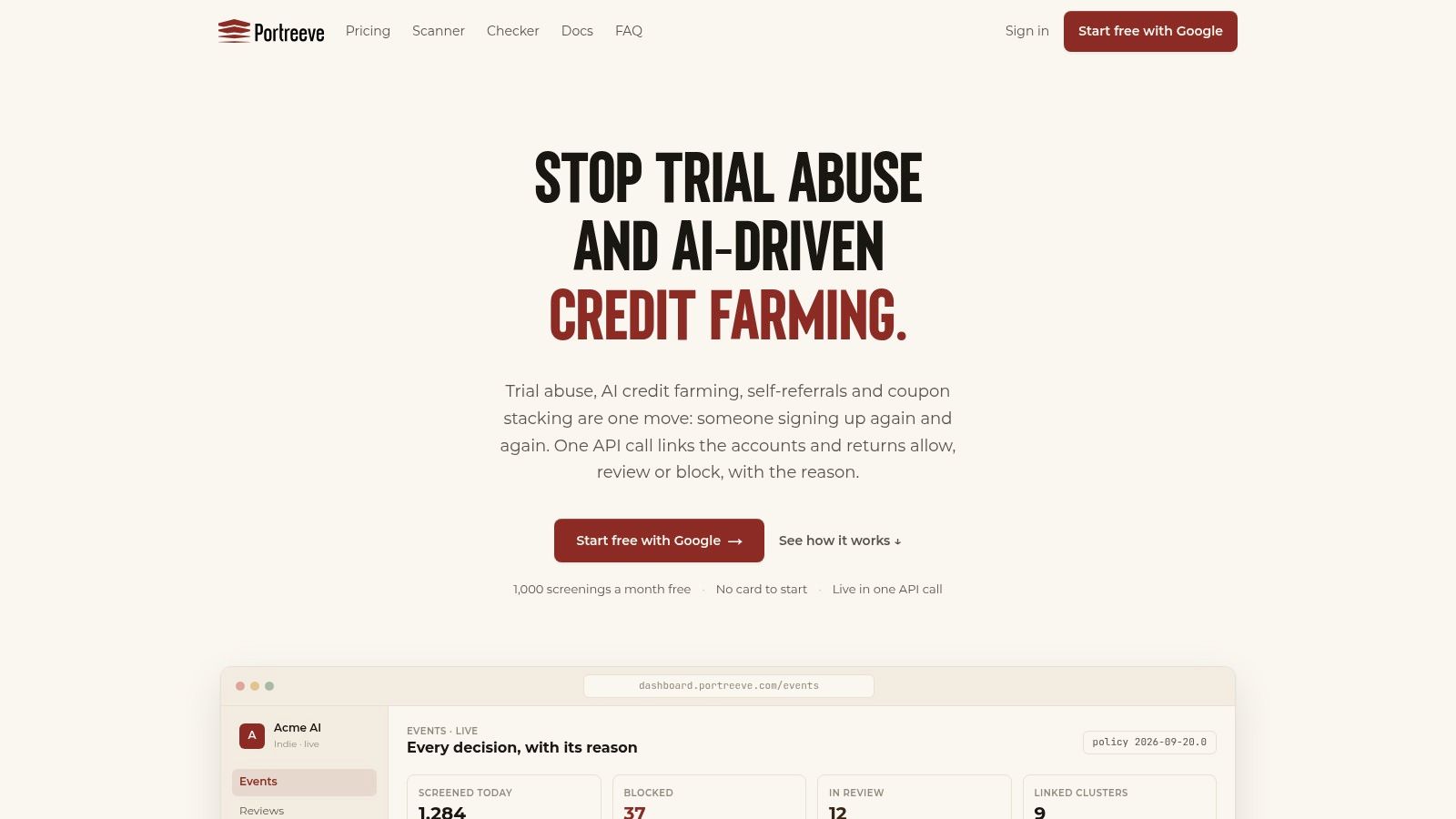
Portreeve is built for teams that need a decision before an account, trial, or payment commits. Its inline screening gate evaluates events such as signup, trial_start, trial_convert, checkout_attempt, and login, then returns a deterministic allow, review, or block verdict with reason codes. The product states that decisions typically return in under 100 milliseconds, with a p99 of approximately 90 milliseconds, making it suitable for flows where a manual queue would arrive too late.
Its central differentiator is persistent identity linkage. A per-tenant abuse graph connects hashed, tenant-scoped signals across email, device token, card fingerprint, and payer wallet. IP isn't used as a core identity key. That design is relevant to subscription businesses dealing with burner emails, repeated trial attempts, card testing, self-referrals, coupon stacking, or AI-credit farming.
Decisioning and operations
Portreeve doesn't leave the application to interpret an opaque risk score. Reason codes explain why the verdict was issued, while the built-in review queue and decision workspace show event history, linked identities, clusters, and supporting evidence. Teams can mark confirmed abuse and propagate that signal across related identities and devices.
Integration is direct through a Node SDK, /v1/verdict HTTP endpoint, webhooks, and documentation. The free Scanner and Checker tools help engineers test signals before deployment. The engine remains consistent across plans, while memory depth, included screenings, overage rates, and support vary.
Pricing and fit
Public pricing is unusually easy to evaluate. The Free plan costs $0 per month and includes 1,000 screenings per month, with live screening pausing at the hard limit. Indie costs $19 per month for 10,000 screenings, Growth costs $79 per month for 50,000, and Scale costs $249 per month for 250,000. Paid plans continue screening through automatic USD overage, and no card is required to start. These figures are documented on Portreeve's product site.
Practical rule: Portreeve fits best when the business must stop abuse at signup, trial, checkout, or login, and needs the evidence and action path in the same workflow.
The main trade-off is architectural. Portreeve fails open if its service degrades, and deterministic verdicts may require policy tuning for unusual edge cases. The Free plan's hard limit can also be restrictive for heavier traffic. For SaaS founders, product managers, engineers, risk teams, and revenue operators, however, it offers a focused way to reduce downstream cleanup by screening before the protected action completes.
2. Sift
Sift is the broadest option in this list for teams that want one fraud program spanning account creation, login, payments, subscriptions, and content abuse. Its platform combines device, behavioral, and network intelligence to support real-time allow and decline decisions, account takeover prevention, payment protection, subscription fraud controls, and case management.
The value proposition is coverage across the customer journey. A team that currently operates separate controls for signup, checkout, and post-transaction review may prefer Sift's broader platform model, especially if it has the resources to tune policies by use case. Its account, payment, and content or abuse modules can support a common operational approach rather than isolated point-tool decisions. Buyers evaluating the category can also use this comparison of fraud prevention tools to frame the difference between broad platforms and focused screening layers.
Where Sift fits
Sift is a strong candidate when account takeover and payment fraud are connected. A login event can be assessed in the same broader program as a later purchase, while review teams can work from case-management workflows instead of moving between unrelated systems. That cross-touchpoint model can reduce vendor sprawl, but it also creates a larger implementation and governance responsibility.
The platform's network effects are part of its enterprise appeal. Sift describes consortium intelligence based on a large volume of events, which can give customers signals beyond their own first-party history. That may help teams that lack enough internal abuse history to build effective patterns, though buyers should ask how the signals are explained and how they affect legitimate users.
Trade-offs
Sift's pricing is quote-based, so smaller teams won't get the same immediate budget certainty as they would from a published plan. The platform also produces decisions that still require thoughtful policy tuning, particularly when a business is balancing fraud catch rates against conversion.
Choose Sift when you want one mature platform across signup through checkout and disputes. Choose a narrower tool when the problem is specifically inline trial abuse, device linkage, or payment-native card screening and a wider deployment would add unnecessary complexity. Sift's current capabilities and modules are described on its official platform site.
3. SEON
SEON is an API-first platform for teams that want to enrich an event with email, phone, social, device, and behavioral signals before deciding what to do. Its modular structure makes it relevant to startups and SaaS companies that aren't ready to deploy a full enterprise fraud stack but need more context at signup, trial start, or payment.
The practical workflow starts with enrichment. SEON can investigate the available identity signals, apply rules, and combine them with machine-learning scoring. That gives a team a way to begin with selected data sources and expand later, rather than committing immediately to a large multi-module implementation. Its APIs, administration panel, and integrations such as Shopify support a relatively direct path from engineering test to operational use.
Scoring versus action
SEON's strength is flexibility, but flexibility shifts responsibility to the buyer. A risk score isn't the same as an application action. Teams must define thresholds, decide when to allow or review, and determine when a score should block an event. That approach can work well for an engineering-led company with clear ownership, but it may create extra operational work for a small team without a dedicated fraud analyst.
The distinction is important for pre-signup screening. Enrichment can reveal that an email or phone number carries suspicious characteristics, while device intelligence can add continuity across sessions. The buyer still needs to decide whether those signals justify friction, especially when a legitimate user shares a device or network with other people.
Buyer question: Ask to see how a raw signal becomes a production action, including the threshold, review path, reason visibility, and feedback loop.
SEON's pricing isn't broadly published in the supplied product information, so budget planning generally requires a sales conversation. That's a limitation for early-stage buyers comparing tools by predictable operating cost. It remains a sensible fit when modular enrichment and configurable scoring matter more than a prepackaged verdict workflow. Details are available from SEON.
4. Stripe Radar
Stripe Radar is the natural starting point for a business whose payments already run through Stripe. It places fraud prevention close to the transaction itself, offering AI-based transaction fraud prevention, risk scores, custom rules, card-testing controls, and manual review. Higher-tier capabilities also address abuse involving trials, bots, and multiple accounts.
The integration advantage is straightforward. A Stripe merchant can configure controls where payment authorization and capture already occur, without introducing a separate payment decisioning service for the first layer of protection. That makes Radar especially practical for checkout fraud, card testing, and payment-related review.
Native payment control
Radar's strongest fit is payment context. The system can use transaction data and Stripe's payment environment to assess an attempt, while custom rules let teams express business-specific policies. Manual review supports cases where the company wants to hold an order rather than accept or reject it immediately.
The limitation appears earlier in the user journey. A team trying to stop trial farming before account creation, or account takeover before login completes, may need additional controls outside Stripe. Higher-tier abuse features also mean that the most relevant capabilities for bots and multi-account activity aren't necessarily available in the entry-level configuration.
The product has posted pricing and pay-as-you-go choices, which makes initial comparison easier than quote-only platforms. Costs still scale with the events and services used. Buyers should model the full flow, not only the payment event, and should distinguish Stripe-native payment protection from broader identity linkage. For a focused explanation of payment abuse, see how to detect card testing in Stripe. The product and pricing details are available on Stripe Radar.
Best fit
Use Radar when Stripe is already the payment system and the immediate problem is transaction fraud or card testing. Add another layer when login, signup, free trials, or off-Stripe payment activity creates risk that Radar can't see.
5. Kount
Kount, part of Equifax, is an identity-trust platform that combines payment fraud, account protection, chargeback prevention, and dispute handling. It is designed for organizations that want order screening and post-purchase processes to sit within a wider fraud and identity program.
Its device intelligence and Identity Trust Global Network give buyers a way to evaluate activity beyond the single order. Kount also supports account creation, login, and checkout use cases, while Verifi integrations address chargeback prevention. For commerce teams operating on platforms such as Shopify, BigCommerce, or Adobe Commerce, its application integrations can reduce some of the work involved in connecting order flows.
One vendor, several workflows
Kount's appeal is breadth. A retailer can consider account protection, transaction decisions, and disputes in one vendor relationship instead of assembling every function independently. That can simplify ownership for a mature risk organization, particularly when chargeback operations are as important as checkout approval.
The cost is scope. Smaller merchants may not need every module, and a deployment that spans identity, order screening, and disputes can involve more integration and process design than a focused tool. Pricing is customized, so buyers must request a commercial model based on their event volumes and selected capabilities.
Kount is a better fit for commerce organizations with several connected fraud problems than for a SaaS team that only needs to stop repeated free-trial enrollment. The buyer should ask whether the platform's review workflow exposes the identity evidence behind a decision, how analysts handle disputes, and which modules are included in the proposed package.
A useful evaluation also separates pre-transaction controls from post-purchase recovery. Blocking a suspicious order and preventing a chargeback are related outcomes, but they happen at different points and require different operational owners. Kount's current product scope is described on Kount from Equifax.
6. Forter
Forter focuses on identity-based trust for global commerce, marketplaces, and high-volume payment flows. Its platform brings together account protection, payment fraud prevention, payment optimization, dispute management, and policy-abuse controls, including returns, item-not-received, promotion, reseller, and reshipper abuse.
The important distinction is that Forter isn't positioned only as a loss-prevention tool. Its payment optimization features, including Smart 3DS, issuer data sharing, and routing capabilities, are intended to help merchants manage the relationship between fraud controls and payment approval. That makes it relevant when a false decline has a direct effect on conversion and revenue.
Where the platform earns its place
Forter's Identity Graph and network effects support real-time allow or decline decisions across customer interactions. A marketplace may use that identity-centric view to connect account activity, payment attempts, and policy abuse rather than treating each event as independent.
Its dispute capabilities add another operational layer. Teams can coordinate fraud and payment workflows instead of managing chargebacks as a disconnected finance process. Certain channels and partners may also offer chargeback-backed programs, though buyers should verify the exact commercial terms and eligibility during evaluation.
Forter is generally an enterprise engagement with custom pricing and a longer assessment cycle. Some of its benefits are most compelling for large consumer retailers and marketplaces, while a B2B SaaS business may find the scope excessive. The implementation should therefore start with the business cost of false declines, payment authorization, and policy abuse, not with a generic request for “AI fraud detection.”
Evaluation focus: Ask whether the proposed deployment improves the decision at the moment of payment, or mainly adds post-purchase workflow.
Forter fits buyers seeking commerce trust plus payment optimization. Its official product information is available from Forter.
7. Arkose Labs
Arkose Labs addresses a different layer of abuse. Its platform is built around bot detection, adaptive challenges, and account security across signup, login, and in-app actions. Products such as Arkose Titan, Bot Manager, and Authenticate combine detection with enforcement, using challenges to increase the effort required by attackers.
That model is useful when automated traffic is the problem, not whether a particular card or identity appears risky. Bot farms can create accounts, test credentials, consume trials, and attack application actions at a speed that makes manual review impractical. Arkose's Verify API tokens provide a way to gate an action after the platform evaluates the request.
Friction is part of the control
Arkose's adaptive challenge approach is designed to apply more friction to suspicious traffic while reducing unnecessary interruption for legitimate users. The operational question is whether the enforcement threshold is tuned correctly. A challenge that stops a bot may also frustrate a legitimate customer if the surrounding signals are weak or the action is incorrectly classified.
The Command Center provides visibility and tuning, while integrations with CDN and cloud providers such as Akamai, Fastly, and Cloudflare can place mitigation closer to the application edge. SIEM and SOAR integrations are relevant for enterprise security teams that need bot findings in a wider incident workflow.
Arkose also offers managed threat research and SOC resources for larger organizations. That can be valuable when the team needs ongoing expertise, but the product is generally sold through enterprise or quote-based engagement and may be expensive for smaller businesses.
Choose Arkose when automated signup, trial, login, or application abuse drives the loss. Pairing it with a payment or identity decision layer may still be necessary because a successful challenge doesn't by itself determine whether an order, account, or wallet should be trusted. Review the current platform scope at Arkose Labs.
8. HUMAN Security
HUMAN Security, formerly PerimeterX, is an enterprise suite for automated abuse across websites, mobile applications, and APIs. Its products address bots, credential stuffing, carding, scraping, ad fraud, and account takeover, with additional protection for client-side scripts and application integrity.
The platform's breadth makes it relevant when abuse doesn't stay inside one page. A team may see automated traffic at signup, credential attacks at login, carding at checkout, and malicious scripts in the browser. HUMAN Security can connect these concerns within an application-protection program rather than forcing separate bot and client-side security projects.
Edge and application coverage
Bot Defender and Account Defender address automated and account-focused attacks, while Code Defender focuses on client-side integrity and script tampering. That distinction matters for organizations concerned about browser-based attacks or third-party JavaScript supply-chain exposure, not just suspicious transactions.
The integration model is heavier than a payment-processor-native control. Teams should expect to discuss application, API, and edge architecture, as well as how the platform will fit existing security operations. That can be justified when bots overwhelm several surfaces, but it may be unnecessary for a small subscription product that needs one low-latency verdict API.
Pricing is contact-sales and the platform is generally positioned toward mid-market and enterprise budgets. Buyers should request a demonstration using their actual signup, login, and checkout paths, then inspect what analysts receive when the system blocks or challenges a request.
HUMAN Security is best for broad automated-abuse protection with application and client-side coverage. It isn't a complete substitute for payment dispute tooling or a persistent identity graph. Explore its current products through HUMAN Security.
9. DataDome
DataDome is an edge-oriented platform for websites, mobile applications, and APIs. It combines bot protection with account protection, DDoS protection, ad protection, and controls for scraping, scalping, and carding. Its agent and AI-agent classification, including Agent Trust scoring, is relevant to teams trying to understand whether automated traffic is a search crawler, a commercial agent, a legitimate user agent, or an attacker.
Pricing visibility and edge protection
DataDome stands out in this shortlist for public, tiered pricing and documented service commitments. Its product information includes plan inclusions, endpoints, and performance or uptime commitments, which gives buyers more information before a sales conversation than quote-only platforms typically provide.
That transparency doesn't eliminate implementation work. DataDome operates at the edge or application layer, so the team must connect it to the relevant traffic paths and decide how enforcement affects legitimate crawlers, users, APIs, and mobile clients. A business that only needs Stripe-native payment rules may find that scope unnecessary.
The platform is a strong candidate when traffic itself is the attack surface. Scraping, scalping, carding, Layer 7 DDoS, and account attacks can all create pressure before a payment decision exists. DataDome can therefore complement a payment fraud tool, but it shouldn't automatically be treated as the system of record for disputes, card authorization, or identity history.
Its public materials make it easier to compare service levels and commercial structure, while the starting price is still meaningful for very small sites. Choose it when edge visibility, automated traffic classification, and pricing transparency are priorities. See the current offering at DataDome.
10. Fingerprint
Fingerprint provides device and browser intelligence, not a complete fraud operations platform. Its SDKs and APIs identify devices and browsers across web and mobile, giving teams a persistent signal for multi-accounting, trial abuse, card testing, and suspicious identity reuse.
That narrower role can be valuable. An email address is easy to replace, while a device signal can help a team connect activity across multiple accounts. Fingerprint can therefore supply the identity continuity that a rules engine or decisioning platform needs when it evaluates whether a signup, login, or checkout should proceed.
Signal layer, not final verdict
Fingerprint's low-latency responses and developer-oriented documentation make it suitable for inline collection and gating. Its self-serve plans, flexible pricing tiers, enterprise service levels, and data-retention options can help teams begin without a full enterprise procurement process.
The trade-off is that the buyer must build or supply the decision layer. Fingerprint tells the application about the device signal, but the team still needs rules, thresholds, review handling, and an operating process for allow, review, and block outcomes. It may work particularly well beside a focused screening product or an internal risk engine.
Privacy review is also part of the implementation. The team should understand what data is collected, how identity signals are retained, and how those practices align with its own policies and customer commitments. Device fingerprinting guidance can help frame that evaluation, but the final decision should come from the buyer's technical and legal review.
Use Fingerprint when device continuity is the missing signal in a broader fraud stack. Don't select it expecting a ready-made case-management or payment-dispute workflow. Product details are available from Fingerprint.
Top 10 Fraud Prevention Software Comparison
| Product | Core focus | Decision model & latency | Identity & linkage & memory | Best fit / Target audience | Pricing & USP |
|---|---|---|---|---|---|
| Portreeve (recommended) | Inline abuse gate for signups, trials, checkouts, logins | Deterministic allow/review/block; p99 ≈ 90 ms (<100 ms) | Per-tenant abuse graph linking email, device token, card fingerprint, payer wallet; configurable memory depth | SaaS founders, PMs, payments & fraud teams, growth/revops | Tiered plans + free 1k/month (hard limit); USP: deterministic verdicts + reason codes, unified evidence workspace, cluster marking |
| Sift | End-to-end fraud (signup → checkout → content) | Real-time allow/decline powered by ML & consortium data | Large global consortium/behavioral signals; device & network intelligence | Enterprises needing single-vendor coverage across touchpoints | Quote-based pricing; USP: massive network effects to reduce false declines |
| SEON | API-first enrichment & scoring | Real-time risk scores (requires thresholds) | Enrichment from email/phone/social + device intelligence | Startups/SaaS adding pre-signup screening quickly | Sales-engage pricing; USP: modular signals and fast time-to-value |
| Stripe Radar | Payment-native fraud for Stripe payments | AI risk scores, custom rules, manual review; inline at capture | Card & payment-focused signals; multi-account/abuse in Pro tier | Merchants already on Stripe seeking low-lift integration | Posted pricing with Pro tier; USP: native Stripe integration, clear pricing |
| Kount (Equifax) | Identity-trust & order screening with dispute tools | Real-time screening + consortium insights | Identity Trust Global Network + device intelligence | Merchants needing screening + chargeback/dispute workflows | Custom pricing; USP: combined fraud & dispute toolset |
| Forter | Identity-centric trust for commerce & marketplaces | Real-time allow/decline via identity graph | Large first-party identity graph & network effects | Global retail, marketplaces, high-volume merchants | Enterprise pricing; USP: conversion optimization + payment routing/3DS |
| Arkose Labs | Challenge-based bot & account security | Adaptive challenge enforcement; Verify tokens for gating | Bot/agent detection; integrates with CDNs & SIEM | Sites targeted by bot farms, ATOs, scripted attacks | Quote-based, premium; USP: attacker-cost raising challenges with managed threat research |
| HUMAN Security (PerimeterX) | Bot & fraud mitigation (web, mobile, APIs) | Comprehensive bot detection + mitigation flows | Client-side integrity, account defender, API protection | Enterprises facing advanced automated abuse | Contact-sales pricing; USP: strong bot detection + client-side integrity checks |
| DataDome | AI-driven bot & edge protection with SLAs | Fast inline edge decisions for bots, DDoS, scraping | Agent/AI-agent classification; documented SLAs | Sites needing transparent pricing and edge protection | Transparent tiered pricing & SLAs; USP: clear plans + edge performance guarantees |
| Fingerprint (fingerprint.dev) | Device/browser fingerprinting & identification | Low-latency device IDs; needs decisioning layer to act | High-accuracy device/browser signals across web & mobile | Teams wanting device identity to power decision engines | Self-serve tiers + enterprise SLAs; USP: high-accuracy device signals, dev-friendly SDKs |
Turn the Shortlist Into a Control Plan
The right choice starts with the abuse event, not the vendor category. Write down what must be protected and when the decision has to happen. A trial-start request, login attempt, checkout authorization, and chargeback represent different control points, even when the same attacker moves through all four.
Next, classify the primary layer. If the priority is payment fraud, Stripe Radar may provide the shortest path for a Stripe-based stack. If the priority is account protection, look at platforms that evaluate login and identity behavior. If bots are overwhelming signup or APIs, an edge and challenge provider may be more appropriate. If the business needs persistent linkage across emails, devices, and payment artifacts, a device or identity layer becomes central. Post-purchase disputes require a separate workflow, not just a faster checkout decision.
Test the decision path
Ask each vendor to show the complete path from event to action. A useful evaluation should answer:
- Decision timing: Can the system return a verdict within the latency budget of signup, login, trial, or checkout?
- Integration ownership: Does the implementation use an SDK, HTTP API, webhook, payment-native configuration, edge deployment, or several of these?
- Action mapping: Can the result become an explicit allow, review, or block action, or must engineers translate a score into policy?
- Reason visibility: Can an analyst see the signals and reason codes behind a decision without reverse-engineering a black-box score?
- Review workflow: Does the platform include a queue, evidence history, adjudication, and feedback process?
Speed matters because real-time abuse often happens before a transaction settles. Industry analysis identifies sub-250 milliseconds as a practical threshold for stopping fraud before settlement on real-time rails. That threshold doesn't mean every signup needs the same target, but it does rule out batch review for decisions that must happen inline.
Evaluate operating risk, not just detection
Run legitimate edge cases through the system. Test shared devices, returning customers, family payment methods, corporate networks, password resets, international users, and customers who trigger more than one policy. The aim isn't merely to see whether a tool catches an obvious attacker. It's to learn how often the product creates friction for people you want to retain.
Then confirm pricing behavior at expected event volumes. Public pricing is useful, but the important questions are whether overages continue screening, whether advanced abuse controls sit behind a higher tier, whether a quote includes review workflows, and whether data retention or support changes the total cost. A low entry price can be misleading if the required action layer is a separate product.
Finally, assign operational ownership. Product teams may own trial policy, engineers may own integration and failure behavior, payments teams may own authorization, and fraud or Trust and Safety teams may own review. A platform is easier to operate when those responsibilities are explicit and the evidence is available to all relevant teams.
The market is large enough that category choice matters. Grand View Research valued the global fraud detection and prevention market at USD 35.3 billion in 2025 and projected USD 40.4 billion in 2026. That expansion creates more options, but it also increases the risk of buying a platform for the wrong layer.
Use this fit guide to narrow the shortlist. Portreeve is the focused choice for low-latency inline abuse screening and persistent cross-event linkage. Stripe Radar fits Stripe-native payment protection. Sift or Kount suit broad, multi-touchpoint fraud programs. Forter is aimed at enterprise commerce and payment optimization. Arkose Labs, HUMAN Security, or DataDome fit automated abuse and edge protection. SEON is useful for modular enrichment and scoring. Fingerprint fits when device intelligence is needed as part of a broader decisioning stack.
The strongest evaluation won't ask which product claims the most intelligence. It will ask which system sees the relevant event, makes the decision soon enough, explains the outcome, fits the team's workflow, protects legitimate users, and behaves predictably when traffic and abuse patterns change.
If your team needs to screen signups, trials, checkouts, or logins before abuse becomes an account or payment problem, Portreeve provides low-latency allow, review, or block verdicts with reason codes and persistent identity linkage. Visit Portreeve to test its screening tools, review workflow, and integration options.